Supreme Court Pushes Menstrual Hygiene in Schools, Says Girls Must Not Quit Education Over Lack of Facilities
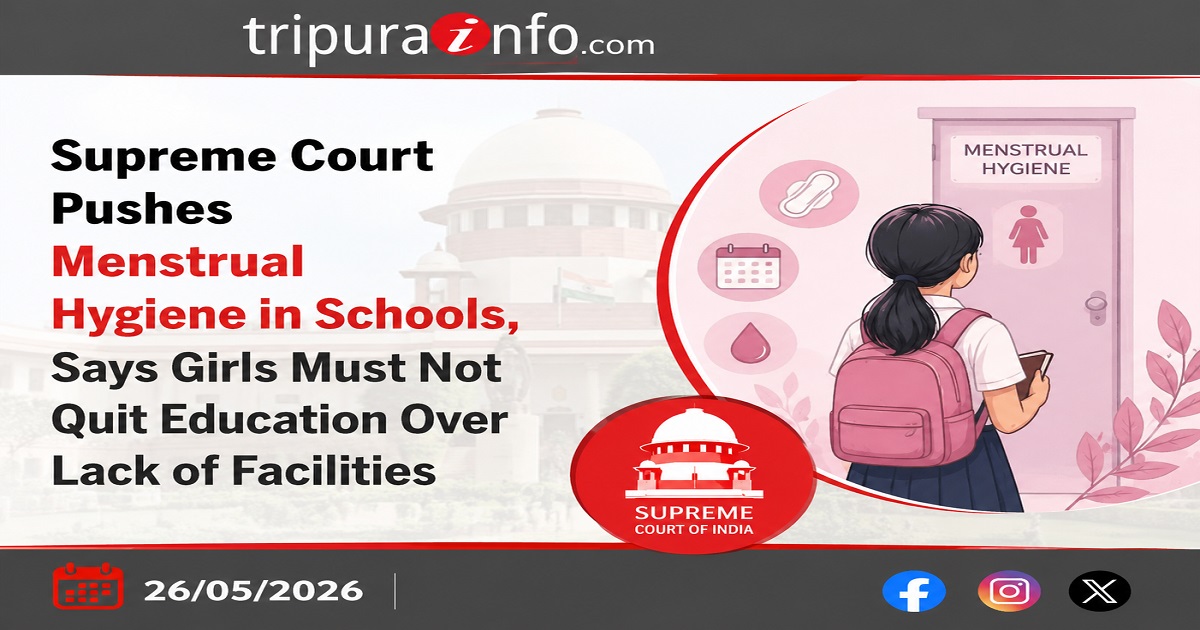 North East, May 26, 2026 : In a significant push for gender justice and educational equity, the Supreme Court of India on Tuesday strongly asserted that girls should never be forced to abandon their education due to the absence of sanitary napkins or proper toilets in schools. The Apex Court urged the Centre and all states to ensure strict implementation of its landmark January 30 judgment mandating free sanitary napkins and functional gender-segregated toilets in schools across the country.
A bench comprising Justice J B Pardiwala and Justice R Mahadevan emphasized that lack of menstrual hygiene facilities should not become a barrier to education for millions of girls.
“Make good use of it. It is for the good of women and girls of this country. Girls should not give up education and sit at home and do some domestic work only for this reason,” the bench observed while hearing the matter.
The court’s remarks came after the Centre informed the bench that the January 30 ruling had already triggered intensified efforts across states and Union Territories to improve menstrual hygiene infrastructure in schools. Additional Solicitor General Archana Pathak Dave, appearing for the Union government, submitted that compliance data had been collected from states for nearly two to two-and-a-half months.
The Supreme Court, however, stressed that mere collection of data was not enough and directed the Centre to ensure effective implementation of the directions “in letter and spirit.” The bench asked the Union government to continue guiding states and periodically collect detailed compliance reports regarding the availability of sanitary napkins and proper toilet facilities in schools.
The court further announced that it would monitor compliance every three months. It directed the Centre to submit fresh progress reports periodically, while all states and Union Territories have been asked to furnish updated status reports to the Union government by August 15. The matter has now been posted for further compliance review on September 1.
Importantly, the bench warned that there “shall not be any lapse” on the part of states in submitting compliance reports. It also declared the Ministry of Education as the nodal ministry responsible for filing all future compliance reports before the court.
The January 30 judgment has been widely regarded as a landmark verdict in advancing menstrual health rights and equal access to education. In the ruling, the Supreme Court held that the right to life under Article 21 of the Constitution includes the right to menstrual health.
“The right to life under Article 21 of the Constitution includes the right to menstrual health. Access to safe, effective and affordable menstrual hygiene management measures helps a girl child attain the highest standard of sexual and reproductive health,” the court had observed in its verdict.
The judgment recognized that poor menstrual hygiene infrastructure directly impacts girls’ participation in education and later affects their participation in broader social and economic life. The court noted that denial of menstrual hygiene facilities strips girls of the right to study on equal terms with others.
Under the directions issued by the Apex Court, all states and Union Territories must ensure that every school — whether government-run, aided or private, and located in urban or rural areas — provides free oxo-biodegradable sanitary napkins manufactured according to ASTM D-6954 standards.
The court also directed schools to make sanitary napkins easily accessible, preferably through vending machines installed inside toilet premises. Where immediate installation is not feasible, schools have been asked to arrange distribution through designated authorities or specific distribution points within the campus.
In addition, the Supreme Court directed authorities to ensure functional, gender-segregated toilets with usable water connectivity in every school across the country.
During Tuesday’s hearing, one advocate also raised environmental concerns regarding the court’s use of the term “oxo-biodegradable” sanitary napkins in the January verdict, arguing that such products may not be environmentally sustainable. The bench asked the law officer to examine the interim application and take necessary steps on the issue.
The Supreme Court’s continued monitoring of the matter is expected to place renewed pressure on governments and educational authorities to address menstrual hygiene challenges that continue to affect school attendance and educational opportunities for girls, especially in rural and economically weaker regions of the country.