Can Gen Z Protests Bring About Sustainable Change? Intense Arguments For and Against Mark Lively Debate in Agartala
By Our Correspondent
Agartala, November 29, 2026
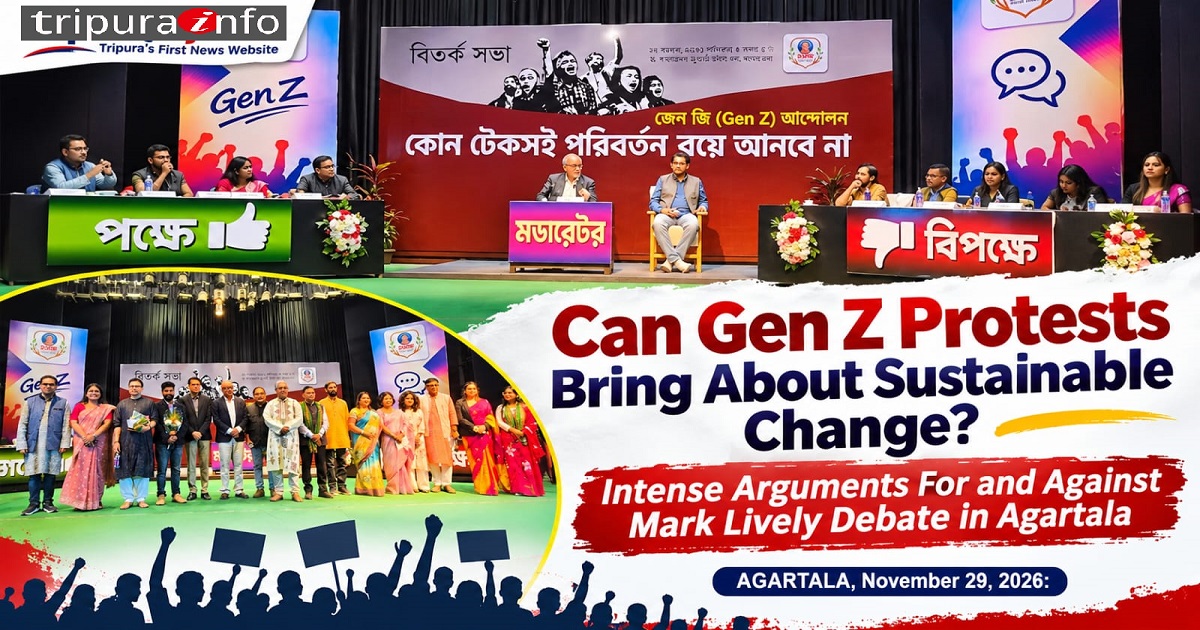 Can the protests and movements led by Generation Z bring about meaningful and sustainable changes in society, politics and governance, or will they remain largely expressions of temporary public anger without creating lasting institutional transformation? This important question formed the centrepiece of an intellectually stimulating and lively debate organised by the Advocate Dilip Sarkar Memorial Foundation at Town Hall in Agartala on Saturday.
The fifth annual invitational debate, organised in memory of eminent advocate Dilip Sarkar, witnessed an impressive gathering of distinguished personalities from Tripura and Kolkata, including members of the judiciary, senior advocates, doctors, academicians, social activists, students and intellectuals. The Town Hall auditorium was packed with an enthusiastic audience, reflecting the growing public interest in contemporary political and social issues, particularly the role of the younger generation in shaping the future.
The motion for the debate was, "Gen Z Protests Will Not Bring About Any Sustainable Change." The topic generated an engaging exchange of ideas, with speakers on both sides presenting detailed arguments, counterarguments and critical observations on the strengths, limitations and long-term consequences of youth-led movements.
The programme was inaugurated by Justice Biswajit Palit of the Tripura High Court. Renowned senior cardiac surgeon from Kolkata, Dr Kunal Sarkar, moderated the debate, bringing his experience and perspective to the discussion. At the beginning of the programme, senior advocate and Secretary of the Foundation, Subrata Sarkar, delivered the welcome address and highlighted the importance of encouraging intellectual engagement and a healthy culture of debate in society.
Representing the proposition, which argued that Gen Z protests would not bring about sustainable change, four speakers presented their perspectives. They were Ipsita Ghosh from Tripura, popular Kolkata-based content creator Agnijit Sen, Dr Mrinal Kanti Deb, an accomplished son of Tripura and Assistant Professor at IGNOU, currently working in Delhi, and senior advocate Jayanta Narayan Chattopadhyay of the Calcutta High Court.
The opposing team, arguing that Gen Z movements are capable of bringing about sustainable social and political transformation, comprised renowned Kolkata-based debater and writer Chandril Bhattacharya, Mrinalini Dikshit, the distinguished young woman from Uttar Pradesh who won the National Youth Parliament 2026, retired IAS officer Moslem Uddin Ahmed of Tripura, and Advocate Ayesha Saha Hirawat of the Tripura High Court.
The debate assumed particular significance against the backdrop of youth-led protests and movements taking place across different parts of the world. Generation Z has increasingly emerged as an influential force in raising questions about governance, accountability, corruption, social justice, economic inequality, employment opportunities and democratic rights. Young people are using social media, digital platforms and public demonstrations to mobilise support, challenge established institutions and demand accountability from those in power.
Against this background, the central question before the speakers was whether such movements could go beyond immediate protests and translate public anger and popular demands into lasting changes in policies, institutions and governance systems.
Those supporting the motion examined the limitations of spontaneous youth-led movements, arguing that public demonstrations and digital mobilisation alone might not be sufficient to achieve long-term transformation. The arguments brought attention to the importance of sustained leadership, organisational discipline, clearly defined objectives, institutional engagement and a practical roadmap for implementing change.
The opposing speakers, meanwhile, defended the transformative potential of Gen Z movements, highlighting the power of young people to challenge established systems, question traditional political structures and bring neglected social issues into the public domain. Their arguments underscored the importance of youth participation, collective action and the ability of a new generation to influence public opinion and reshape political and social priorities.
A significant dimension of the discussion was the distinction between protest as an immediate expression of dissatisfaction and protest as the beginning of a larger process of social transformation. Speakers explored whether movements without conventional leadership structures could sustain themselves over time and whether digital activism could be converted into organised public participation and meaningful institutional reforms.
The exchange also highlighted that the success of any movement cannot be measured merely by the number of participants, the intensity of demonstrations or the attention it receives on social media. Its long-term impact depends on public participation, continuity, realistic objectives, responsible leadership and the ability to translate demands into concrete action.
The interaction between the two teams created an energetic intellectual atmosphere, with speakers presenting contrasting interpretations of the same social phenomenon. The audience remained deeply engaged throughout the programme, appreciating the arguments and counterarguments put forward by both sides.
One of the most important aspects of the event was its emphasis on encouraging young people to question prevailing assumptions, examine public issues critically and develop the confidence to express independent opinions. The debate provided a platform for participants from different professional and intellectual backgrounds to examine a contemporary issue from multiple perspectives.
The Advocate Dilip Sarkar Memorial Foundation was established in memory of the late eminent advocate Dilip Sarkar (1938–2014), who had an illustrious career spanning 49 years in the legal profession. He served as Public Prosecutor at the Agartala Bench of the Gauhati High Court and played a significant role as the first Public Prosecutor of the Tripura High Court. He also served as Special Public Prosecutor in several important cases during his distinguished legal career.
To honour his memory and contribution to the legal profession, the Foundation has been organising the annual invitational debate. The initiative aims to promote a healthy culture of discussion and disagreement, encourage logical reasoning and critical thinking, strengthen intellectual engagement and develop public-speaking skills among students and young people.
The fifth annual debate in Agartala once again demonstrated the importance of creating platforms where complex social and political questions can be examined through reasoned arguments rather than emotional reactions or preconceived positions.
Although the debate centred on whether Gen Z protests can bring about sustainable change, its broader message extended beyond the motion itself. It highlighted the need for constructive dialogue between generations, greater youth participation in democratic processes and the importance of converting the energy of protest into responsible, organised and sustained efforts for social improvement.
The event concluded as a significant intellectual gathering, reinforcing the value of open discussion, democratic disagreement and independent thinking. At a time when young people are increasingly influencing public discourse and demanding a greater role in shaping their future, initiatives such as the Dilip Sarkar Memorial Debate can play an important role in nurturing an informed, confident and socially responsible generation.
more news...