Tripura High Court Extends Protection to Suspended IAS Officer Abhishek Chandra in Rs 14.55-Crore Alleged Tender Fraud Case
By Our Correspondent
Agartala, November 29, 2026
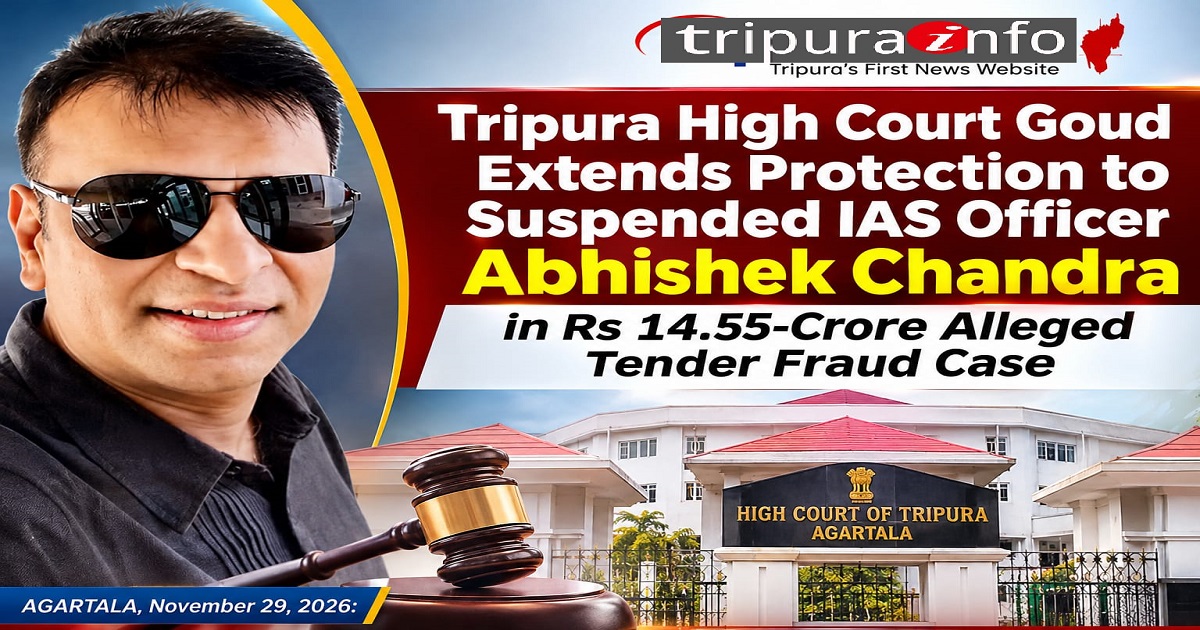 The Tripura High Court has once again granted interim protection to suspended IAS officer Abhishek Chandra in connection with the alleged Rs 14.55-crore government tender fraud case, directing the State authorities not to initiate any further action against him pursuant to FIR No. 44 of 2026, registered on July 1, 2026, until further orders.
The latest order was passed on November 24 by a Division Bench comprising Justice T Amarnath Goud and Justice Biswajit Palit in I.A. No. 01 of 2026 in W.P. (Crl.) No. 11 of 2026. Significantly, this is not the first interim protection received by Abhishek Chandra from a Division Bench comprising Justice T Amarnath Goud. Earlier, on September 16, the same judge, sitting with Justice S Datta Purkayastha, had granted interim protection in proceedings initiated by the Enforcement Directorate against him. Subsequently, on November 10, Justice Goud and Justice Biswajit Palit rejected the ED's application seeking vacation of that protection and made the interim stay absolute.
The sequence of judicial orders has become an important development in the continuing legal battle involving the suspended IAS officer, the alleged tender fraud and the parallel proceedings initiated under the Prevention of Money Laundering Act (PMLA).
According to the November 24 order, Abhishek Chandra, the petitioner in W.P. (Crl.) No. 11 of 2026, had filed an interlocutory application seeking a stay on the entire investigation by the respondents in FIR No. 44 of 2026, dated July 1, 2026. During the hearing, the State Public Prosecutor, Raju Datta, informed the Court that the investigation had already been completed and the charge-sheet filed. Therefore, according to the prosecution, nothing further survived for consideration in the stay application.
However, counsel representing Abhishek Chandra namelyAbhishek Chandra's counsel, Navin Kumar, and Kaushik Ray fairly acknowledged that the investigation had been completed and the charge-sheet submitted, but submitted that various agencies were allegedly harassing the petitioner in different ways and creating fresh problems on the strength of the FIR. The petitioner's counsel requested the Court to proceed with the main criminal writ petition. The Public Prosecutor, meanwhile, sought time to ascertain certain facts relating to an affidavit filed by the petitioner during the proceedings.
After hearing both sides, the Division Bench observed that intervention was necessary to maintain a balance of convenience. Accordingly, it directed the respondents to refrain from initiating any further action against Abhishek Chandra pursuant to FIR No. 44 of 2026 until further orders. The Court also recorded that the connected W.P. (Crl.) No. 14 of 2026 was pending and that both criminal writ petitions should be heard together at an early date. The matters have been listed for December 15, 2026.
The criminal proceedings originated from a complaint lodged by Nagpur-based businessman Manish Malani, representing M/s SK Sales Corporation, against Abhishek Chandra and three other individuals. According to the complaint, the alleged fraud began in February 2024, when Malani was introduced to Abhishek Chandra, who allegedly represented himself as a senior IAS officer exercising influence and authority over government tender processes in Tripura.
The complainant alleged that Chandra introduced him to lucrative government contracts, particularly in the Mid-Day Meal programme, the power sector and the Directorate of Higher Education. After verifying that Chandra was serving as Special Secretary, Planning (Statistics), Government of Tripura, the complainant allegedly trusted his representations.
The complaint further alleged that Malani was advised to enter into a joint venture with Krishna Chakraborty, represented by her husband Sudip Paul, to participate in government tenders. A joint venture agreement was reportedly executed on September 4, 2024, for participating in Mid-Day Meal supply contracts.
According to the complaint, the firm was subsequently induced to deposit substantial Earnest Money Deposits (EMDs) and other tender-related payments through demand drafts purportedly in favour of the Directorate of Education, Tripura. Between September 2024 and February 2025, the complainant alleged that a total of Rs 14,55,42,945 was paid against purported government tenders, tender notices and work orders.
The complaint alleged that meetings were arranged in Agartala and New Delhi, WhatsApp groups were created for communication, and individuals were introduced as government officials and persons responsible for processing payments. The complainant also alleged that certain RTGS transactions and partial payments reinforced his belief that the tenders and contracts were genuine.
However, when the promised refunds and profits allegedly failed to materialise, Malani reportedly discovered that the purported tenders and work orders had never been issued by the Government of Tripura. According to his complaint, officials of the Directorate of Higher Education subsequently informed him that no such tenders had been floated.
The complaint named Abhishek Chandra, Utpal Kumar Choudhury, Krishna Chakraborty and Sudip Paul, alleging a criminal conspiracy involving cheating, impersonation, forgery and fraudulent collection of government tender deposits. On the basis of the complaint, New Capital Complex Police Station registered Case No. 2026NCC044 on July 1, 2026, invoking several provisions of the Bharatiya Nyaya Sanhita, 2023. These allegations are yet to be finally adjudicated by a competent court.
The case subsequently attracted the attention of the Enforcement Directorate, which initiated a money-laundering investigation arising from the criminal FIR. In its press release dated November 5, the ED stated that it had conducted search and seizure operations at 13 premises across Tripura, West Bengal and Maharashtra on November 4 under Section 17 of the PMLA.
According to the ED, the alleged racket operated through a fictitious entity named Directorate of Higher Education, which was reportedly a proprietary concern of Utpal Kumar Choudhury. The name allegedly resembled that of the genuine government department. The ED alleged that demand drafts collected from the complainant were deposited into accounts associated with the fictitious entity and that forged tender notices and work orders were used to induce payments.
The agency further claimed that funds were transferred through several shell entities, some allegedly registered in the names of domestic staff and associates of Utpal Kumar Choudhury. It also alleged that proceeds were used for acquiring immovable properties, including properties in Mumbai, and for foreign travel and luxury purchases. The ED additionally referred to an earlier investigation arising from five FIRs registered in Tripura and West Bengal, involving the same alleged fictitious entity and modus operandi and aggregate alleged fraud exceeding Rs 44 crore. These are allegations and investigative claims by the ED, not final judicial findings against Abhishek Chandra.
An important turning point in the legal proceedings came on September 16, 2026, when Abhishek Chandra approached the Tripura High Court through W.P. (Crl.) No. 14 of 2026, challenging the proceedings initiated by the Enforcement Directorate. A Division Bench comprising Justice Dr. T Amarnath Goud and Justice S Datta Purkayastha passed an interim order in I.A. No. 01 of 2026, granting interim protection against the impugned proceedings until further orders. The proceedings under challenge included the ED's provisional attachment action dated July 31, 2026.
The Enforcement Directorate subsequently approached the High Court through I.A. No. 02 of 2026 in W.P. (Crl.) No. 14 of 2026, seeking recall or vacation of the September 16 interim protection. The ED, represented by Deputy Solicitor General B Majumder, argued that the writ petition was not maintainable because the PMLA provided alternative statutory remedies before the Adjudicating Authority and the Appellate Tribunal. The agency also argued that the provisional attachment order was subject to a statutory 180-day period.
However, Abhishek Chandra's counsel, Navin Kumar argued that the ED had failed to comply with the requirements of Section 5 of the PMLA. The defence also submitted that the five FIRs relied upon by the ED did not name Chandra or contain allegations against him.
After hearing the parties, a Division Bench comprising Justice T Amarnath Goud and Justice Biswajit Palit rejected the ED's application on November 10. The Court observed that the grievances raised by the petitioner and the requirements of Section 5(5) of the PMLA required detailed examination. It also held that the balance of convenience favoured the writ petitioner. Consequently, the September 16 interim order suspending the ED proceedings dated July 31 was directed to continue until disposal of the writ petition. The Court made the interim stay absolute and directed that W.P. (Crl.) No. 14 of 2026 be heard along with W.P. (Crl.) No. 11 of 2026.
The two connected criminal writ petitions have separate procedural backgrounds. In W.P. (Crl.) No. 11 of 2026, the proceedings concern the criminal FIR and the complaint lodged by Manish Malani. During the September 16 proceedings, the Public Prosecutor pointed out that Malani, the de-facto complainant, had not been impleaded as a respondent. The Court recorded the objection and allowed the petitioner's counsel time to file an application for his impleadment. In W.P. (Crl.) No. 14 of 2026, the principal challenge concerns the ED's PMLA proceedings and provisional attachment action.
With the November 24 order, Abhishek Chandra has obtained another interim direction restraining further action under FIR No. 44 of 2026, while the earlier protection against the specific ED attachment proceedings remains in force.
The December 15 hearing will therefore be important for the further examination of both criminal writ petitions. The central questions before the High Court include the legality of the challenged proceedings, the objections raised by the petitioner, the statutory requirements governing the ED's attachment action and the issues arising from the original criminal complaint.
It is important to clarify that none of these interim orders amounts to an acquittal, a declaration of innocence or a final determination that the allegations are false. Equally, the allegations in the complaint and the ED's investigative claims have not yet been established through a final judicial determination. The next hearing may bring further clarity to the legal position in a case that has attracted considerable public attention because of the involvement of a suspended IAS officer, allegations of fraudulent government tenders involving Rs 14.55 crore and parallel investigations by the police and the Enforcement Directorate. Next hearing date is December
more news...