Tripura Civic Polls 2026: Teliamura Records Highest Turnout at 88.98%, Dharmanagar Lowest at 76.89%, 1.04 Lakh Voters Stay Away from Polling
By Our Correspondent
Agartala, November 28, 2026
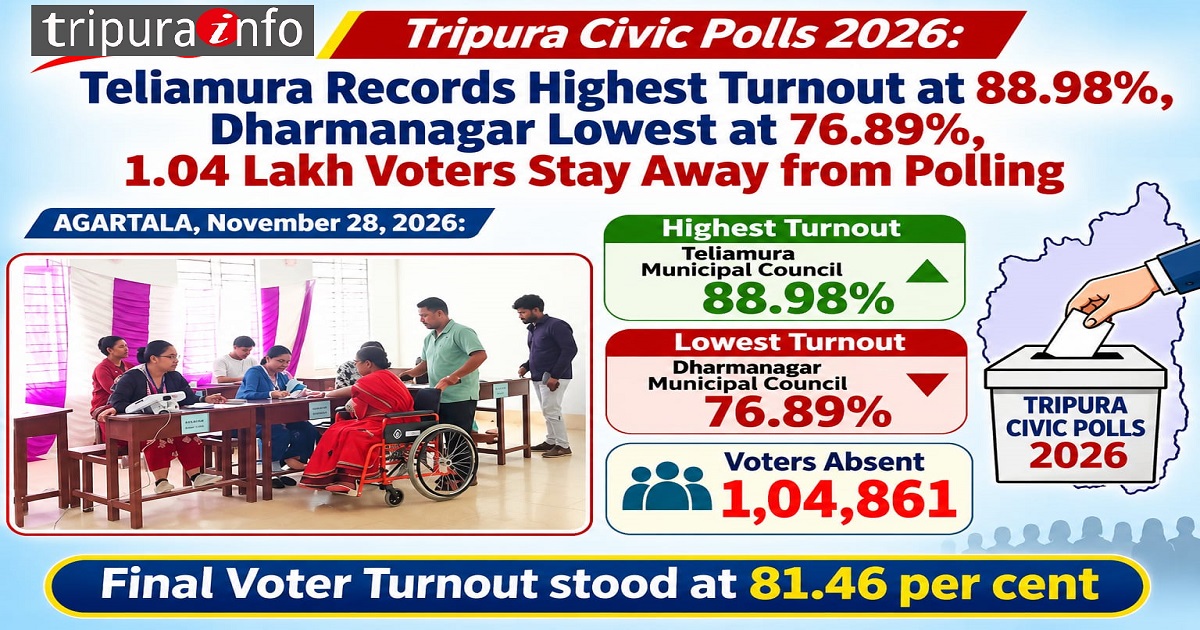 The final voter turnout figures of the November 27 Tripura Urban Local Body elections have revealed significant variations in electoral participation across the state's 16 urban local bodies. According to the final consolidated report issued on November 28, Teliamura Municipal Council recorded the highest voter turnout at 88.98 per cent, while Dharmanagar Municipal Council registered the lowest at 76.89 per cent. The statewide final turnout stood at 81.46 per cent, including election-duty votes (EDV).
Out of a total electorate of 5,65,513 voters, 4,60,652 exercised their franchise, leaving 1,04,861 registered voters absent from the electoral process. The difference between the highest and lowest turnout was 12.09 percentage points, reflecting considerable variations in voter participation across different urban local bodies.
The constituency-wise figures reveal that Teliamura Municipal Council recorded 10,557 votes against an electorate of 11,864, achieving 88.98 per cent turnout. Amarpur Nagar Panchayat followed with 88.05 per cent, while Bishramganj Nagar Panchayat registered 86.19 per cent. Belonia Municipal Council recorded 86.16 per cent, Khowai Municipal Council 86.13 per cent, Sabroom Nagar Panchayat 86.12 per cent, Melagarh Municipal Council 85.96 per cent and Udaipur Municipal Council 84.70 per cent.
Sonamura Nagar Panchayat registered 84.23 per cent turnout, Ambassa Municipal Council 83.86 per cent, Kumarghat Municipal Council 82.97 per cent, Bishalgarh Municipal Council 81.57 per cent, Panisagar Nagar Panchayat 81.40 per cent and Agartala Municipal Corporation 80.52 per cent. Kailashahar Municipal Council recorded 77.54 per cent, while Dharmanagar Municipal Council remained at the bottom with 76.89 per cent.
A closer examination of the absentee voter figures presents another significant dimension of the election. Although Dharmanagar recorded the lowest percentage of voter participation, Agartala Municipal Corporation accounted for the highest absolute number of voters who did not cast their ballots. Out of 3,62,582 registered electors in Agartala, 2,91,947 votes were recorded, leaving 70,635 voters absent. This represents approximately 67.4 per cent of all non-voters across the 16 urban local bodies.
Dharmanagar recorded 7,522 absent voters against its electorate of 32,546, followed by Udaipur with 4,095, Kailashahar with 3,963, Bishalgarh with 2,822 and Belonia with 2,281. Khowai recorded 1,953 non-voters, Kumarghat 1,853, Sonamura 1,400, Teliamura 1,307, Panisagar 1,134, Ambassa 1,110, Bishramganj 1,010, Amarpur 988 and Sabroom 786. These figures indicate that the absolute number of absent voters and the percentage of voter turnout present two different pictures of electoral participation, particularly in larger urban constituencies.
The election statistics have emerged against the backdrop of widespread political allegations of violence, intimidation and violations of the Model Code of Conduct during the polling process. Opposition parties, particularly the CPI(M) and Congress, raised serious complaints against ruling-party supporters, alleging attacks on party workers, threats to voters, obstruction of opposition polling agents and attempts to influence the electoral process at different locations.
The opposition alleged that incidents of intimidation and violence were reported from several urban areas, including Agartala, Bishalgarh, Sabroom, Khowai, Melagarh, Bishramganj and Belonia. Allegations of forcible eviction of polling agents, obstruction of political workers and threats to opposition supporters also featured prominently in the complaints submitted by opposition parties.
The Congress demanded cancellation of the elections and fresh polling, while the CPI(M) sought repolling in seven urban local bodies, citing alleged electoral irregularities and violence. CPI(M) leaders also expressed concern over attacks on party workers and alleged attempts to prevent opposition supporters from exercising their democratic rights.
The political tensions continued even after polling, with opposition parties organising protests and demanding intervention by the State Election Commission. Congress leaders staged a protest outside the Commission's office, while CPI(M) workers organised a road blockade near GB Bazar in Agartala. The opposition also raised questions about the conduct of the election administration and the effectiveness of the enforcement of the Model Code of Conduct.
The allegations, however, require independent verification by the competent authorities. The final statistical report of the State Election Commission establishes voter participation but does not determine whether voters were prevented from voting or whether particular incidents amounted to violations of the Model Code of Conduct.
The final figures therefore present two important aspects of the 2026 civic elections. On one hand, the statewide turnout of 81.46 per cent reflects substantial participation by urban voters. On the other, the absence of 1,04,861 registered electors, together with the political controversy surrounding alleged violence and electoral malpractice, raises important questions about the quality and fairness of the electoral environment.
The immediate challenge before the State Election Commission is to examine the complaints impartially, investigate allegations of intimidation and electoral malpractice, and take appropriate action wherever violations are established. The credibility of the municipal election process will ultimately depend not only on the final voting percentages but also on whether every eligible voter was able to exercise the democratic right to vote freely and without fear.
Source: Final Vote Percentage Report in Connection with General Election to the Urban Local Bodies, 2026, dated November 28, 2026. Final turnout figures include election-duty votes (EDV).
more news...