Governor flags threat to Tripura’s oral heritage, urges Sahitya Akademi to document tribal traditions before they disappear
By Our Correspondent
Agartala, November 27, 2026
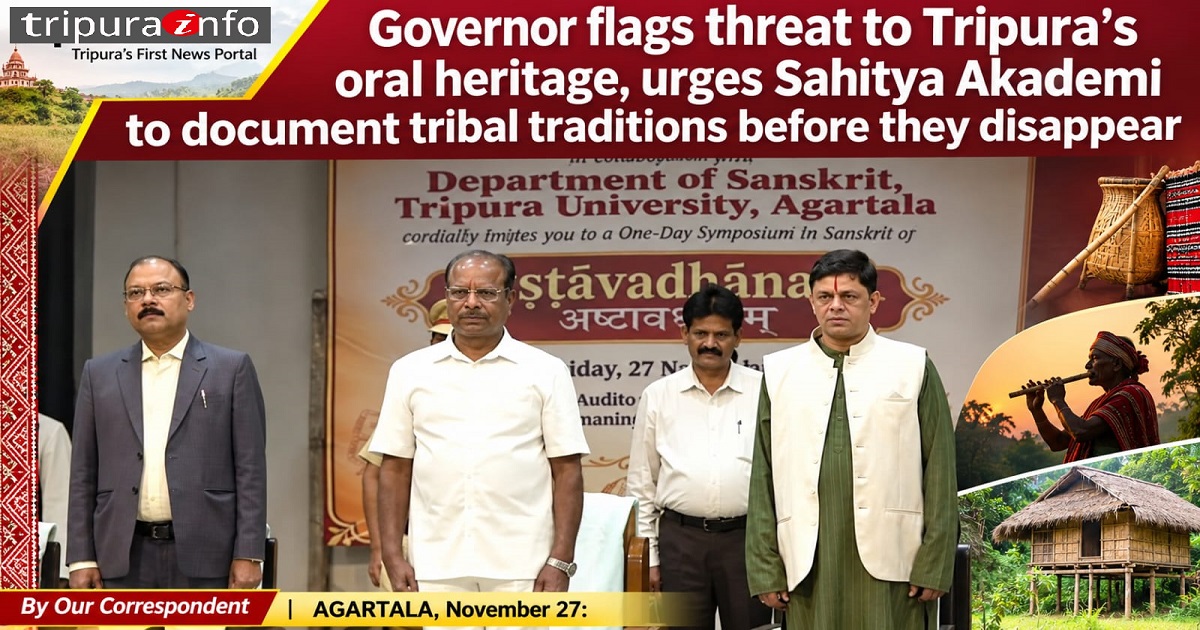 Tripura Governor N. Indrasena Reddy on Friday called for urgent efforts to preserve the State’s indigenous languages and oral traditions, warning that the cultural wealth of its tribal communities could gradually disappear without systematic documentation.
Addressing a symposium on Ashtavadhanam at Tripura University, the Governor urged the Sahitya Akademi to take up a comprehensive exercise to record the traditional songs, folklore and oral narratives of Tripura’s 19 tribal communities. He also proposed a dedicated Telugu Chair at the university, citing the presence of thousands of Telugu-speaking families who have made the State their home over several generations.
The symposium, organised jointly by the university’s Department of Sanskrit and the Sahitya Akademi, New Delhi, marked the first presentation of the classical literary performance tradition in Northeast India. Padma Shri awardee and renowned exponent Madugula Nagaphani Sharma was the principal performer.
The Governor’s appeal brought the question of linguistic preservation into focus at an event devoted to one of India’s most demanding classical literary traditions.
Pointing out that Kokborok had been recognised as an official language of Tripura 50 years ago, Mr. Reddy expressed concern over the limited size of its written literary corpus. He stressed that recognition alone was not enough to ensure the survival of a language and that its oral traditions, songs and cultural expressions needed to be documented and archived.
He asked the Sahitya Akademi to take immediate steps in this direction so that the cultural memory of the State’s tribal communities was not lost.
The Governor’s proposed Telugu Peetham at Tripura University, meanwhile, was intended to encourage comparative literature and cultural interaction between classical Indian traditions and the Northeast. He said the initiative could be aligned with the National Education Policy 2020.
Turning to the central theme of the symposium, Mr. Reddy described Ashtavadhanam as much more than a literary performance. It represents an extraordinary exercise in concentration, memory and spontaneous poetic composition, he said, adding that its emphasis on Dharana, or the ability to retain and recall information, had particular relevance in an age increasingly dependent on technology.
He described Dr. Sharma as a living bridge between India's Vedic intellectual heritage and the contemporary world. The Governor also urged the Sahitya Akademi to retain the traditional terminology Avadhanam instead of introducing modern labels such as "Noble Literature Game".
Tripura University Vice-Chancellor Debabrata Das, who presided over the inaugural session, highlighted the importance of Sanskrit and ancient India's oral systems of knowledge transmission.
Referring to Shravana, Manana and Nididhyasana — listening, reflection and contemplation — he said these practices formed the foundation of traditional learning. He also cited Vedic recitation methods such as Padapatha and Ghanapatha as examples of the intellectual rigour involved in preserving knowledge through oral transmission.
Mr. Das said the university was committed to promoting the Indian Knowledge System (IKS), pointing to the dedicated IKS corner in its central library. He expressed hope that the live demonstration of Ashtavadhanam would encourage students and researchers to explore India's classical intellectual traditions.
Sahitya Akademi Secretary Varun Gulati, in his welcome address, sought to explain the centuries-old art to younger audiences, including Gen Z and Gen Alpha students. He described Ashtavadhanam as the "art of returning", referring to the performer's ability to attend to multiple challenges simultaneously and return to each with remarkable precision.
Prof. Harekrishna Satapathy, Chairperson of the Sahitya Akademi's Sanskrit Advisory Board, delivered the keynote address and described Dr. Sharma as the "eighth wonder of the world".
He referred to the performer's distinction as a Dvi-Sahasravadhani, having demonstrated the ability to undertake Avadhanam before 2,000 scholars simultaneously without using pen or paper.
Dr. Sharma spoke about his decades-long Tapas Sadhana and offered a demonstration of spontaneous Sanskrit composition. In a striking performance, he composed an extempore verse, known as Dattapadi, incorporating the names of four Indian cricketers — Jadeja, Dravid, Kambli and Kumble — into the episode of Hanuman's crossing of the ocean in the Ramayana.
The composition drew attention to the improvisational demands of the art, which requires the performer to combine memory, linguistic command, creativity and the ability to respond instantly to challenges.
Scholars and participants from Tripura, Assam, Sikkim and other parts of the country attended the symposium. Dr. Jaya Saha, Member of the Sanskrit Advisory Board, Sahitya Akademi, and Devraj Panigrahi, Head of the Department of Sanskrit at Tripura University, delivered the welcome and coordination remarks.
The symposium thus brought two distinct but interconnected concerns to the fore: the preservation of India's classical literary practices and the need to protect the linguistic and cultural traditions of the Northeast.
more news...