Tripura University moots Japanese language and cultural centre to strengthen India-Japan academic ties, VC proposes student exchange programmes
By Our Correspondent
Agartala, November 26, 2026
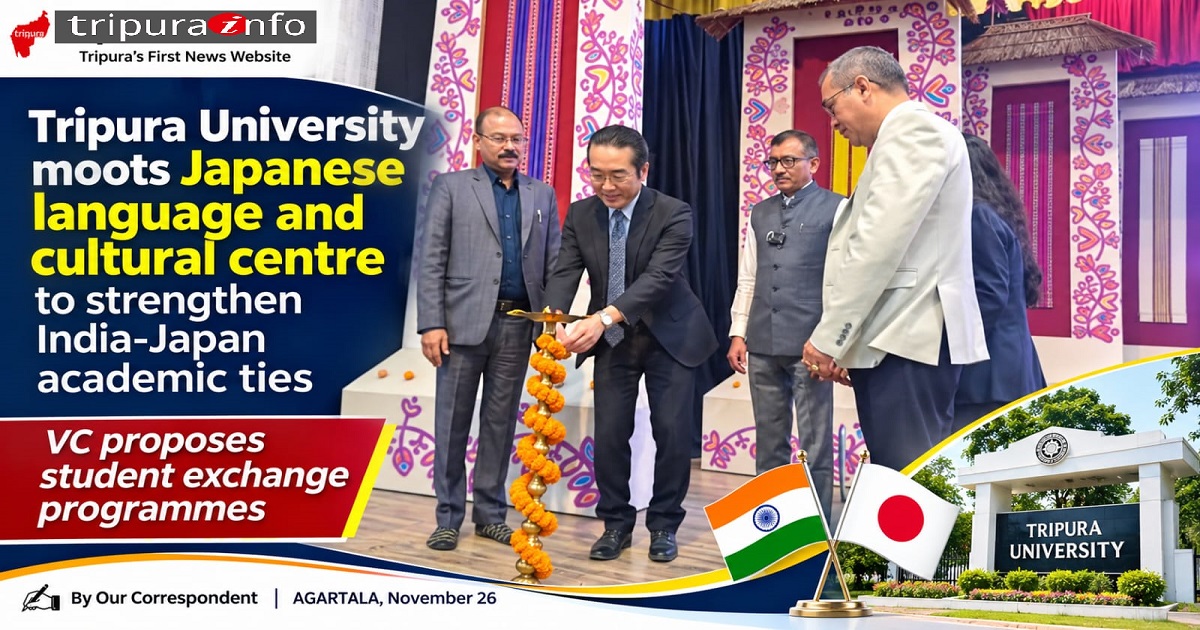 Tripura University Vice-Chancellor Professor Debabrata Das has proposed establishing a Japanese language and cultural centre on the university campus to promote academic collaboration and strengthen cultural ties between India and Japan. The proposed centre would provide students with opportunities to learn Japanese, understand the country's cultural heritage and develop academic links with Japanese institutions.
The proposal was made during the inaugural session of a two-day international conference, Exploring the Canvas: Prospects of Northeast-Centred Indo-Japan Ties, which commenced at Tripura University on Wednesday. Jointly organised by the university's Department of Business Management and The Japan Foundation, New Delhi, the conference seeks to examine the opportunities for expanding India-Japan cooperation, with particular emphasis on the strategic and developmental potential of Northeast India.
Professor Das stressed the need to establish institutional partnerships with Japanese universities and promote student exchange programmes. He said a dedicated language and cultural centre could help students gain international exposure while creating opportunities for sustained academic and cultural engagement between the two countries.
The proposal assumes significance in the context of efforts to strengthen India's engagement with Japan through education, regional connectivity, economic cooperation and cultural diplomacy. The conference provides an academic platform to examine how Northeast India can contribute to these areas of bilateral cooperation.
Dr. Manish Das welcomed the participants at the inaugural session. Delivering the keynote address, Professor Sanjeev Mehta of Royal Thimphu College, Bhutan, highlighted the importance of regional connectivity in the development of Northeast India. He discussed how improved connectivity and stronger regional linkages could create opportunities for cooperation with Japan and enhance the region's role in wider regional engagement.
Professor W.C. Singh, Vice-Chancellor of Dhanamanjuri University, Manipur, spoke about the prospects for collaboration in higher education. He highlighted the importance of institutional partnerships and academic exchanges in strengthening educational relations between India and Japan.
Teruyuki Hoshina, Director of Japanese Studies and Global Partnership at The Japan Foundation, New Delhi, outlined the Foundation's contribution to educational cooperation and cultural exchange. He also discussed opportunities to deepen engagement between Indian and Japanese institutions through academic and cultural initiatives.
An edited volume titled Exploring the Canvas: Prospects of Northeast-Centred Indo-Japan Ties: Research and Perspectives, published by Bloomsbury Publishing India, was released during the inaugural session. The book brings together research perspectives on various dimensions of India-Japan relations, particularly in the context of Northeast India.
The academic programme includes invited lectures by 11 professors representing institutions across the country. Their presentations will address different aspects of bilateral relations, including regional cooperation, diplomacy, economic engagement and cultural exchanges.
A panel discussion titled "Northeast India as a Strategic Bridge: Reimagining Indo-Japan Partnerships through Regional Connectivity and Cultural Diplomacy" is another major component of the conference. It will examine the region's potential to facilitate stronger diplomatic, economic and cultural engagement between the two countries.
As many as 55 research papers are scheduled to be presented during the two-day event. The presentations will cover a broad range of subjects, including geopolitics and diplomacy, trade and investment, connectivity and technology, the green economy, education and cultural exchange.
The conference is expected to provide opportunities for academics and researchers to identify areas of joint research, student mobility and institutional cooperation. It will also examine how universities in Northeast India can contribute more actively to India's expanding engagement with Japan.
For Tripura University, the proposed Japanese language and cultural centre could become an important institutional initiative, linking international academic cooperation with opportunities for students in the region.
The conference will continue on November 26, with academics and researchers expected to deliberate on ways to develop sustained educational, research and cultural partnerships between Northeast India and Japan.
more news...