Tripura High Court Seeks Official Records of TTAADC Decision to Cancel Illegal Appointments, Asked to Submit Executive Council Resolution by December 9
By Our Correspondent
Agartala, November 25, 2026
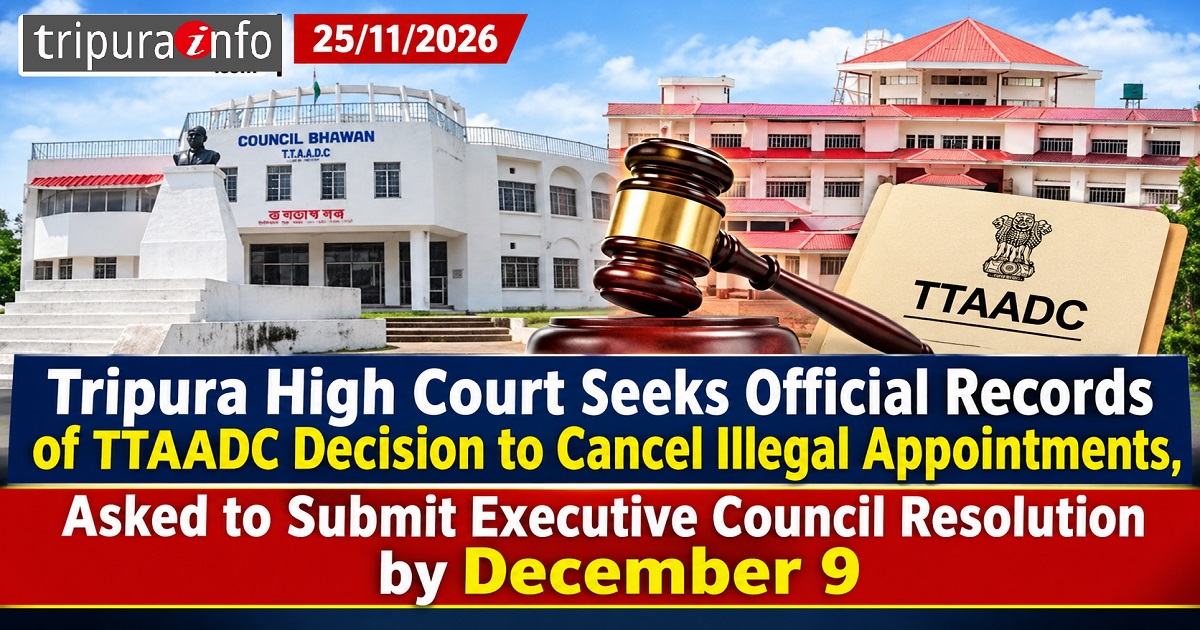 The Tripura Tribal Areas Autonomous District Council (TTAADC) has come under renewed judicial scrutiny over allegations of illegal recruitment, irregular appointments and corruption in its administrative functioning. In a significant development before the Tripura High Court, the Council's counsel informed the court that the Executive Council had reportedly decided to cancel the disputed appointments. However, the ADC administration failed to produce any official document establishing that such a decision had actually been taken.
Taking note of the submission, a Division Bench comprising Chief Justice MS Ramachandra Rao and Justice S Datta Purkayastha directed the TTAADC administration to produce the relevant documents, including the Executive Council's resolution, before the court by December 9. The next hearing in the matter has accordingly been scheduled for that date.
The development has raised serious questions about the legality of the recruitment process, the authority under which the appointments were made and the accountability of those responsible for the decisions.
During the hearing, the petitioners' counsel Senior Advocate Purushottam Roy Barman challenged the ADC administration's explanation that the recruitment had become necessary because the Council did not have its own recruitment or service rules governing the concerned posts. The petitioners argued that the absence of separate rules framed by the TTAADC did not give the administration the authority to make appointments outside the established legal framework.
They pointed out that the existing legal provisions governing the Council clearly provide that, in matters where the ADC does not have its own laws, the relevant laws and rules of the State Government are to be followed. According to the petitioners, the administration could not justify allegedly irregular appointments by citing the absence of its own recruitment policy when the existing legal framework already provided an alternative procedure.
Advocate Purushottam Roy Barman, appearing for the petitioners, said the developments in court reflected serious questions about the manner in which the ADC administration had been functioning. He maintained that the case had exposed the absence of proper administrative procedures and accountability in the recruitment process.
The court's direction to produce the official resolution by December 9 is particularly significant because the ADC administration's claim that it has decided to cancel the appointments must now be supported by documentary evidence. Until the relevant records are placed before the court and examined, the legal status of the proposed cancellation remains unclear.
The latest proceedings have also brought renewed attention to several recruitment controversies involving the TTAADC over the past few years. The Sub-Zonal Development Officer (Sub-ZDO) and Deputy Zonal Officer recruitment processes have also faced allegations of irregularities, including claims of bribery and manipulation. Earlier recruitment examinations conducted by the Council also attracted allegations of question-paper and answer-key leaks, leading to demands for police investigations and accountability.
Another major controversy involved allegations that more than 120 people had been appointed without proper public advertisements and transparent recruitment procedures. These allegations triggered protests and questions about whether unemployed candidates had been denied equal opportunities in public employment. The controversy also raised concerns about the absence of a transparent and publicly accessible recruitment mechanism in the Council.
The allegations against the ADC administration are not limited to recruitment. The Council has also faced accusations of financial irregularities, questionable contract allocations and misuse of development funds. In November 2026, questions were raised over the implementation of the Rubber Smoke House Project, including allegations of incomplete construction and irregular payments to an outside contractor. The contract was reportedly awarded to Himachal Pradesh-based M/S Shivratna Construction and Earthmovers Company, owned by Shubham Jindal. These allegations have raised questions about project monitoring, financial accountability and the procedures followed in awarding contracts.
Opposition groups have repeatedly alleged nepotism supported by top Tipra Motha leadership, administrative mismanagement and irregularities in the allocation of contracts and management of public assets. Allegations have also surfaced regarding the utilisation of funds intended for village development and tribal welfare.
Meanwhile, the latest High Court proceedings have triggered political reactions in Tripura. Former Tipra Motha founder Pradyot Kishore Debbarma yesterday appeared in a Facebook Live session and stated that various demands of people living in the tribal-dominated ADC areas were gradually moving towards fulfilment. He also claimed to have held discussions with authorities in Delhi. His latest Facebook Live was reportedly his third such public communication during the past month.
However, the continuing allegations concerning recruitment irregularities, financial management and the utilisation of development funds have become important issues in the debate over the functioning of the ADC administration. Critics have questioned why the alleged irregularities in development projects and the management of public assets have not received similar public attention.
Reacting to the latest developments, CPI(M) State Secretary Jitendra Chaudhury alleged that information about the alleged diversion and misuse of ADC development funds was already available to the Chief Minister of Tripura. He questioned why the BJP-led State Government had remained silent over the allegations, suggesting that political understanding between the BJP and Tipra Motha was preventing effective action against alleged corruption in the ADC administration.
His remarks have added another dimension to the controversy, with the opposition demanding greater transparency and accountability in the management of the Sixth Schedule institution. The allegations concerning the transfer or management of public assets and the utilisation of village development funds have also raised demands for a comprehensive investigation.
Significantly, the latest developments in the recruitment case have coincided with an important change in the leadership of the Tripura High Court. On November 24, 2026, the Supreme Court Collegium recommended the transfer of Chief Justice MS Ramachandra Rao to the Karnataka High Court as its Chief Justice. It also recommended Justice Vivek Singh Thakur, currently serving as a Judge of the Himachal Pradesh High Court, for appointment as the next Chief Justice of the Tripura High Court. The recommendations are subject to completion of the prescribed formal appointment process.
The recruitment controversy will now return before the High Court on December 9, when the TTAADC is required to produce documentary evidence of its alleged decision to cancel the disputed appointments. The next hearing is expected to be important in determining whether the Council actually adopted a formal decision and what legal steps it proposes to take regarding the appointments.
For thousands of unemployed youths in the tribal areas, the case has become an important test of transparency, equal opportunity and accountability in public recruitment. The central question remains whether appointments to public posts in the TTAADC were made in accordance with established laws and procedures, and whether those responsible for any proven violations will be held accountable.
more news...