Faculty Raise Questions Over Recruitment, Promotions, Financial Decisions and Treatment of Teachers, Demand Independent Probe into NIT Agartala Director’s Functioning
By Our Correspondent
Agartala, November 24, 2026
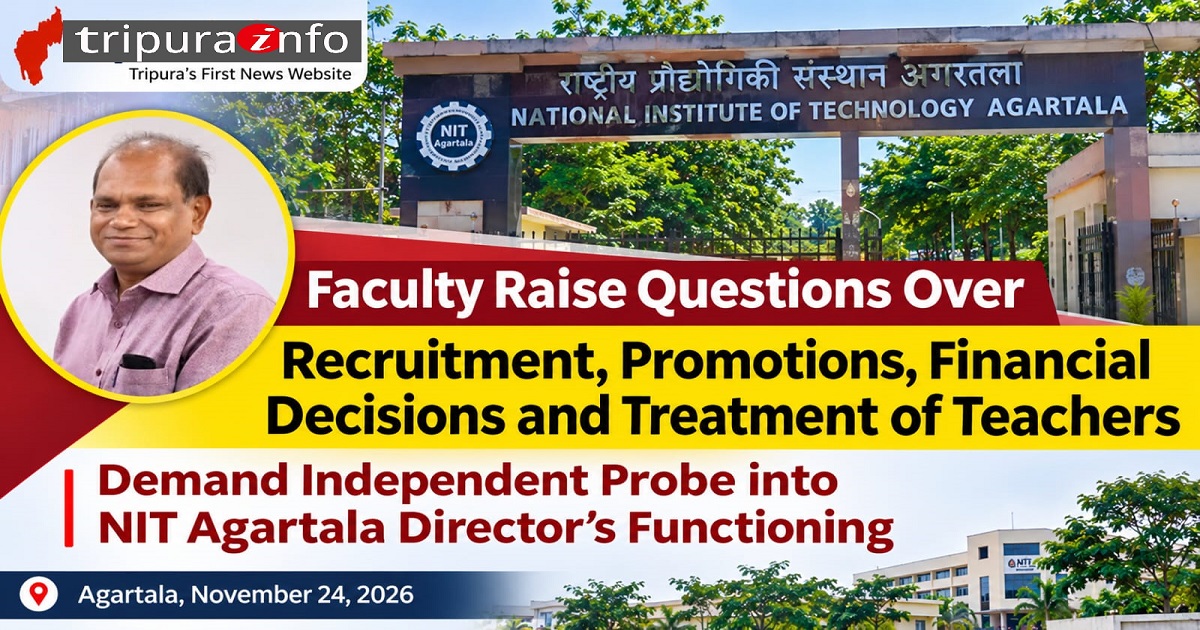 Serious allegations of administrative irregularities, favouritism, questionable appointments and financial mismanagement have brought the functioning of the National Institute of Technology (NIT), Agartala, under growing scrutiny. A section of faculty members and employees has raised questions about the administrative decisions taken under the leadership of Director Professor SK Patra, alleging that institutional rules and established procedures have not always been followed.
The allegations are particularly significant because NIT Agartala is an Institute of National Importance under the Union Ministry of Education. It receives public funds and is expected to maintain high standards of transparency, fairness, academic freedom and accountability.
The controversy is not limited to one particular appointment or administrative decision. Several issues have reportedly emerged concerning the appointment and continuation of senior officials, faculty promotions, recruitment procedures, medical reimbursements, administrative powers, treatment of employees and the overall academic environment.
One of the most serious controversies concerns Registrar Dr. Asish Badola, who reportedly continued in the position on a contractual basis after retiring from his parent organisation in May 2025.
A complaint has questioned whether the institute's decision to continue his service from June 2025 was consistent with the prescribed Recruitment Rules governing Registrar appointments in NITs.
The complaint has also questioned the role of the Selection Committee and the Board of Governors (BoG) in approving the arrangement. According to the allegations, the Selection Committee included a recommendation allowing the Registrar to continue on a contractual basis after retirement for the remaining period of his five-year tenure.
The complainant has questioned whether the committee had the authority to introduce such a condition when the applicable recruitment rules may prescribe different service requirements.
Another important question concerns the alleged exercise of full administrative and financial powers by the Registrar after retirement, including functioning as the Drawing and Disbursing Officer (DDO).
Questions have also been raised about the use of institutional funds for legal representation in a High Court case in which the Registrar was reportedly a private respondent along with the institute.
These matters require examination of the appointment order, Board resolutions, legal bills and applicable service rules.
Faculty members have also raised concerns about the handling of promotions and higher administrative positions.
Questions have been raised over the process of Higher Administrative Grade (HAG) upgradation and whether all eligible senior Professors received an equal opportunity to apply.
According to allegations reported earlier, the application deadline was January 15, 2026, but the scrutiny process reportedly took place only on August 28, 2026.
Some senior Professors had allegedly requested an extension of the application period so that more eligible candidates could participate.
The delay and the decision not to extend the application period have raised questions about transparency and equal opportunity.
There are also allegations that some important administrative positions, including Deans and Heads of Departments, were given to relatively junior faculty members despite the availability of senior Professors.
Faculty members have questioned whether academic experience, seniority and established institutional norms were properly considered.
Another serious issue concerns the alleged unequal treatment of faculty members in medical reimbursement cases.
According to complaints, the medical reimbursement claim of a Professor recovering from a cardiac procedure was reportedly questioned by the institute's accounts administration.
At the same time, questions have been raised over the sanctioning of certain medical expenses, allegedly relating to cosmetic and skin treatments claimed by a senior administrative functionary for himself and his wife.
The complainants want to know whether these expenses were permissible under government medical reimbursement rules and whether the same standards were applied to all employees.
If different standards were followed for different individuals, the matter would require an independent financial and administrative audit.
Faculty members have also alleged that the institute's administration has become increasingly divided, with some employees feeling that those considered close to the top management receive greater importance while others are sidelined.
Questions have been raised over the manner in which administrative responsibilities are distributed, decisions are communicated and employees' grievances are handled.
There have also been complaints about the handling of the State Government's nominee to the Board of Governors and whether the institute administration followed the proper procedure in its correspondence with the State Government.
These allegations raise an important question: Are major administrative decisions being taken strictly according to institutional rules, or are personal preferences and internal groupings influencing the administration?
Concerns have also been expressed about the academic environment, student facilities and the quality of institutional administration.
Students had earlier raised grievances over hostel food, cleanliness, internet connectivity, electricity, drinking water and restrictions within the campus.
The students temporarily suspended their agitation after receiving assurances, but the concerns highlighted during the protest raised questions about the administration's response to basic student problems.
There have also been allegations concerning the functioning of the Central School within the NIT campus, including declining examination performance and questions about teacher recruitment procedures.
Some faculty members have further raised concerns about whether recruitment advertisements were sufficiently publicised to ensure that qualified local candidates received a fair opportunity.
These matters require examination through academic performance records, recruitment advertisements, selection documents and the responses of the concerned authorities.
The allegations now extend across several areas of administration, including recruitment, promotions, financial approvals, medical reimbursements, service continuation and faculty welfare.
The demand for an independent inquiry has therefore become increasingly important.
more news...