Chief Justice Calls for Taking Constitutional Values to Tripura’s Villages, Says Constitutional Literacy Must Go Beyond Reading the Constitution
By Our Correspondent
Agartala, November 22, 2026
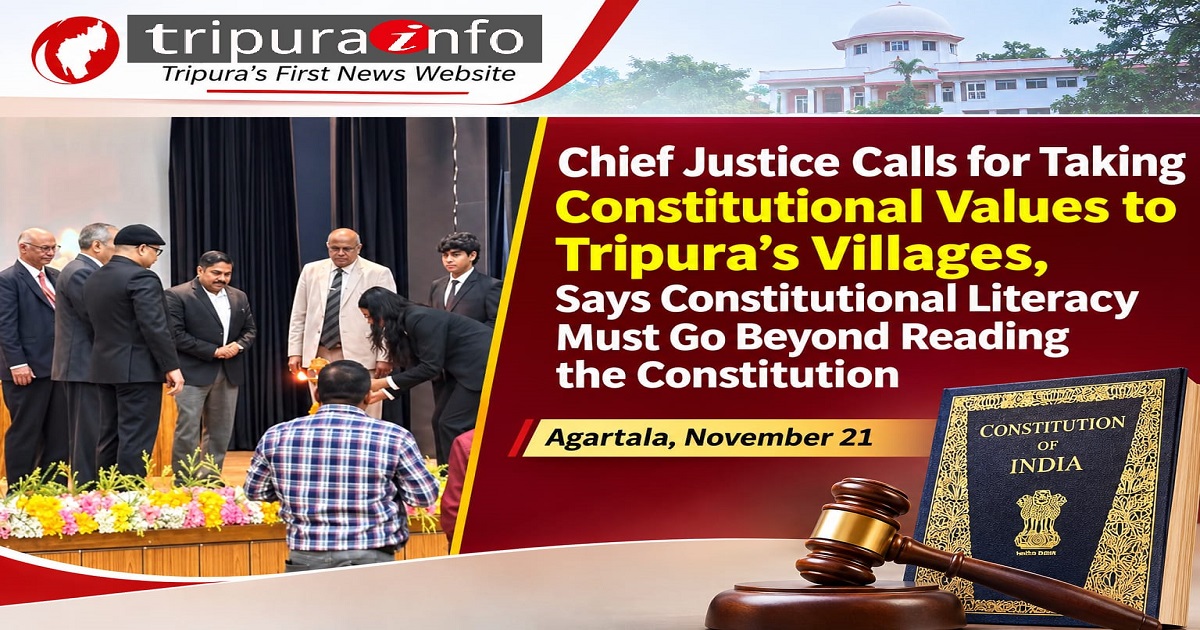 Emphasising the need to strengthen constitutional awareness and democratic values at the grassroots level, Chief Justice of the Tripura High Court Justice MS Ramachandra Rao and Chancellor of National Law University (NLU) Tripura, has called for taking the Constitution to villages and ensuring that ordinary citizens understand, realise and practise their constitutional rights and values in everyday life.
Addressing the inaugural session of Nyaya Sangam 2.0, organised by the Pro Bono Club of National Law University Tripura at the Tripura Judicial Academy Auditorium in Agartala on Saturday, the Chief Justice observed that constitutional literacy should not remain confined to reading or knowing the provisions of the Constitution. Rather, people must understand its underlying principles, values and rights and apply them in their daily lives.
Highlighting the importance of grassroots participation, Justice Rao stressed the role of Panchayati Raj institutions, vernacular media and community-level discussions in spreading constitutional awareness among rural populations. He described the Constitutional Literate Village initiative as a great initiative and emphasised that it should be treated as a continuous and sustained journey rather than a one-time programme or ceremonial exercise.
The Chief Justice's remarks assume particular significance for Tripura, where a substantial section of the population lives in rural and remote areas, including villages under the Tripura Tribal Areas Autonomous District Council. Ensuring that constitutional rights, legal protections and democratic responsibilities reach these communities remains an important challenge for strengthening inclusive governance and access to justice.
The conclave was organised around the theme, "From Constitutional Awareness to Grassroots Empowerment: Strengthening Democracy Through Constitutional Literacy in Rural North-East India." It aimed to explore ways of translating constitutional knowledge into meaningful social empowerment, particularly among rural and disadvantaged communities across the North-East.
Welcoming delegates and participants, NLU Tripura Vice-Chancellor Prof. (Dr.) Yogesh Pratap Singh highlighted the University's extensive engagement with approximately 1,200 Gram Panchayats and Village Committees across the State. He explained that the University has been providing technical and legal handholding support to strengthen participatory and theme-based Gram Panchayat Development Plans (GPDPs).
According to the Vice-Chancellor, during the first phase, assistance was extended to 480 Gram Panchayats and Village Committees across three districts, followed by another 717 institutions in the remaining five districts. The initiative seeks to develop child-friendly, women-friendly, tobacco-free, drug-free and constitutionally literate villages.
Justice Dr. T. Amarnath Goud, Judge of the Tripura High Court and Executive Chairman of the Tripura State Legal Services Authority, also addressed the gathering. Emphasising the importance of youth participation in social transformation, he described young people as the grassroots pillars of the North-East and urged them to take an active role in addressing serious social challenges, including drug trafficking, child marriage, offences under the Protection of Children from Sexual Offences (POCSO) Act and HIV-related issues.
He also underlined the importance of legal aid and encouraged young people to contribute to spreading legal awareness and ensuring that vulnerable sections of society can access justice.
Prof. (Dr.) K. V. S. Sarma, Vice-Chancellor of the National Law University and Judicial Academy, Assam, highlighted the responsibility of National Law Universities in promoting constitutional awareness through clinical legal education, research, institutional collaboration and engagement with Panchayati Raj institutions.
He emphasised the need to develop effective mechanisms through which ordinary citizens can understand and exercise their constitutional rights rather than allowing constitutional knowledge to remain restricted to academic institutions and legal professionals.
The two-day initiative, *Nyaya Sangam 2.0, features panel discussions and expert deliberations focusing on constitutional literacy, grassroots democracy, access to justice and the protection of children's rights, with particular emphasis on Project Samvidhan Gram.
The central message emerging from the inaugural session was that constitutional democracy can become meaningful only when its principles reach the last person in the remotest village. The Chief Justice's call for making constitutional literacy a sustained grassroots movement has placed renewed emphasis on the responsibility of educational institutions, legal services authorities, local self-government bodies and civil society organisations to take constitutional awareness beyond classrooms and courtrooms and into the everyday lives of people.
more news...