TU VC Debabrata Das calls for cooperatives and local enterprises to translate Swadeshi ideals into grassroots economic activity
By Our Correspondent
Agartala, November 20, 2026
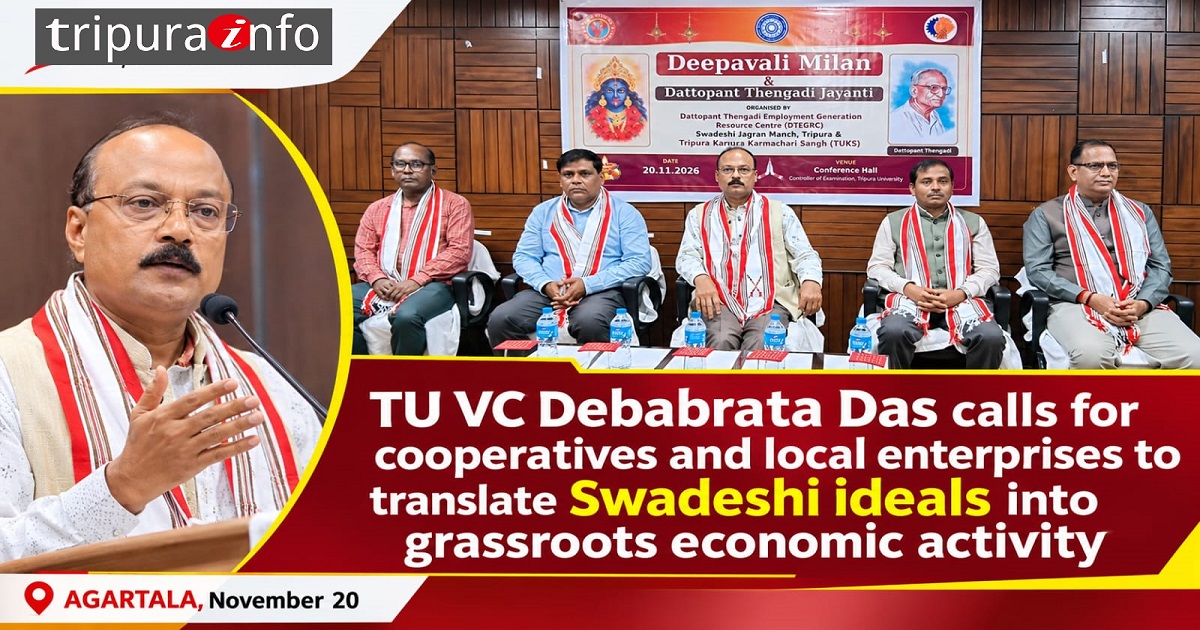 Tripura University Vice-Chancellor Debabrata Das has called for greater reliance on local resources, indigenous products and cooperative enterprises to translate the Swadeshi philosophy into tangible economic activity, stressing that self-reliance must extend beyond slogans and find expression in everyday economic life.
Addressing a joint programme organised by the Swadeshi Jagaran Manch (Tripura Prant) and the Tripura University Employees’ Association (TUKS) on the university campus on Friday, Prof. Das said local entrepreneurship and community-based economic initiatives could play a significant role in strengthening the domestic economy and advancing the vision of an Atmanirbhar Bharat.
The programme marked Diwali Milan and the birth anniversary of Rashtrarishi Dattopant Thengadi, founder of several organisations associated with the Swadeshi movement and labour activism.
Emphasising the economic implications of Swadeshi, Prof. Das observed that multinational companies might generate local employment but a substantial share of their profits could flow outside the country. In contrast, traditional artisans, cottage industries and small entrepreneurs often struggled to secure adequate institutional and market support.
He urged university employees, women’s self-help groups (SHGs) and local residents to explore the formation of cooperatives and Farmer Producer Companies (FPCs) to establish small-scale enterprises.
Among the possibilities he identified were managing the university canteen through a cooperative model, producing cane and bamboo handicrafts and expanding local candle manufacturing. Such initiatives, he said, could generate employment, encourage entrepreneurship and create sustainable livelihood opportunities.
The Vice-Chancellor assured the gathering that the university administration would extend support to local producers, particularly in promoting and marketing their products. He stressed that educational institutions should contribute to strengthening the local economy by connecting available resources and skills with viable business opportunities.
Delivering the keynote address, Dr. Dharmendra Dubey, All-India Publicity Head of the Swadeshi Jagaran Manch and a faculty member of Tripura University, highlighted the ideological contribution of Dattopant Thengadi.
He said Thengadi had sought to formulate an alternative to the competing economic ideologies of capitalism and communism by advancing a Swadeshi-oriented ‘Third Way’. His approach, Dr. Dubey said, placed national interest, social responsibility and the dignity of labour at the centre of economic activity.
Referring to Thengadi’s message to workers, he cited the principle: “We will take full payment for our work, and we will work in the interest of the nation.” The statement, he said, reflected the importance of balancing workers’ rights with a commitment to national development.
The university’s Finance Officer Debasish Pal , speaking at the programme, said reducing dependence on foreign products and resisting the influence of foreign advertising were important steps towards strengthening domestic industries. Giving preference to indigenous products, he said, would help create a stronger economic foundation for a developed India.
Earlier, University Registrar Prof. Samir Kumar Shil extended Diwali greetings and highlighted the importance of the ‘Vocal for Local’ initiative. He said promoting indigenous products and enterprises would be essential to realising the vision of making India a ‘Vishwaguru’ by 2047.
The programme was attended by Subhra Nandi, State Coordinator of Swavalambi Bharat Abhiyan; Dr. Vishwabandhu, State Office Head of the Swadeshi Jagaran Manch; Dr. Om Prakash, State Publicity Head of the organisation; Dr. Satyadev Mishra, Chairman of the Swadeshi Research Institute’s Tripura chapter; and Manas Pal, Secretary of TUKS.
Faculty members, administrative officials, research scholars and university employees also attended the programme.
The discussions placed particular emphasis on the role of universities and community organisations in converting the Swadeshi philosophy into practical economic initiatives through local production, cooperative ownership and stronger market linkages.
more news...