Three Years After RTI Appeal, Tripura Information Commission Issues Major Order on Chakma Customary Laws
By Our Correspondent
Agartala, November 20, 2026
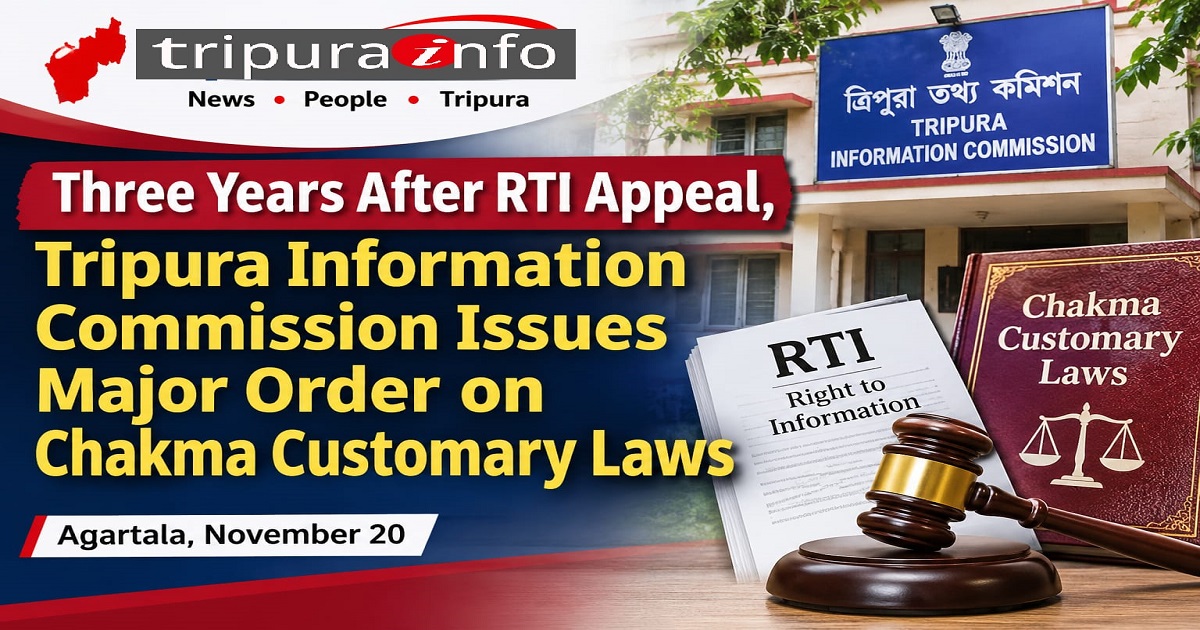 Nearly three years after an RTI appeal was filed, the Tripura Information Commission has issued a significant 21-page order concerning the denial of information relating to the Chakma Customary Laws Bill, 2022, raising serious questions about the functioning of the Tribal Welfare Department and the prolonged delay in delivering justice under the Right to Information Act.
The order, signed by State Chief Information Commissioner BS Mishra, concerns an RTI application filed by Jagdish Rawat of Janakpuri, New Delhi, on July 28, 2023. The appeal was registered as Appeal No. TIC (SA)-26 of 2026-27. The respondents included the State Public Information Officer of the Directorate of Tribal Welfare, Shri S Prabhu, the then Additional Secretary and First Appellate Authority, and Smt. Sanchita Roy, the then designated SPIO.
The applicant had sought information relating to the Chakma Customary Laws Bill, 2022 (TTAADC Bill No. 14 of 2022). However, certain information was withheld by the department on the ground that the matter was still under examination before the State Legislature, invoking Section 8(1)(c) of the RTI Act.
The Commission found that merely stating that a matter was under examination before the Legislature could not automatically justify withholding information. It observed that the department had failed to identify any specific legislative privilege that could be threatened by disclosure or establish the necessary legal and factual connection for invoking the exemption.
The Commission also questioned the decision of the then First Appellate Authority, Shri S Prabhu, to direct the SPIO to transfer the RTI application to the President of a Chakma organisation for furnishing information directly to the applicant. The Commission observed that the responsibility of a public authority to provide information available in its official records could not legally be transferred to an external private organisation without statutory authority.
The Commission further examined Shri S Prabhu's role in the original RTI proceedings and held that he was a deemed SPIO under Section 5(5) of the RTI Act because he had participated in the process, possessed relevant information and directly communicated the department's response to the applicant.
Finding statutory lapses in the handling of the application, the Commission calculated that the delay between September 2, 2023, and October 6, 2026, amounted to 1,131 days. Accordingly, it proposed the maximum monetary penalty of Rs 25,000 under Section 20(1) of the RTI Act against Shri Prabhu. However, the Commission has issued a show-cause notice giving him seven days to explain why the penalty should not be imposed.
The Commission has also sought his explanation regarding proposed action under Section 20(2) for failure to furnish information within the statutory period, unsupported invocation of the legislative privilege exemption and continued failure to discharge his responsibilities as deemed SPIO. Separately, it has recommended that the competent disciplinary authority examine his conduct as First Appellate Authority under the applicable service rules.
The Commission, however, did not propose any monetary penalty or disciplinary recommendation against Smt. Sanchita Roy, the then designated SPIO. It observed that she did not have custody of the relevant information and had sought assistance from the concerned ADC Cell before Shri Prabhu directly furnished the response.
In its operative directions, the Commission instructed the present SPIO of the Tribal Welfare Directorate to provide all available information and documents sought in the original RTI application within 15 days of receiving the order. The information must be furnished point-wise, and no document can be withheld merely by stating that the matter is under examination or consideration. The department has also been directed to preserve the original RTI records and submit a compliance report within 30 days.
However, the respondents have submitted a clarification before the CIC maintaining that the matter was handled in good faith and through normal administrative procedures. According to their explanation, the formulation and examination of the Chakma Customary Laws were under active consideration by the Government at the relevant time. Certain departmental opinions and legal views, including opinions obtained from the Law Department and referred to TTAADC for comments and response, formed part of an ongoing inter-departmental consultation process.
The respondents have stated that internal departmental opinions and legal views were not disclosed because the matter had not reached a final decision. They have also maintained that the non-disclosure was limited to internal deliberations and was neither arbitrary nor intended to obstruct the applicant's right to information.
The clarification further states that the RTI application was processed through the normal administrative channel and that the First Appellate Authority had instructed the concerned SPIO to provide copies of the relevant Customary Laws. The respondents have denied any deliberate intention to withhold information or cause undue delay and have stated that a detailed explanation will be submitted before the Commission within the prescribed period.
It is reported that the respondent have also emphasised that the Commission has, at this stage, only issued show-cause directions concerning the proposed penalty and disciplinary action. No final penalty or disciplinary order has yet been passed against Shri Prabhu.
However, the most significant question arising from the proceedings concerns the extraordinary delay in delivering the decision itself. The original RTI application was filed in July 2023, and the second appeal was submitted to the Information Commission on November 10, 2023. Yet the hearings were conducted only on October 6 and October 12, 2026.
Why did the Tripura Information Commission take almost three years to dispose of an appeal concerning the citizen's statutory right to information? Was the delay due to an excessive backlog, administrative shortcomings or other institutional reasons? Did the prolonged pendency indirectly allow the continued withholding of information that the applicant had sought through a statutory mechanism?
While the Commission has now questioned the conduct of the departmental officers and proposed action against the then Additional Secretary, its own delay in deciding the appeal also deserves public scrutiny. The effectiveness of the RTI Act depends not only on the accountability of public authorities but also on the timely functioning of the statutory institutions entrusted with protecting citizens' right to information.
The case has therefore brought two important issues into focus: accountability within the Tribal Welfare Department and the responsibility of the Tripura Information Commission to ensure that citizens do not have to wait years to obtain information under the RTI Act.
more news...