Mebar Kumar Jamatia’s Demand for Financial Benefits for MDCs Raises Questions Over Pradyot Kishore’s ‘No Power, No Position’ Political Philosophy
By Our Correspondent
Agartala, November 20, 2026
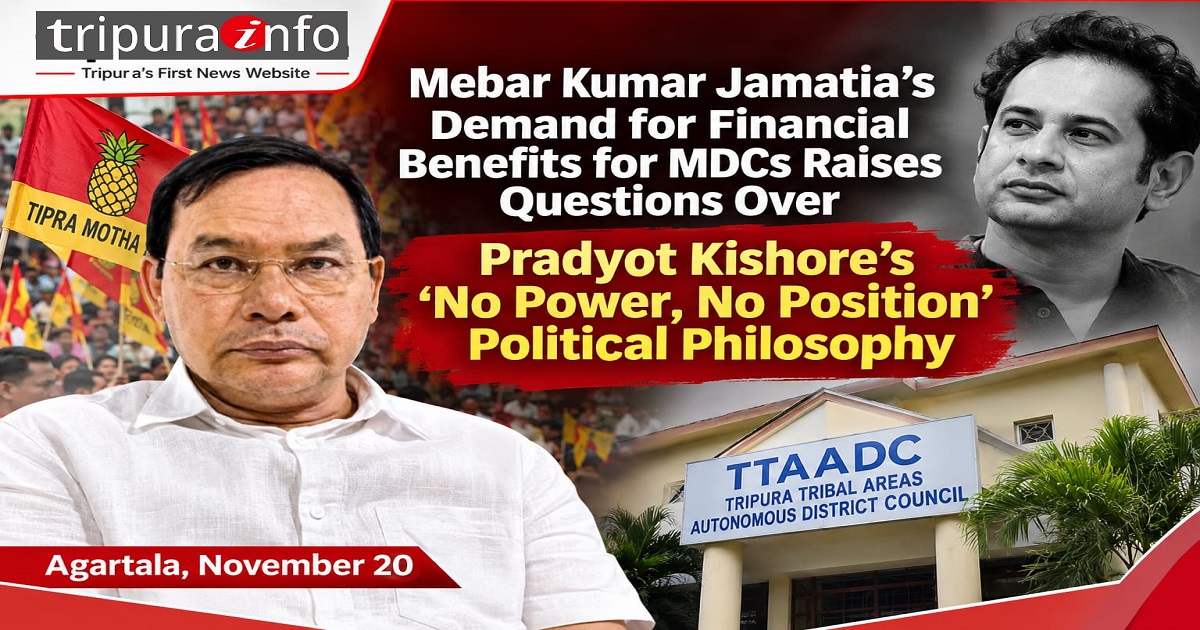 Is Tipra Motha, the regional political party founded on the promise of protecting the constitutional rights, identity and dignity of the Tiprasa people, gradually moving towards the politics of power, positions and financial privileges? A fresh political debate has emerged within and around the party following senior Tipra Motha leader Mebar Kumar Jamatia’s recent demand for enhanced financial benefits and honorarium for Members of the District Council (MDCs), a demand that has brought renewed attention to the political philosophy repeatedly articulated by party founder Pradyot Kishore Debbarma.
Pradyot Kishore has repeatedly maintained in public meetings, political rallies and other forums that neither he nor his associates entered politics with the ambition of becoming ministers, MLAs, MDCs or occupying government positions. According to him, the Tipra Motha movement was never intended to capture power or provide political rehabilitation to individual leaders. Its central objective, he has consistently argued, is to secure constitutional safeguards, political rights, identity, dignity and a protected future for the Tiprasa people.
By presenting Tipra Motha as a rights-based movement rather than a conventional political party driven by electoral power, Pradyot has sought to distinguish his organisation from traditional power-centred politics. His repeated assertion has been that the interests and future of the Tiprasa community must remain above personal political ambitions and positions.
However, recent developments within the party and the TTAADC administration are raising questions about whether this philosophy is being reflected in the political priorities of some of its senior leaders.
The latest controversy has gained momentum following a Facebook post by veteran Tipra Motha leader Mebar Kumar Jamatia, who has raised the issue of the financial status, honorarium and administrative recognition of MDCs. His arguments have brought an important historical and political dimension to the debate, particularly concerning the long-pending proposals to restructure and strengthen the Tripura Tribal Areas Autonomous District Council (TTAADC).
According to Jamatia, in November 2019, the then BJP-led Tripura Cabinet under Chief Minister Biplab Kumar Deb had taken an important initiative towards increasing the powers and status of the tribal autonomous council. Subsequently, on January 17, 2020, the Tripura Legislative Assembly unanimously adopted a proposal to increase the strength of the Council from 30 to 50 members.
The proposals reportedly included three major components: renaming the Tripura Tribal Areas Autonomous District Council as the Tipra Territorial Council (TTC), increasing the number of elected MDCs from 30 to 50, and expanding the number of administrative departments under the Council from 17 to 43.
The underlying argument was that the TTAADC administers approximately 68 per cent of Tripura's geographical area and carries enormous responsibilities in terms of governance, development and delivery of public services. Therefore, its administrative authority, financial resources, political representation and institutional status should be strengthened in proportion to the vast area and population under its jurisdiction.
However, despite the passage of several years, questions remain over the implementation of these proposals. Jamatia's position is that political announcements and unanimous legislative resolutions cannot be considered sufficient unless they translate into concrete administrative and constitutional changes. The demand for greater autonomy, therefore, remains an important issue for the tribal population.
At the same time, his recent comments have brought the financial entitlements of MDCs into the centre of the political discussion. Jamatia has questioned why elected representatives of the TTAADC should continue to receive comparatively limited financial benefits when their responsibilities cover such a vast geographical area and a substantial population.
Drawing a comparison with the 60 elected MLAs of the Tripura Legislative Assembly, who reportedly receive monthly remuneration and associated benefits amounting to approximately Rs 1.50 lakh, he has questioned why MDCs should not receive appropriate financial recognition for their public responsibilities.
He has also referred to the historical disparity in the honorarium of MDCs, pointing to figures ranging from Rs 12,000 to Rs 18,000 and arguing that there has been no adequate improvement in their financial entitlements over nearly four decades. According to this argument, elected representatives responsible for addressing public grievances relating to education, healthcare, roads, connectivity, development and administration should not be financially marginalised.
Jamatia's argument is that the demand for increased honorarium is not simply about personal financial benefits. Rather, it is connected with the institutional dignity, functional effectiveness and recognition of the autonomous council and its elected representatives. He has also pointed out that nearly 85 per cent of MDCs are representatives of the Tiprasa community, making the issue politically significant for the constituency that Tipra Motha claims to represent.
Nevertheless, the comparison between the remuneration of MLAs and MDCs also raises questions about the financial capacity of the autonomous council, the sources of its revenue and the need to link any enhancement of remuneration with clearly defined responsibilities, accountability and administrative performance.
The controversy becomes even more politically significant when viewed against the recent developments in the TTAADC's administrative structure. Discussions over the expansion of Executive Member positions, the creation of additional posts and the political aspirations of different leaders have intensified speculation about the growing importance of positions within the party-led administration.
Significantly, on November 17, 2026, an amendment bill concerning an increase in the number of Executive Members in the TTAADC from nine to twelve was reportedly passed unanimously during a Council session. The proposed expansion creates the possibility of three additional Executive Member positions, potentially widening the scope of administrative responsibilities as well as political representation within the Council.
Although increasing the number of Executive Members may be justified on administrative grounds, particularly considering the geographical size and responsibilities of the TTAADC, the timing and political implications of the move have attracted attention. It has inevitably raised questions about whether the expansion is primarily intended to improve governance or whether internal political accommodation and the distribution of positions are also influencing the decision.
more news...