Tripura University hosts international conference on endocrinology and reproductive health Scientists from India and abroad gather at three-day conference; Vice-Chancellor calls for research-driven solutions to healthcare challenges and stronger global collaborations
By Our Correspondent
Agartala, November 18, 2026
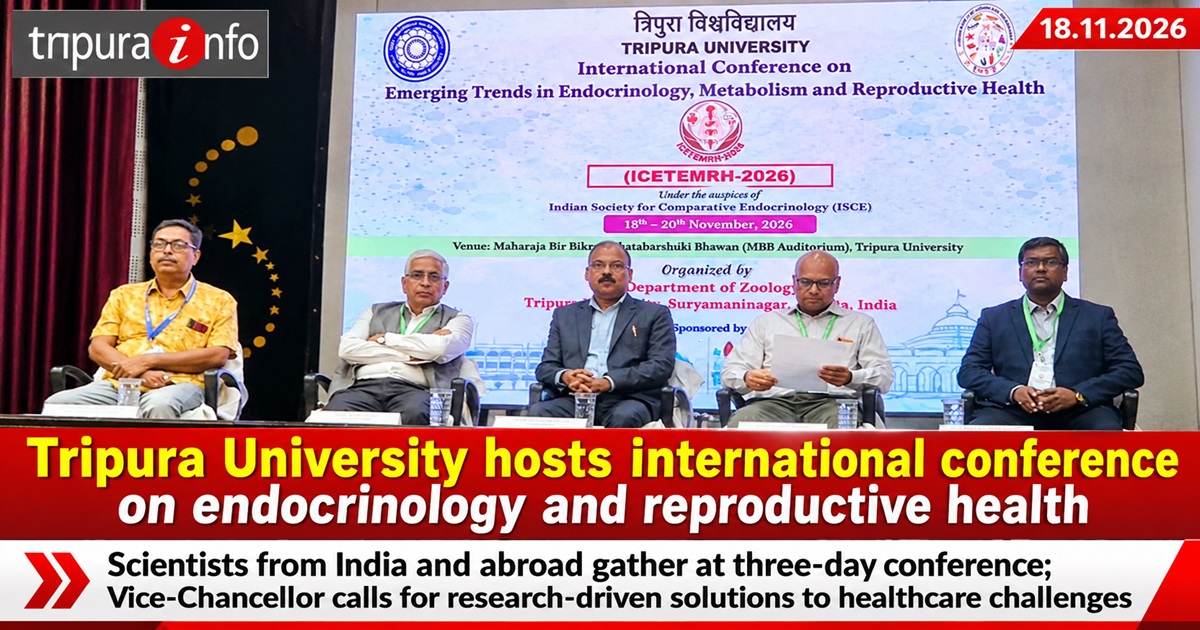 Emphasising the need to translate scientific research into tangible social and economic benefits, Tripura University Vice-Chancellor Prof. Debabrata Das on Wednesday called upon Indian researchers to move beyond academic publications and develop indigenous scientific solutions that directly improve people's lives and livelihoods.
Addressing the inaugural session of a three-day international conference on Emerging Trends in Endocrinology, Metabolism and Reproductive Health (ICETEMRH-2026), Prof. Das advocated a research approach centred on what he described as the 'Triple-L' concept — taking research from the laboratory to life and livelihoods. He also identified consistency and collaboration as two essential pillars of meaningful scientific innovation.
Organised by the Department of Zoology, Tripura University, in collaboration with the Indian Society for Comparative Endocrinology (ISCE), the conference began at the university's Suryamaninagar campus on Wednesday and will continue until November 20. It has brought together scientists, academicians and researchers from India and several other countries to deliberate on emerging developments in endocrinology, metabolism and reproductive health.
In his presidential address, Prof. Das welcomed the national and international delegates and linked the conference's objectives to the national vision of Viksit Bharat 2047. He observed that producing high-impact research papers alone was insufficient to address the country's developmental challenges. Researchers, he said, needed to focus on indigenous, India-centric solutions across medical, veterinary and zoological sciences rather than repeatedly pursuing conventional areas of research.
Highlighting structural constraints faced by universities, the Vice-Chancellor called for stronger institutional partnerships to overcome limitations in research infrastructure. He stressed the need for universities to move beyond institutional silos and collaborate with specialised research organisations, including the Indian Council of Agricultural Research (ICAR), the Council of Scientific and Industrial Research (CSIR) and the Indian Council of Social Science Research (ICSSR), besides international research centres.
Such partnerships, he said, would help universities access advanced laboratory facilities and strengthen their research capabilities. Advocating self-reliance in healthcare, Prof. Das also questioned India's dependence on foreign regulatory approvals, including those of the US Food and Drug Administration, for medicines and vaccines developed domestically. He called for a stronger indigenous regulatory and research ecosystem.
Inviting visiting scientists to assess the university's laboratory facilities and offer constructive suggestions, he reiterated Tripura University's commitment to developing a competitive research environment with international standards.
Chief guest Prof. Umesh Rai, Vice-Chancellor of the University of Jammu and president of ISCE, traced the growth of the society since its establishment in 2003. He advocated a 'Lab to Land and Land to Lab' approach to strengthen India's knowledge economy, stressing the importance of experiential and transdisciplinary learning.
Prof. Rai also proposed the formation of a national committee, to be chaired by Prof. Vinod Kumar with Prof. Pankaj Kumar as Member Secretary, to modernise the curriculum in endocrinology and reproductive physiology.
Special guest Prof. Matt Vijayan of the University of Calgary, Canada, expressed pleasure at visiting Tripura and encouraged students to interact freely with international experts, raise challenging questions and make the most of the academic exchanges offered by the conference.
Earlier, delivering the welcome address, Prof. Debajyoti Bhattacharjee, Dean of the Faculty of Science at Tripura University, underlined the importance of holding international academic conferences in physical mode. Direct interaction among scientists and researchers, he said, could facilitate the exchange of innovative ideas and create opportunities for international postdoctoral research and academic collaboration.
The inaugural ceremony began with the National Anthem, the National Song and the university's Kulgeet, followed by the lighting of the ceremonial lamp. The dignitaries were felicitated by the organising committee. Dr. Shiv Shankar Singh, Head of the Department of Zoology and organising secretary, was also present.
The conference has drawn several internationally recognised researchers, including Prof. Suraj Unniappan, Prof. Colin Brauner and Prof. Som Niyogi from Canada; Prof. Deborah M. Power and Prof. Adelino Canario from Portugal; and Dr. Indrajit Chowdhury from the United States, besides Prof. Matt Vijayan.
Among the prominent Indian participants are Prof. Vinod Kumar, Prof. G. Taru Sharma, Prof. M. Laloraya, Prof. B. K. Agarwala, Prof. Bechan Lal, Prof. C. M. Chaturvedi, Prof. C. Haldar, Prof. S. Majumdar, Prof. S. Peter, Prof. D. D. Sharma and several other scientists and academicians.
The conference is expected to provide a platform for exchanging research findings, exploring emerging scientific approaches and strengthening national and international collaboration in endocrinology, metabolism and reproductive health. The inaugural session concluded with a vote of thanks.
more news...