Private Diagnostic Centres and Clinics Accused of Overcharging Patients in Tripura, No Effective Government Control and Monitoring Over Test Rates
By Our Correspondent
Agartala, November 18, 2026
 The issue of alleged overcharging by private pathological laboratories, diagnostic centres and healthcare clinics in Tripura has once again come under scrutiny, with concerns growing over the absence of effective government regulation and transparent rate fixation for medical investigations and treatment. Patients and their families are increasingly facing substantial expenses at private healthcare facilities, often at a time when they are physically vulnerable, anxious and left with limited alternatives.
A recent experience scared by one retired TCS Officer involving medical investigations at the Government GBP Hospital in Agartala has raised serious questions about the affordability of private diagnostic services and the need for government intervention to protect patients from excessive charges.
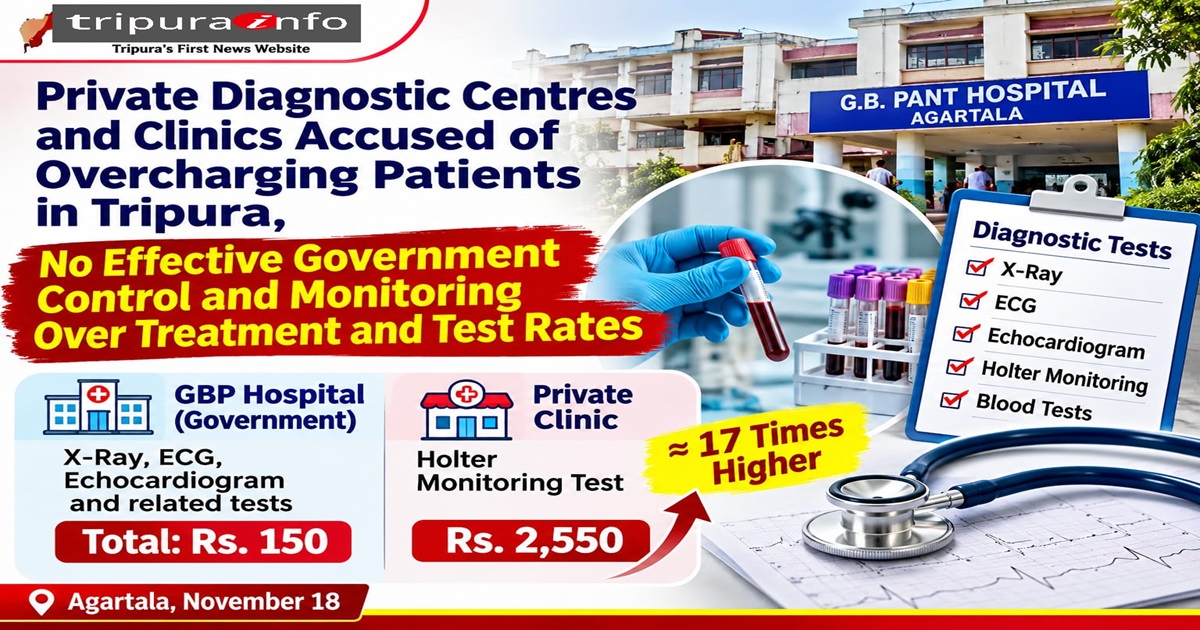
According to an account shared by a patient, several investigations, including X-ray, ECG, echocardiogram and related tests, were completed at GBP Hospital for a total expenditure of just Rs. 150. The investigations were reportedly conducted efficiently and within a remarkably short period. The patient expressed sincere appreciation for the initiative and professional support extended by Dr Sayantan Saha, MD.
The experience was cited as an example of what an efficient, affordable and patient-oriented public healthcare system can achieve when medical professionals and the administration work together.
However, the same patient had to undergo a Holter monitoring test at a private clinic because the Holter machine at GBP Hospital was reportedly out of order. The private facility charged Rs. 2,550 for the single investigation. The amount was nearly 17 times the total expenditure incurred for the entire set of investigations at the government hospital.
This striking difference has brought the issue of private diagnostic charges into focus. Questions are being raised about how private laboratories and clinics determine their prices, whether the charges are justified by the actual cost of services and why patients are not adequately protected against arbitrary pricing.
The concern extends beyond pathological laboratories. Private clinics and healthcare establishments are also facing allegations of charging excessively for consultations, diagnostic procedures, medical investigations and different forms of treatment. In the absence of publicly accessible and effectively enforced standard rates, patients often have little opportunity to verify whether the amounts demanded are reasonable.
Healthcare is an essential service, and patients cannot always postpone investigations or treatment simply because private facilities demand high charges. In many cases, when equipment at government hospitals becomes non-functional or specialist services are unavailable, patients are compelled to approach private establishments. This creates a situation in which people with limited financial resources are forced to bear expenses they may not be able to afford.
The question is therefore not merely about one Holter test costing Rs. 2,550. It concerns the broader absence of an effective and transparent mechanism to regulate diagnostic and treatment charges across the private healthcare sector.
The state government and the Health Department need to examine whether existing regulatory provisions are being properly implemented and whether a comprehensive rate-fixation mechanism is necessary. A government-approved rate chart for common pathological tests, X-rays, ECGs, echocardiograms, Holter monitoring and other diagnostic procedures could help bring transparency to the system.
Private hospitals, nursing homes, clinics and diagnostic laboratories should be required to display their approved or declared charges prominently. Patients should receive itemised bills, and an accessible grievance-redressal mechanism should be established to investigate complaints of excessive billing.
At the same time, the government must ensure that essential diagnostic equipment in public hospitals remains functional. The failure of a machine at a government hospital should not automatically push patients towards expensive private services. Regular maintenance, adequate technical staff and accountability for equipment downtime are equally important.
more news...