Former Tripura CM accuses ruling party of using intimidation and administrative machinery ahead of civic polls, alleges attempts to capture five urban local bodies
By Our Correspondent
Agartala, November 17, 2026
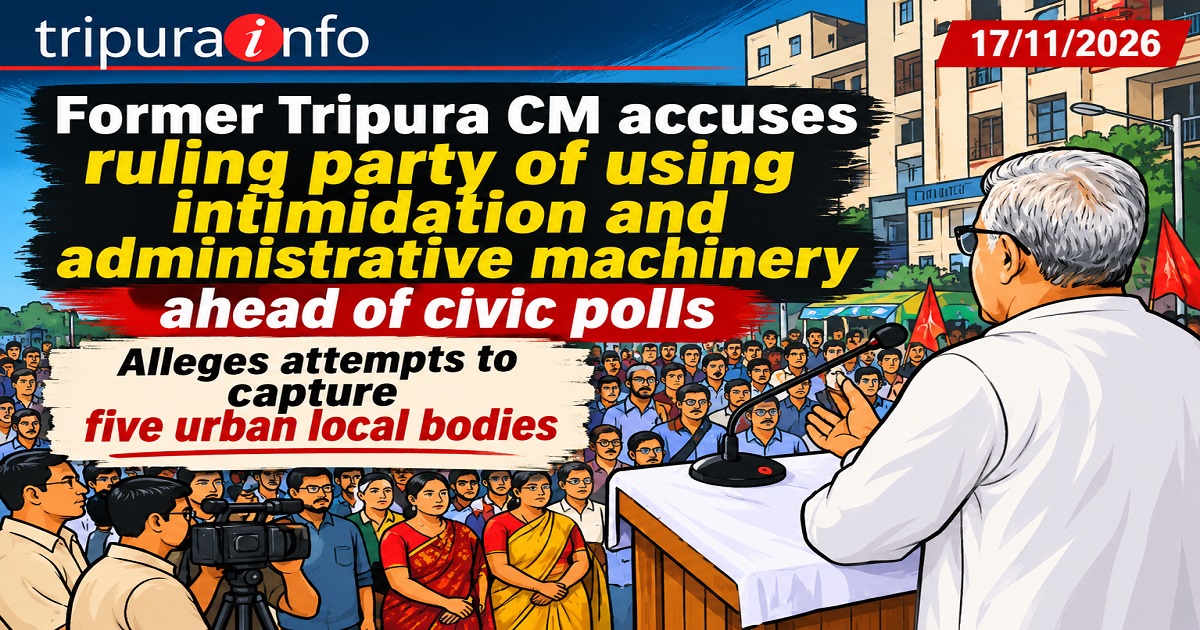 Former Tripura Chief Minister Manik Sarkar on Tuesday launched a blistering attack on the BJP, accusing the ruling party of resorting to intimidation, political violence and misuse of the administration because it was apprehensive about its electoral prospects in the November 27 urban local body polls.
In a politically charged address at an election meeting at Ker Chowmuhani in Agartala, the senior CPI(M) leader said people who had voted for the BJP in 2018 and 2023 were now beginning to realise their mistake.
“They are now understanding that they brought a crocodile by digging a canal,” Sarkar said, using a sharp Bengali political expression to describe the alleged disillusionment among voters.
The former Chief Minister alleged that the BJP, despite having been in power for years, had failed to retain public confidence and was increasingly depending on intimidation rather than its performance to face the electorate.
“If the BJP has actually worked for the people, why is it so afraid of them?” he asked, accusing ruling party leaders and Ministers of making provocative statements and allegedly encouraging miscreants to intimidate Opposition supporters.
Sarkar claimed that the State administration was being used to advance the BJP's partisan interests instead of ensuring a level playing field for all political parties.
He alleged that Left Front candidates were being targeted through attacks on their livelihoods and that even the houses of people who had agreed to act as proposers for Opposition candidates were not being spared.
The allegations, if established, would raise serious questions about the conduct of the electoral process. Sarkar maintained that the intimidation was aimed not merely at candidates but also at ordinary citizens willing to participate in democratic activities.
The CPI(M) leader singled out five urban local bodies — Mohanpur, Jirania, Majlishpur, Ambassa and Kamalpur — alleging that the ruling BJP had resorted to electoral capture in these areas.
According to Sarkar, the ruling establishment was aware that the BJP could face defeat if voters were allowed to exercise their franchise freely. He alleged that administrative influence and the mobilisation of miscreants were being used to prevent the Opposition from putting up an effective electoral challenge.
He said the alleged developments had tarnished Tripura's image nationally and questioned the credibility of the democratic process in the State.
The former Chief Minister, however, insisted that such tactics would not succeed in preventing the CPI(M) from contesting the elections.
Neither intimidation nor the alleged use of government machinery could silence the Opposition, he asserted, adding that the BJP's political days were numbered.
The BJP had not immediately responded to the allegations made by the CPI(M) leader.
Sarkar also sought to turn the spotlight on issues beyond electoral politics, particularly the availability of essential commodities through ration shops.
Taking a swipe at the government's claims of development and welfare, he said ordinary people were struggling to obtain basic food items through the public distribution system.
“Rice is available, but dal is not. If dal is available, there is no salt or flour,” he said, portraying the situation as evidence of the disconnect between the government's development narrative and the everyday hardships of ordinary households.
His remarks sought to highlight the difficulties faced by economically vulnerable sections in accessing essential commodities, an issue that could resonate with urban voters during the civic election campaign.
The condition of public spaces in Agartala also figured prominently in his address. Sarkar expressed concern over Swami Vivekananda Maidan and the playground of Netaji Vidyaniketan School, alleging that the government was destroying these important public facilities.
“What is happening?” he asked, questioning the rationale behind the alleged destruction of playgrounds.
He argued that public grounds were not merely recreational spaces but important facilities for children, students and young people. Their preservation, he suggested, was a matter of public interest and government accountability.
more news...