South Tripura Schools to Launch ‘Ek Bharat Shreshtha Bharat’ Clubs Amid Concerns Over Teacher Shortages and Poor Educational Infrastructure
By Our Correspondent
Agartala, November 17, 2026
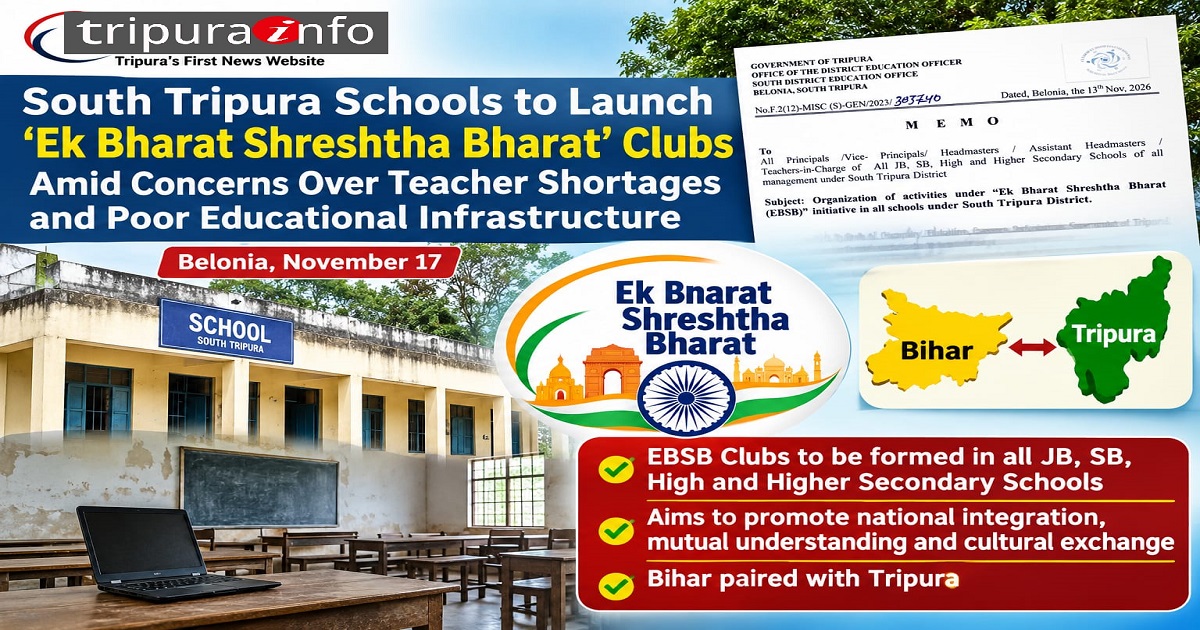 At a time when government schools across Tripura are facing serious challenges relating to shortages of teachers, inadequate educational infrastructure and gaps in the implementation of computer education, the Education Department has initiated a new programme to promote cultural exchange and national integration among students.
The Office of the District Education Officer (DEO), South Tripura, has issued a memorandum directing all Junior Basic (JB), Senior Basic (SB), High and Higher Secondary schools across the district to establish ‘Ek Bharat Shreshtha Bharat (EBSB) Clubs’ and organise various cultural and educational activities every month.
The memorandum, issued on November 13, 2026, from the District Education Office at Belonia, is addressed to all principals, vice-principals, headmasters, assistant headmasters and teachers-in-charge of schools under different managements in South Tripura district. It refers to a communication from the Directorate of Secondary Education, Government of Tripura, dated November 11, 2026.
According to the memorandum, the Government of India has been implementing the ‘Ek Bharat Shreshtha Bharat’ initiative with the objective of promoting national integration, mutual understanding and cultural exchange among people belonging to different States and Union Territories.
Under the programme, Bihar has been paired with Tripura, and schools have been instructed to introduce students to the language, literature, traditions, culture and historical heritage of the partner state.
The DEO has specifically requested all heads of educational institutions to take necessary steps to constitute EBSB Clubs in their respective schools and organise activities every month in accordance with the guidelines and suggestions circulated by the Directorate of Secondary Education.
The suggested activities include familiarising students with the alphabets, songs, proverbs and unique words of the paired state's language through 100 sentences. Students will also participate in essay competitions on the paired state, while optional classes may be organised to help them learn its language.
The memorandum further suggests organising dramas, folk theatre performances and role plays highlighting the culture, history and traditions of Bihar. Schools have also been encouraged to identify, translate and disseminate similar proverbs in the languages of the two states and prepare theme-based display boards and wall magazines focusing on Bihar.
While the initiative aims to broaden students' cultural understanding and strengthen national integration, its introduction has also brought the broader condition of school education in Tripura into focus.
The question is whether schools struggling with basic educational requirements will be able to implement additional programmes effectively without first addressing their existing deficiencies.
Across Tripura, concerns have repeatedly been raised over vacant teaching posts, inadequate classroom facilities and the shortage of essential educational infrastructure. The situation is particularly concerning in the field of computer education, which has increasingly become an important component of modern schooling.
Although computer education has been emphasised as an essential requirement in schools, many institutions reportedly continue to face shortages of functional computer laboratories, equipment and adequate facilities to provide meaningful practical education to students.
The issue has also been highlighted by organisations representing ICT instructors. In a recent development, computer instructors staged a rally in Agartala on November 13, demanding better wages, job security and direct government responsibility for the implementation of the ICT-at-Schools programme. The organisation also alleged that several schools lack even the minimum infrastructure required for effective computer education.
The larger concern, therefore, is not about the relevance of cultural exchange programmes. Initiatives such as EBSB can certainly help students understand India's linguistic and cultural diversity and develop a stronger sense of national unity. However, the effectiveness of such programmes will depend on the availability of teachers, adequate infrastructure and the ability of schools to conduct regular academic activities.
The introduction of EBSB Clubs in all schools under South Tripura district represents another administrative initiative in the state's education sector. But alongside cultural programmes, parents, teachers and students are also expecting concrete steps to strengthen the basic foundations of school education, including filling vacant teaching posts, improving classroom facilities and ensuring functional computer laboratories.
Ultimately, cultural awareness and national integration are important components of education, but they cannot substitute for the fundamental responsibility of ensuring quality teaching, adequate infrastructure and equal learning opportunities for every student.
more news...