Census 2027: Tripura Begins Preparations for Second Phase: State-Level Workshop Held in Agartala, 40 Questions Listed for Population Enumeration
By Our Correspondent
Agartala, November 14, 2026
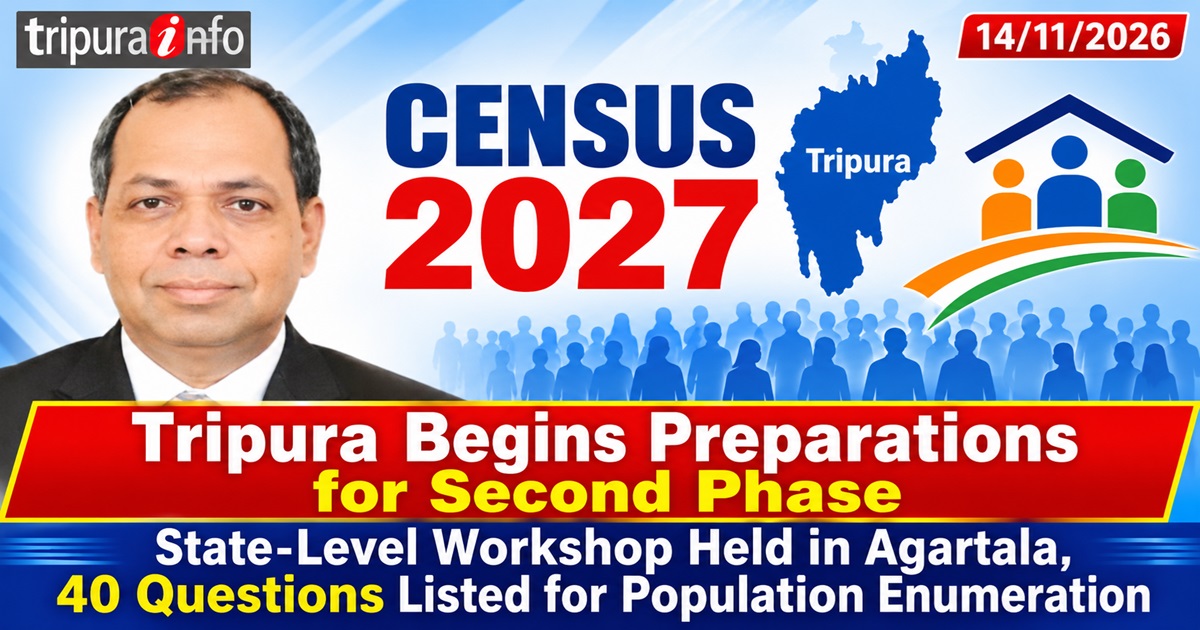 Preparations for Census 2027 have gained momentum in Tripura, with the second phase of the nationwide population enumeration exercise scheduled to begin in the state from January 25, 2027. In this connection, a state-level workshop was organised at Pragna Bhavan in Agartala on November 13 to familiarise officials with the upcoming exercise and strengthen administrative preparedness for its successful implementation.
The workshop was jointly organised by the Directorate of Economics and Statistics, Government of Tripura, and the Directorate of Census Operations, Tripura. Chief Secretary JK Sinha, IAS inaugurated the programme in the presence of senior officials from different government departments and other distinguished participants.
Addressing the gathering, Chief Secretary JK Sinha underlined the importance of Census 2027 in the formulation of government policies, development planning and ensuring the effective delivery of public services. Drawing upon his administrative experience, he explained how accurate and comprehensive population data play an essential role in determining policy priorities and understanding the socio-economic conditions of different sections of society.
He observed that census information is not merely a collection of demographic figures but an important foundation for informed government decisions and inclusive development. Reliable population statistics help the government assess the requirements of citizens, identify areas requiring greater attention and formulate development programmes based on actual needs. He also called upon the officials concerned to discharge their responsibilities with sincerity, dedication and accuracy so that the exercise could be completed successfully.
Tripura's Census 2027 State Nodal Officer and Secretary of the Planning (Statistics) Department, Bikash Singh, described the census as an important administrative and developmental exercise rather than merely a routine government procedure. He emphasised that the information collected through the census would serve as a valuable resource for development planning and contribute towards the national objective of building a developed India.
He stressed that the successful implementation of the census would depend on proper coordination, adequate preparation and the active participation of officials engaged in the enumeration process.
Biswajit Das, Deputy Director General from the Office of the Registrar General and Census Commissioner of India, Ministry of Home Affairs, Government of India, New Delhi, also addressed the workshop. Speaking on behalf of the Registrar General, he appreciated the contributions of census officials and personnel and acknowledged the cooperation extended by the Tripura Government in facilitating census-related activities.
Director of Census Operations, Tripura, Ratan Biswas, IAS delivered the welcome address and highlighted the importance of interdepartmental coordination for conducting the exercise smoothly. He emphasised that the successful completion of Census 2027 would require the active involvement of the state administration and all officials assigned census responsibilities.
Meanwhile, the proposed scope of information collection during the second phase of Census 2027 has drawn considerable attention following the circulation of a list containing 40 questions relating to individuals and households. The questions indicate the wide range of demographic, social, educational, occupational and household-related information expected to be covered in the enumeration process.
The information listed includes the name of the individual, relationship with the head of the household, gender, year of birth, age, marital status and age at marriage. Details relating to the names and particulars of parents and spouses, citizenship, Scheduled Caste and Scheduled Tribe status, mother tongue and knowledge of other languages also feature in the displayed questionnaire.
Educational qualifications and literacy are among the other important areas covered. Information relating to whether an individual is literate, digitally literate, attending school, college or another educational institution, and the level and stream of education would help build a broader understanding of the educational profile of the population.
Employment and livelihood-related information also occupies an important place in the list. Questions relate to whether an individual was employed during the preceding 12 months, the nature of employment, whether the person works in agriculture, industry, commerce or services, the category of employment and whether an individual is currently looking for work. The list also refers to economically inactive individuals, including students, homemakers and persons unable to work, as well as whether they are seeking employment.
Migration and residential history constitute another significant area. Information relating to the place of birth, reasons for changing residence, duration of stay at the present address and permanent address is included. Such information can help understand population movement, migration patterns and changes in the distribution of people across different locations.
The questionnaire displayed in the circulating poster also refers to family and household-related information, including the number of living children and total children in different marital and family circumstances. Details concerning COVID-19 vaccination centres, the number of bank accounts and certain identification particulars, including mobile numbers, Aadhaar numbers, voter ID numbers, passport numbers and driving licence details, are also mentioned in the list.
The extensive range of information indicated in the poster highlights the importance of the forthcoming census in building a comprehensive demographic and socio-economic profile of the population. Information on education, employment, migration, family structure and household circumstances can provide important inputs for future planning in areas such as education, healthcare, housing, employment generation, infrastructure and social welfare.
For Tripura, where development requirements differ between urban areas, rural communities and remote tribal regions, reliable population data will be particularly important. Accurate enumeration can help policymakers understand the changing needs of different communities and ensure that development programmes are planned on the basis of credible information.
more news...