ICT Instructors Stage Rally in Agartala, Demand Fair Wages, Job Security and State Takeover of Computer Education Programme
By Our Correspondent
Agartala, November 13, 2026
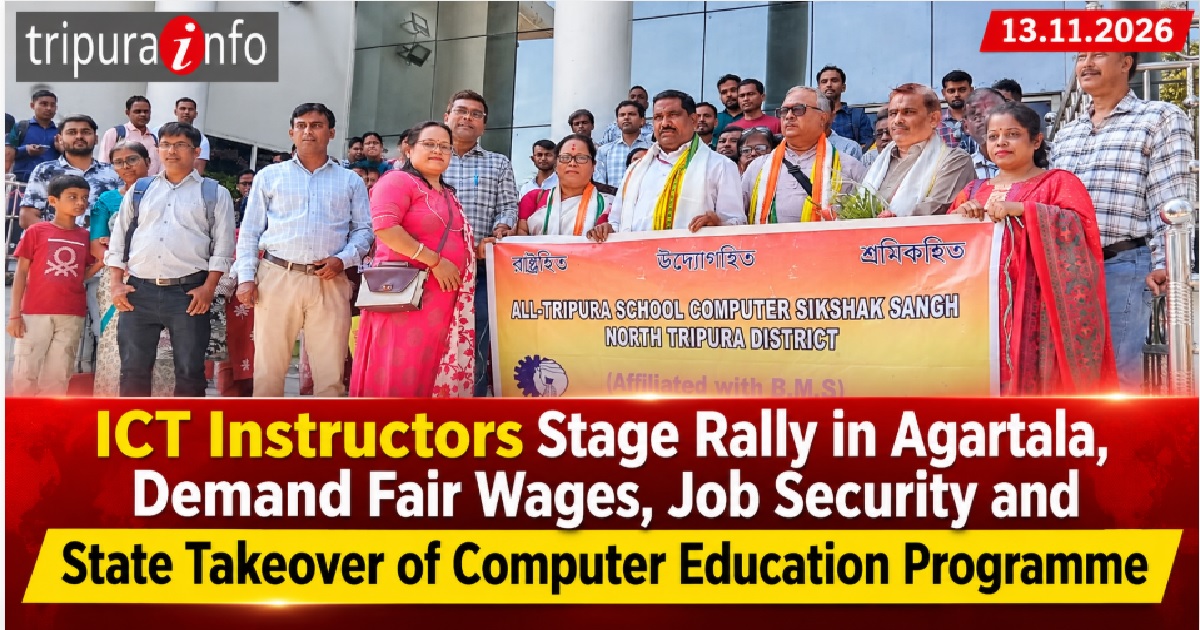 ICT (Information and Communication Technology) Instructors working under the ICT at Schools programme in Tripura staged a rally in Agartala and submitted a memorandum to Chief Minister Prof. (Dr.) Manik Saha, demanding fair remuneration, job security, social protection and comprehensive reforms in the delivery of computer education in government schools.
The rally and deputation were organised by the All Tripura School Computer Sikshak Sangha (ATSCSS), affiliated with the Bharatiya Mazdoor Sangh (BMS), with the cooperation of the central and state leadership of the labour organisation. Through the memorandum, the association appealed to the Chief Minister, who also heads the Education Department, to personally intervene in what it described as years of professional neglect, financial deprivation and administrative shortcomings affecting both ICT instructors and school students.
The memorandum, submitted under the signature of association General Secretary Subhankar Roy, raised serious questions about the present condition of computer education in government schools across Tripura. The association alleged that in a large number of schools, even the minimum infrastructure required to conduct meaningful ICT education has not been developed. According to the organisation, apart from approximately 10–15 per cent of schools where computer education is functioning, the programme in many institutions is operating with inadequate or makeshift facilities. It further alleged that the system has increasingly become a formality benefiting third-party implementing agencies rather than delivering meaningful computer literacy to students, particularly in remote and rural areas.
One of the most significant concerns raised in the memorandum relates to the discontinuation of computer education in 365 schools in March 2026. The association claimed that computer laboratories in these schools have remained unused since the programme was stopped, with equipment and laboratory facilities effectively reduced to storage spaces. Questioning the government's approach towards digital education, the instructors asked whether students in these 365 schools no longer require computer education. They also expressed concern over the future of instructors whose five-year engagement period has ended or is approaching completion, arguing that repeated project-based arrangements without a long-term government policy are creating uncertainty for both teachers and students.
The association also highlighted the financial condition of ICT instructors, alleging that they are being subjected to unfair employment conditions despite performing responsibilities beyond their primary teaching assignments. According to the memorandum, instructors are generally required to remain present in schools from 11:00 AM to 4:20 PM and are frequently assigned additional classes, clerical responsibilities and examination-related duties in accordance with their qualifications. However, the association claimed that the sanctioned monthly remuneration of Rs 10,000 is reduced to approximately Rs 8,000 after deductions towards EPF, ESIC and professional tax. It further alleged that payments are not always made on time, adding to the financial difficulties of instructors.
The organisation described the existing contractual arrangement as exploitative and alleged that third-party agencies exercise arbitrary control over instructors. It also claimed that when instructors approach official authorities with their grievances, they are often told that they are third-party employees and that the government has limited scope to intervene. At the same time, the association alleged that instructors are assigned various additional duties and sometimes face threats if they refuse to perform work beyond their designated responsibilities.
The memorandum argued that the absence of employment security has also affected the quality and continuity of computer education. According to the association, many instructors are compelled to seek alternative sources of income because they cannot depend on their ICT assignments for a stable future. This uncertainty, it maintained, ultimately affects students, as instructors cannot be expected to deliver quality education when their own professional and financial conditions remain insecure.
Moving beyond employment-related grievances, the association placed two major policy demands before the Chief Minister. Its first demand is to make computer education a mandatory subject in all government schools in Tripura, with examination marks included in students' merit lists. It also called for proper textbooks or guide materials to be provided to every student so that computer education becomes a structured academic subject rather than an occasional practical activity.
The second major demand is to bring ICT education under the direct management of the state government through Samagra Shiksha Abhiyan. The association has called for a minimum pay structure, employment security and systematic quality monitoring by the Education Department. It argued that the government should take responsibility for continuing and managing the programme after the completion of project-based arrangements instead of leaving schools and instructors dependent on successive third-party contracts.
The instructors also invoked the objectives of the National Education Policy (NEP) 2020, arguing that digital and technology-driven education is central to India's changing educational requirements. They questioned how the objectives of Digital India and the state's vision of 'Ek Tripura Shrestha Tripura' could be achieved when computer education remains inadequately implemented in government schools.
The memorandum further alleged that public funds allocated for ICT education are not producing the desired educational outcomes because of inadequate infrastructure, weak monitoring and the dominance of third-party implementing agencies. The association called for an evaluation of the existing system and greater accountability in the utilisation of public money.
In a strong expression of dissatisfaction, the association stated that its members would even be prepared to resign en masse if meaningful improvements were not introduced. However, it emphasised that its objective was not to abandon computer education but to secure genuine reforms, dignity for instructors and better learning opportunities for students.
The issues raised by the association also bring attention to the broader question of remuneration and financial arrangements under the Samagra Shiksha programme. The Samagra Shiksha Framework for Implementation 2022 provides for recurring expenditure towards ICT laboratories, including Rs 1.80 lakh annually per ICT lab under instructional expenses. However, this provision does not itself establish a fixed monthly salary for individual ICT instructors. Their actual remuneration and employment conditions therefore need to be examined against the applicable project agreements, tender conditions and contractual arrangements.
The association has urged the Chief Minister to initiate direct discussions with its representatives and take concrete administrative and policy decisions to address the grievances. Copies of the memorandum have also been marked to the Union Education Minister, the All India President and Secretary of the Bharatiya Mazdoor Sangh, and the Tripura Pradesh BMS leadership.
The latest rally has brought the condition of ICT instructors and the future of computer education in government schools back into public discussion.
more news...