Agartala Records AQI of 125, Air Quality Classified as ‘Poor’; PM2.5 Concentration Raises Health Concerns
By Our Correspondent
Agartala, November 13, 2026
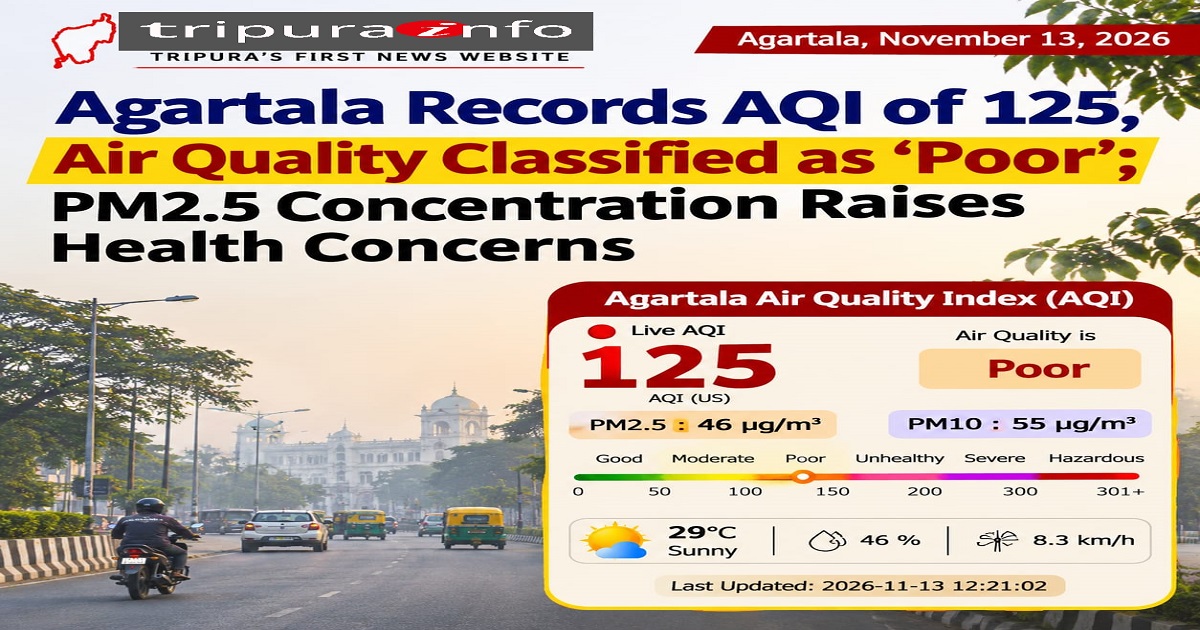 Air quality in Agartala has raised fresh concerns after a real-time air pollution report recorded an Air Quality Index (AQI) of 125 on Friday afternoon, with the air quality classified as 'Poor' under the US AQI scale displayed by the AQI.in website. The rising pollution reading has raised questions about the quality of air in the state capital and the need for regular monitoring and preventive measures to protect public health.
According to the latest reading, updated at 12:21 pm on November 13, PM2.5 concentration stood at 46 micrograms per cubic metre (µg/m³), while PM10 was recorded at 55 µg/m³. The temperature was around 29 degrees Celsius, with sunny weather, 46 per cent humidity and wind speed of 8.3 kilometres per hour.
The latest reading showed a slight increase in AQI from 123 to 125 within approximately one hour. The earlier reading, recorded at 11:21 am, showed PM2.5 at 44 µg/m³ and PM10 at 65 µg/m³. Thus, while PM2.5 increased slightly, PM10 concentration declined during the period. Although these are short-term readings and do not establish a long-term pollution trend, they indicate the importance of keeping a regular watch on Agartala's air quality.
The development is particularly noteworthy because Agartala is traditionally known for its greenery and relatively small urban area. Unlike major metropolitan cities, it does not have large-scale industrial activity across the city. Nevertheless, increasing vehicular movement, road dust, construction activities and other everyday activities can contribute to air pollution.
The Air Quality Index, commonly known as AQI, is a measurement that tells people how clean or polluted the air is. The higher the AQI number, the greater the level of pollution and the potential health risks. According to India's Central Pollution Control Board (CPCB), the official National AQI scale ranges from 0 to 500. An AQI between 0 and 50 is considered Good, 51–100 Satisfactory, 101–200 Moderate, 201–300 Poor, 301–400 Very Poor and 401–500 Severe. It is important to clarify that the AQI.in screenshot uses the US AQI scale, under which a reading of 125 falls in the Poor category. Under India's official classification, an AQI of 125 would fall in the Moderate category. The two systems have different classification limits.
PM2.5 and PM10 are two important forms of particulate pollution. PM2.5 consists of extremely small particles measuring 2.5 micrometres or less, which can enter deep into the lungs and potentially reach the bloodstream. PM10 refers to particles measuring up to 10 micrometres, commonly associated with road dust, construction activities and other airborne materials. The biggest concern about PM2.5 is that it cannot always be seen with the naked eye. Even when the sky looks clear, people may be breathing polluted air. Prolonged exposure can aggravate asthma, cause breathing difficulties and increase respiratory and cardiovascular health risks, particularly among children, elderly people and those with existing health conditions.
Air pollution is not limited to industrial cities. Even a relatively small city like Agartala can experience deteriorating air quality because of everyday human activities. Increasing numbers of cars, buses, trucks, auto-rickshaws and two-wheelers contribute to vehicle emissions. Traffic congestion at busy junctions and narrow roads can further increase exposure to exhaust fumes. Road dust from damaged roads, uncovered construction materials, roadside excavation and transportation of sand and cement without proper covering can increase the amount of dust suspended in the air. Construction and demolition activities, burning of garbage, plastic and dry leaves, and emissions from diesel generators and commercial establishments can also contribute to pollution. The exact contribution of these sources to Agartala's present AQI requires scientific assessment and regular monitoring.
Agartala still has an opportunity to prevent air pollution from becoming a major urban problem. The Agartala Municipal Corporation, Tripura State Pollution Control Board, Traffic Department and other concerned authorities need to work together on a practical clean-air action plan. Regular cleaning of roads, mechanical sweeping and controlled water sprinkling in dusty areas can help reduce road dust. Construction agencies and private builders should be instructed to cover sand, cement and other materials and follow proper dust-control measures. Open burning of garbage, plastic and dry leaves should be strictly prohibited, while the municipal corporation should ensure regular waste collection and proper disposal.
Traffic congestion should be reduced through better traffic management, proper parking arrangements and improved public transport. Vehicles should undergo regular pollution checks, while unnecessary use of private vehicles should be discouraged. Planting more trees along roads, in parks, around schools and in residential areas can help improve the urban environment. Equally important is protecting existing trees and green spaces from unnecessary destruction.
The authorities should also establish and maintain reliable air quality monitoring stations at important locations in Agartala. Regular AQI reports should be made available to the public so that residents can understand pollution levels in different parts of the city and appropriate action can be taken whenever required. Schools, colleges, market associations, local clubs and voluntary organisations can also organise awareness programmes to encourage environmentally responsible behaviour.
Controlling air pollution cannot be the responsibility of the government alone. Citizens should avoid burning household garbage and dry leaves, maintain their vehicles properly, use public transport whenever possible and keep roadsides and residential surroundings clean. Children, elderly people and those suffering from asthma or heart and lung diseases should take additional precautions when pollution levels increase.
Agartala's development should not be measured only by new roads, buildings, streetlights, flyovers and other infrastructure. Clean air, clean water, green spaces, proper drainage and scientific waste management are equally important indicators of a modern and smart city.
more news...