Despite Ashish Saha and Jitendra Chaudhury’s Desire for Unity, Opposition Fails to Unite Against BJP: Exposes Leadership Crisis?
By Our Correspondent
Agartala, November 11, 2026
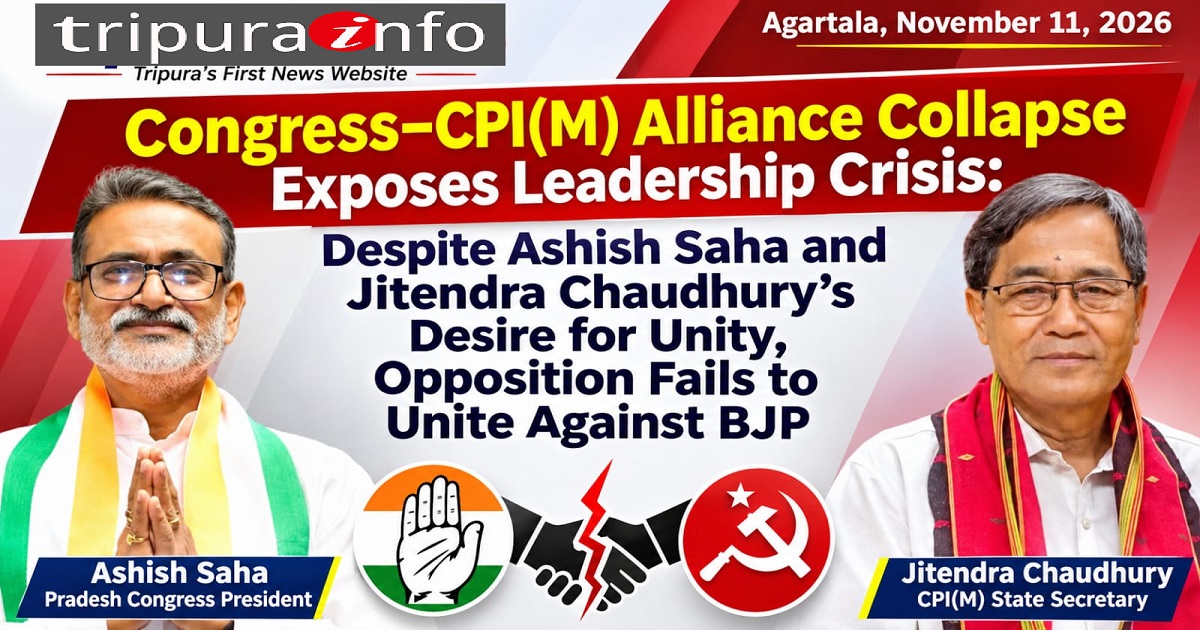 The failure of the Congress and CPI(M) to forge a united opposition alliance for the Tripura municipal elections has triggered fresh political questions over the authority, influence and organisational control of the two parties' state leaderships. Despite apparent willingness and expressions of disappointment from both Pradesh Congress President Ashish Kumar Saha and CPI(M) State Secretary Jitendra Chaudhury over the failure to reach an electoral understanding, the proposed broader anti-BJP alliance ultimately failed to take shape.
The developments have raised an uncomfortable question within the opposition camp: if both state-level leaders genuinely wanted an understanding to prevent the division of anti-BJP votes, why could they not persuade their respective party organisations to reach an agreement? Does the failure indicate that the two state leaders lack sufficient authority over their own party structures, or that internal resistance and competing political interests have become stronger than their leadership's stated position?
The issue has assumed particular significance ahead of the municipal elections, where a united opposition could potentially have consolidated votes against the ruling BJP. Instead, the failure of negotiations has left Congress and CPI(M) to pursue their electoral strategies separately, creating the possibility of a division of anti-BJP votes.
Ashish Kumar Saha reportedly expressed his disappointment over the failure of the alliance, maintaining that an understanding between the opposition parties would have been beneficial. His position suggests that the possibility of a joint electoral arrangement was not something he had dismissed outright. However, despite such sentiments, the Congress leadership could not translate the proposed understanding into a concrete political agreement.
On the other hand, CPI(M) State Secretary Jitendra Chaudhury has also expressed dissatisfaction over the failure to establish a broader opposition alliance. In his public remarks, he maintained that there was no lack of sincerity on the CPI(M)'s part and that the principal objective was to defeat the BJP. He also indicated that the CPI(M) had taken initiatives to create an appropriate atmosphere for opposition unity and had been willing to work towards a joint electoral understanding.
In another statement, Jitendra Chaudhury reportedly attributed responsibility for the collapse of the proposed alliance to the Congress. He indicated that despite efforts and discussions, the expected understanding could not be achieved. The CPI(M) leadership's position has therefore placed the responsibility for the breakdown of negotiations largely on its Congress counterpart.
The contrasting political narratives emerging from the two parties have, however, exposed a deeper organisational problem. If Ashish Saha believed that an alliance would have been beneficial and Jitendra Chaudhury also wanted opposition unity to defeat the BJP, the obvious question is why their respective political organisations failed to follow the wishes of their own state presidents and secretaries.
Were there powerful sections within the Congress and CPI(M) unwilling to accept an alliance? Did local-level political calculations, candidate selection and differences over seat-sharing override the decisions or preferences of the state leaderships? Or were the two leaders unable to exercise sufficient influence over their respective party organisations to make the proposed arrangement possible?
These questions are particularly relevant because the proposed understanding was not merely about sharing a few municipal seats. It was politically connected with the larger objective of preventing anti-BJP votes from being divided among Congress, CPI(M) and other opposition forces.
The failure also raises questions about the credibility of the opposition's collective strategy. When the leaders publicly speak about the necessity of unity but their parties cannot reach even a basic electoral understanding, voters are naturally left wondering whether the opposition has a coherent political strategy to challenge the ruling party.
more news...