Despite Five FIRs Cited in Financial Irregularity Proceedings Against IAS Officer Abhishek Chandra, Tripura High Court Rejects ED's Plea to Vacate Stay
By Our Correspondent
Agartala, November 11, 2026
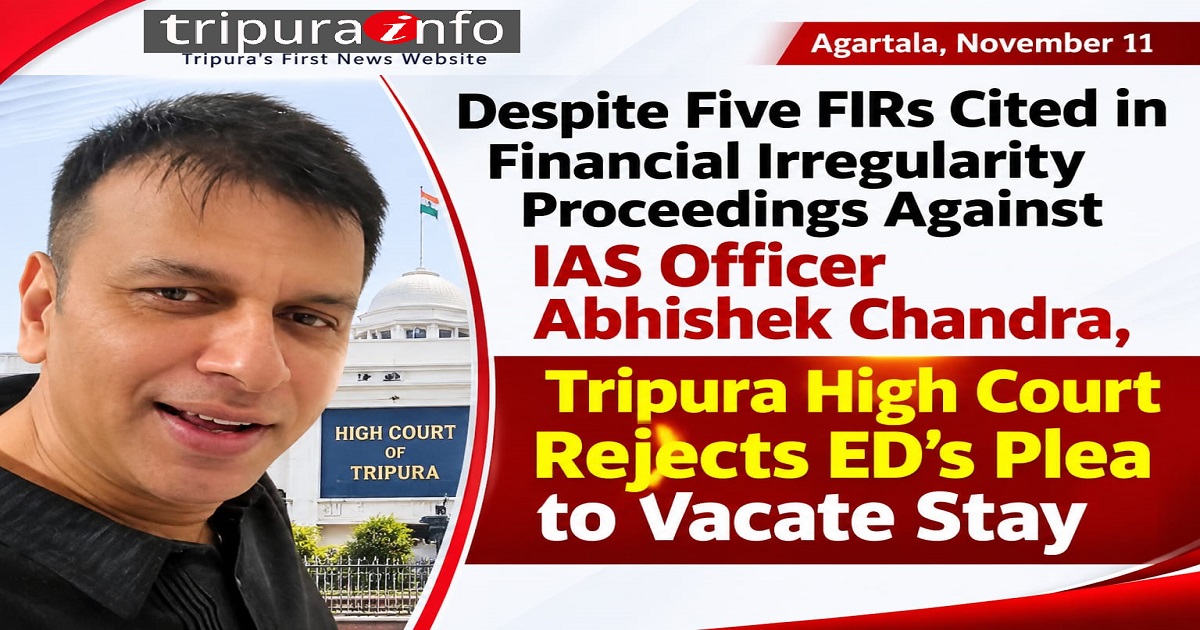 Despite the Enforcement Directorate (ED) relying on five separate FIRs in connection with its proceedings involving allegations of financial irregularities against senior IAS officer Abhishek Chandra, the Tripura High Court on Tuesday rejected the agency's plea seeking withdrawal of an interim stay on its provisional attachment proceedings. A Division Bench comprising Justice Dr. T. Amarnath Goud and Justice Biswajit Palit ruled that the statutory compliance issues raised by the officer's defence, particularly under Section 5(5) of the Prevention of Money Laundering Act (PMLA), required detailed judicial examination before the interim protection could be withdrawn.
The High Court dismissed IA No. 02 of 2026, filed by the Union of India and the Directorate of Enforcement, and ordered that the interim protection granted to Abhishek Chandra on September 16, 2026, against the ED proceedings initiated on July 31, 2026, would continue until the final disposal of his writ petition. The Bench also made the interim stay absolute.
The judgment is significant because the ED had strongly contested the maintainability of Chandra's writ petition, arguing that he should exhaust the alternative statutory remedies available under the PMLA instead of directly approaching the High Court under Article 226 of the Constitution.
Representing the Union Government and the ED, Deputy Solicitor General of India B. Majumder argued that the provisional attachment proceedings initiated against Abhishek Chandra could not ordinarily be challenged through a writ petition when an effective statutory mechanism was available under the PMLA. He submitted that the officer should first approach the Adjudicating Authority and thereafter pursue the appellate remedy under Section 26 of the Act, followed by a further appeal before the High Court under Section 42.
The ED also pointed out that the provisional attachment order was valid for 180 days from July 31, 2026, and argued that the statutory period would expire in the coming months. The agency sought vacation or recall of the High Court's September 16 interim order, which had suspended the impugned proceedings.
To strengthen its arguments, the ED relied on the Supreme Court's judgments in P. Chidambaram vs. Directorate of Enforcement (2019) and Vijay Madanlal Choudhary vs. Union of India (2022). It also cited an August 12, 2026, judgment of the Chhattisgarh High Court concerning the availability of statutory remedies against provisional attachment orders under the PMLA.
However, counsel appearing for Abhishek Chandra, Mr. Navin Kumar, strongly opposed the ED's application and argued that the existence of an alternative remedy did not automatically prevent the High Court from exercising its constitutional jurisdiction. Relying on the Supreme Court's judgment in Whirlpool Corporation vs. Registrar of Trade Marks, Mumbai (1998), he submitted that a writ petition could be entertained where there were questions concerning jurisdiction, violation of natural justice or non-compliance with mandatory legal provisions.
A major contention raised by Chandra's defence was that although the ED relied upon five separate FIRs in its proceedings, his name did not appear in any of those FIRs and, according to his counsel, there were no allegations against him in any of them. His lawyer also questioned whether the Deputy Director of the ED had complied with the mandatory requirements of Section 5 of the PMLA while initiating the provisional attachment proceedings.
The defence specifically argued that the legality of the attachment proceedings required scrutiny in view of the statutory safeguards prescribed under the Act. Counsel maintained that the ED could not proceed merely on assumptions and was required to demonstrate compliance with the relevant statutory conditions.
The Division Bench examined the rival submissions and the relevant provisions of Section 5 of the PMLA. The judges particularly focused on the statutory requirements governing provisional attachment and the obligation under Section 5(5) concerning the filing of a complaint before the Adjudicating Authority within 30 days of attachment.
In paragraph 9 of its judgment, the High Court specifically observed that the impugned order under challenge was required to be tested for compliance with Section 5(5) of the PMLA. The Bench also took note of the defence submission that the five FIRs relied upon by the ED did not name Abhishek Chandra or contain allegations against him.
The Court further noted that the ED's counsel had confined his arguments to the application seeking vacation of the interim stay, although a counter-affidavit had been filed in the main case. The Bench observed that the legal issues involved required examination on their entirety and could not be conclusively addressed merely while deciding the application for withdrawal of interim protection.
In paragraph 12, the judges recorded that the grievances raised by the petitioner, considered alongside the provisions of Section 5(5) of the PMLA, required detailed examination. The Court also found that the balance of convenience favoured the writ petitioner and that the matter needed to be decided finally on all issues.
Accordingly, the Division Bench rejected the ED's application and directed that the interim order dated September 16, 2026, suspending the proceedings initiated by the respondents on July 31, 2026, would continue to remain in force pending disposal of the writ petition. The Court expressly made the stay absolute.
The judgment was delivered on November 10, 2026, following a hearing on October 14. The Union of India and the Directorate of Enforcement were represented by Deputy SGI B. Majumder, while Abhishek Chandra was represented by advocates Navin Kumar, K. Roy, U. Sankar Singha, D. Chakraborty and Sumana Debbarma.
The judgment does not record any separate submission or independent response by the Tripura Government in this particular interlocutory proceeding. The applicants were the Union of India and the Directorate of Enforcement.
The High Court has directed that the connected main writ petition, WP(Crl.) No. 14 of 2026, be listed as part-heard along with WP(Crl.) No. 11 of 2026 on November 24, 2026.
more news...