BMS-Affiliated Teachers Organisation Alleges Massive Irregularities in Tripura’s Multi-Crore ICT-at-Schools Project, Computer Teachers Claim Salary Exploitation
By Our Correspondent
Agartala, November 10, 2026
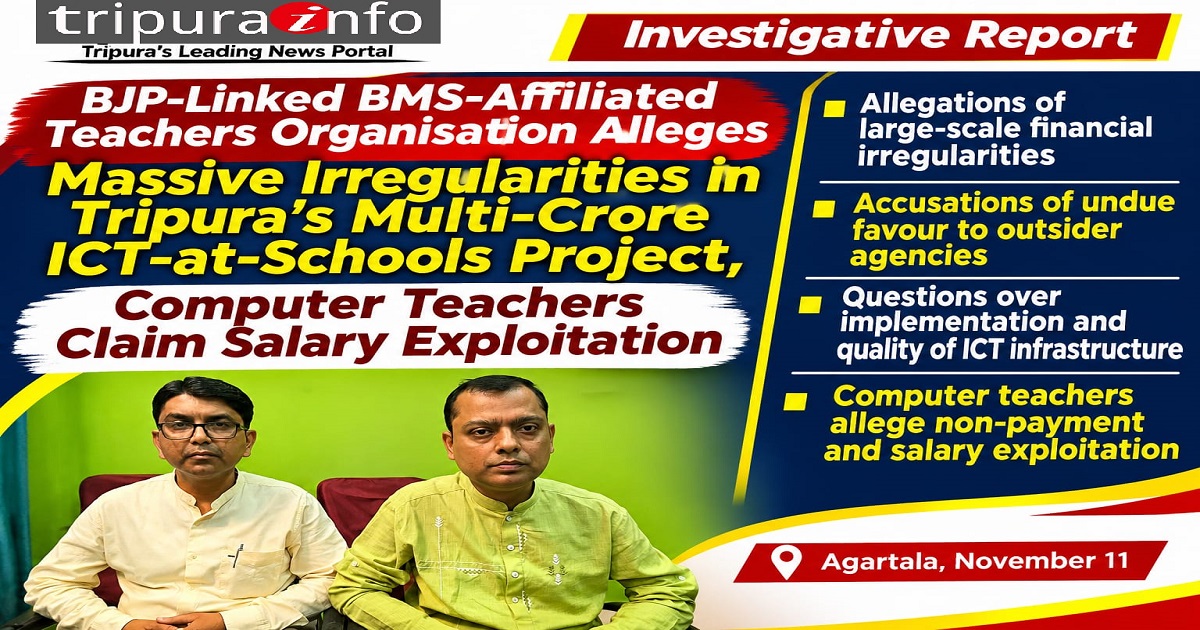 Serious allegations of financial irregularities, and exploitation of computer instructors have surfaced in Tripura’s multi-crore Information and Communication Technology (ICT) at Schools project, implemented under the Samagra Shiksha programme of the State Education Department. The allegations have assumed particular significance because they have been raised by representatives of a workers’ organisation affiliated with the Bharatiya Mazdoor Sangh (BMS), the labour wing associated with the BJP.
In an explosive disclosure on the Tripurainfo Investigative Podcast, aired on November 7, 2026, Chandan Sutradhar, Deputy Office Secretary of the Thikashramik Sangha, and Bhavatosh Chakraborty, Secretary of the ICT at Schools Schemes Computer Teachers Organisation, alleged that the implementation of the project has been marked by serious lapses in tender transparency, contractual compliance, salary payments and monitoring of educational infrastructure.
The two representatives alleged that the tendering process for the ICT at Schools project did not adequately follow the original guidelines of the Central Government. According to them, the tender conditions were framed in such a manner that local agencies in Tripura found it extremely difficult to participate, while companies from outside the State managed to secure opportunities to execute the project.
They also questioned whether the agencies entrusted with the implementation of the programme were fulfilling their contractual obligations towards computer instructors and other employees, particularly regarding salaries and statutory benefits.
One of the most significant aspects of the allegations concerns the salary structure mentioned on page 29 of the tender document. During the podcast, Bhavatosh Chakraborty and Chandan Sutradhar produced a copy of the relevant page, claiming that it establishes the minimum monthly remuneration provisions for different categories of personnel engaged in the project covering 400 schools.
According to the document presented by them, the prescribed monthly salary ranges were as follows:
State Project Officer: Rs 40,000–60,000.
District Coordinators: Rs 20,000–25,000.
Trainers/Instructors: Rs 15,000–22,000.
However, Bhavatosh Chakraborty, who himself works as an ICT instructor, claimed that his appointment letter mentions a monthly salary of only Rs 10,000. After various deductions, he reportedly receives approximately Rs 8,300 in hand.
This has raised a fundamental question: If the tender document provides for monthly remuneration of Rs 15,000–22,000 for trainers and instructors, why are some computer teachers reportedly receiving only Rs 10,000 before deductions?
The organisation wants the Education Department to clarify how much money is allocated for each instructor, how much is actually transferred to the implementing agency and how much ultimately reaches the employees. It has also demanded verification of whether the agencies are complying with the financial conditions of the tender.
Another important provision mentioned on page 29 of the tender document relates to Performance Link Variable Pay (PLVP). As per the document presented during the podcast, 10 per cent of the employees' salary is to be retained as performance-linked variable pay and released every three months, subject to quality assessment and evaluation by the Project Management Committee.
However, the representatives alleged that this provision is not being implemented properly and that the concerned employees have not received the benefits stipulated under the tender conditions.
The tender also reportedly requires the implementing agency to pay all employees by the 7th day of the following month. The organisation alleged that this condition is routinely violated and that computer instructors frequently face delays in receiving their monthly salaries.
The workers' representatives have further raised questions over the actual provision of statutory employment benefits, including Provident Fund (PF), Employees' State Insurance (ESI/ESIC), bonus, maternity benefits and other applicable social security entitlements.
They alleged that despite the employees working continuously in government schools under a government-sponsored educational programme, there is considerable uncertainty regarding their employment security and statutory entitlements.
The tender conditions reportedly clarify that any dispute between the implementing agency and its recruited employees would not be the responsibility of the Directorate of Secondary Education (DSE). The employees would also not be entitled to claim government employment merely because they are working in government schools under the project, and the State Government would not assume direct contractual liability towards them.
This arrangement has raised a larger question about accountability. When a government department entrusts an important educational programme to private agencies, who will ensure that the workers receive the salaries and benefits stipulated in the contract?
The allegations are not confined to salary-related issues. The representatives also questioned the monitoring and maintenance of computer laboratories and the actual delivery of ICT education in government schools.
According to the responsibilities outlined in the tender document, the implementing agency is expected to undertake several important activities, including project management, infrastructure maintenance, training, performance monitoring and compliance with the Service Level Agreement (SLA).
The Responsibility Matrix reportedly identifies 23 major activities. In most cases, the private bidder has been assigned the responsibility and accountability (R/A), while the Directorate of Secondary Education has been placed in the consulted (C) category.
However, the representatives alleged that effective monitoring by the implementing companies is largely absent. They claimed that computers in several schools have become non-functional and that there is no effective mechanism for ensuring timely repairs and maintenance.
The tender reportedly provides for a dedicated help desk to register complaints, monitor service-related problems and ensure their resolution. However, the instructors alleged that they are unaware of any functioning help desk through which they can report technical problems and obtain assistance.
Questions have also been raised about whether computer classes are being conducted regularly in all schools, whether students are receiving the prescribed training and whether schoolteachers are being trained as required under the programme.
The instructors alleged that in several schools, computer teachers are sometimes compelled to take classes in the absence of regular subject teachers. They further claimed that neither the Education Department nor the outsourced agencies are maintaining adequate supervision to ensure that the prescribed academic activities are being conducted properly.
The tendering process and the original implementation of the project also bring the role of the then political and administrative leadership under scrutiny.
At the time when the relevant tender process was undertaken, Biplab Kumar Deb was the Chief Minister of Tripura, Ratan Lal Nath was the Education Minister, IAS officer Soumya Gupta was the Secretary of the Education Department, and NC Sharma was the Director of Education.
The allegations have consequently raised questions about the decisions taken during that period, the framing of tender conditions and the selection of implementing agencies.
The original tender records, evaluation documents, financial transactions, contractual agreements and official explanations will need to be examined to establish whether any irregularities actually occurred.
The computer instructors' organisation has also been seeking intervention from the present Education Department administration.
According to the representatives, the current Education Department Secretary, Milind Ramteke, has already met and interacted with the computer teachers during a deputation programme.
However, the organisation wants a detailed discussion with Director of Secondary Education Sumit Roy Chowdhury to place before him the issues relating to salary discrepancies, contractual obligations, delayed payments, statutory benefits and the deteriorating condition of computer infrastructure in schools.
The representatives alleged that despite their attempts to meet the Director and explain the problems in detail, they have not been able to secure a meeting with him.
The prolonged uncertainty, combined with alleged low salaries and the absence of adequate employment benefits, has reportedly intensified dissatisfaction among computer instructors. The organisation indicated that the teachers may be compelled to launch a stronger agitation if their grievances remain unresolved.
more news...