Pollution Control Board Under Fire for Alleged Failure to Enforce Environmental Norms During Durga Puja, Diwali: Government Events Too Accused of Violations
By Our Correspondent
Agartala, November 9, 2026
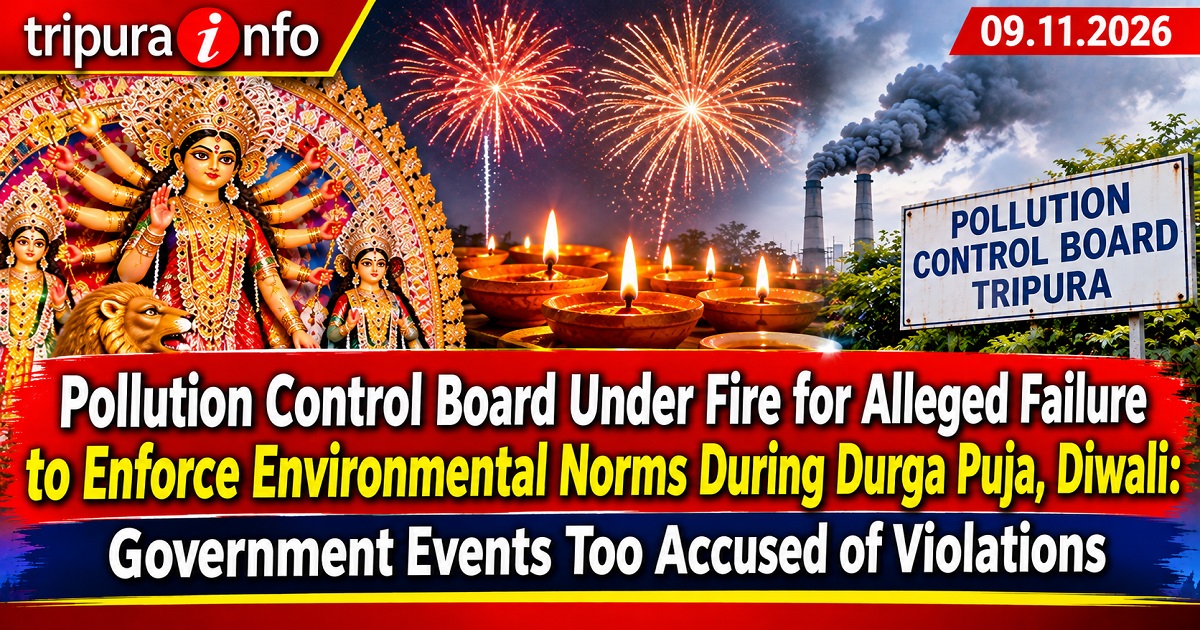 The alleged failure of the Tripura State Pollution Control Board to enforce its own environmental guidelines during the recent Puja and Diwali celebrations has triggered serious questions about the functioning of the regulatory body and the government's commitment to controlling pollution in the state.
Despite issuing official advisories restricting the use of firecrackers, DJ sound systems and plastic or flex-based decorative materials, the Pollution Control Board's visible enforcement activities appeared largely absent during several major celebrations. More significantly, allegations have emerged that government-sponsored events themselves witnessed violations of the very guidelines issued by the authorities.
On Sunday, November 8, massive firecracker celebrations reportedly took place at Mata Tripureswari Temple in Udaipur and at the AD Nagar Police Lines in Agartala, allegedly with government support and participation. This has raised questions about how the government expects ordinary citizens to follow environmental restrictions when official events themselves are accused of disregarding them.
The Pollution Control Board had earlier issued an advisory discouraging the bursting of firecrackers to prevent air and noise pollution. However, the celebrations at these prominent government locations have raised questions about whether the advisory was effectively monitored or enforced.
The controversy is not limited to firecrackers. The Pollution Control Board had also issued instructions against the use of DJ sound systems to control noise pollution. Chief Minister Dr Manik Saha had also appealed for responsible celebrations and the avoidance of excessive noise.
However, during the Durga Puja immersion carnival, DJ music was reportedly played during idol processions even in the presence of the Chief Minister. This has raised questions about the seriousness with which environmental guidelines are being followed by government departments and event organisers.
If restrictions are applicable to ordinary citizens and private organisers, why should government-sponsored celebrations be treated differently?
Another major concern relates to the use of plastic and flex materials for decorative purposes.
The Pollution Control Board had reportedly issued an advisory discouraging plastic and flex-based decorations in view of their environmental impact. Nevertheless, during the Puja celebrations, thousands of flex banners bearing photographs of political leaders and ministers were seen in front of various pandals and at public locations.
The situation has triggered criticism over the apparent contradiction between official environmental advisories and the practices followed by political leaders and organisers.
Environmental responsibility should begin with those holding public office. When elected representatives and government authorities are expected to set examples for society, their alleged disregard for environmental guidelines sends an unfortunate message to the public.
The most important question is whether the Tripura State Pollution Control Board conducted any meaningful monitoring during the Puja and Diwali celebrations.
Did officials conduct field inspections to measure ambient noise levels and air pollution during the celebrations? Were sound-level meters deployed at major public gatherings? Were air-quality monitoring instruments used near the locations where large-scale firecracker celebrations took place?
Did senior officials of the Pollution Control Board visit the affected locations in groups to inspect and test the operational condition and effectiveness of pollution-monitoring machines?
more news...