Justice BV Nagarathna’s Remarks on Govt. Jobs Trigger Debate: Tripura Government Faces Questions Over Low-Paid Contractual Jobs
By Our Correspondent
Agartala, November 8, 2026
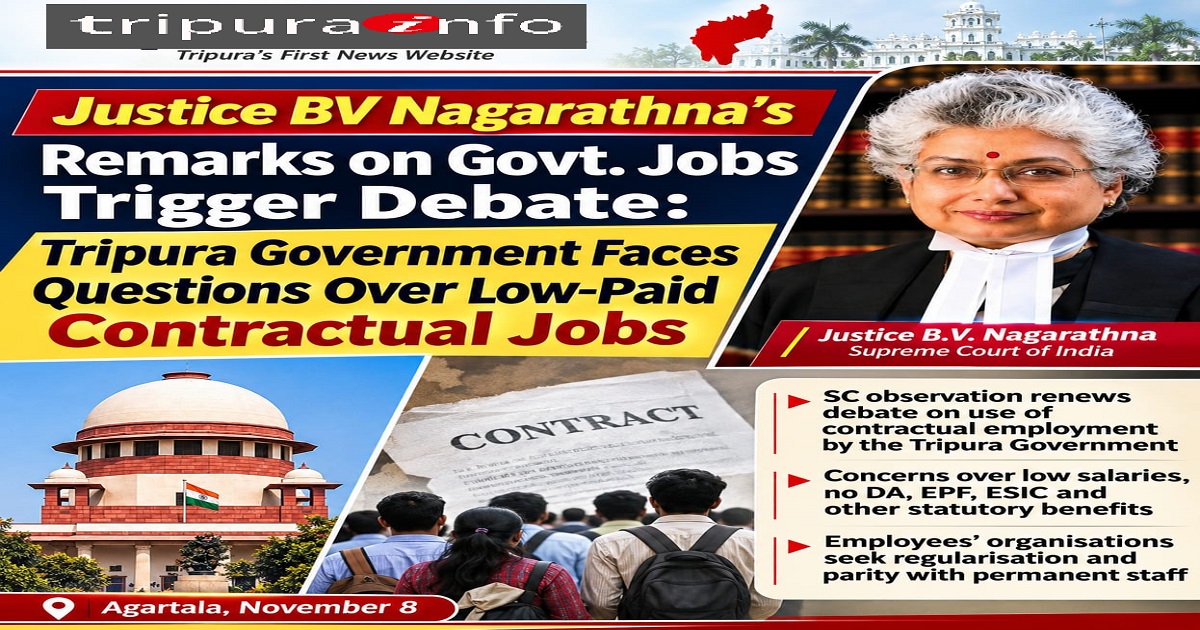 The recent observations of Supreme Court Justice BV Nagarathna regarding the accountability, productivity and privileges of government employees have triggered a nationwide debate over the future structure of government employment. Her remarks have particular relevance for Tripura, where the State Government has increasingly relied on contractual, fixed-pay and outsourced appointments to fill vacancies in various government departments and institutions.
However, the debate in Tripura raises an important question that deserves equal attention: while the Supreme Court judge has questioned the accountability of permanent government employees and suggested contractual recruitment as a possible way to improve performance, what about the accountability of governments that recruit young and qualified candidates on contractual terms but allegedly pay them less than half the remuneration of comparable regular employees, without providing adequate employment security or statutory benefits?
The issue is not simply whether government employees should be permanent or contractual. It is whether the government is fulfilling its responsibilities as an employer and ensuring fair wages, social security, dignity and protection for people working in government establishments.
The observations were made on November 5 during a Supreme Court hearing involving the Punjab Government's failure to pay Dearness Allowance to government employees. A bench comprising Justice BV Nagarathna and Justice R. Mahadevan was examining the dispute. Justice Nagarathna questioned the privileges enjoyed by government servants, including DA, allowances and pension, and raised concerns about administrative inefficiency, red-tapism and the absence of accountability.
She reportedly suggested that government servants should henceforth be recruited on a contractual basis so that their performance and accountability could be ensured. She also questioned why government employees who were expected to work sincerely and efficiently were generating so much litigation across the country.
It is important, however, to distinguish between a judicial observation and a binding judgment. These were oral remarks made during a hearing, not a Supreme Court ruling directing governments to replace permanent employees with contractual workers. The proceedings also resulted in a stay on contempt proceedings against the Punjab Chief Secretary.
In Tripura, the remarks have opened up an equally important debate about the State Government's own recruitment policies. Over the past several years, various departments, government societies, missions, projects and institutions have increasingly engaged employees on fixed-pay, contractual and outsourced arrangements. Even when recruitment takes place through public advertisements and competitive selection procedures, successful candidates often find themselves employed without the service conditions enjoyed by regular government employees.
Tripura has a large number of educated unemployed youths, including graduates, postgraduates, engineers, technical professionals and other qualified candidates. For many of them, a contractual government appointment is not necessarily a matter of choice but an economic compulsion in the absence of adequate permanent employment opportunities.
The central grievance is that in many contractual engagements, employees are reportedly paid less than half of what comparable regular employees receive for similar responsibilities. In several cases, they also claim that there are no meaningful additional allowances, special incentives, pensionary benefits or adequate social-security arrangements. Such disparities become particularly serious when contractual employees are required to perform essentially the same duties, work the same hours and shoulder comparable responsibilities.
more news...