Tripura Government Moves to Merge More Low-Enrolment Schools in TTAADC Areas, Hundreds More May Face Merger
By Our Correspondent
Agartala, November 7, 2026
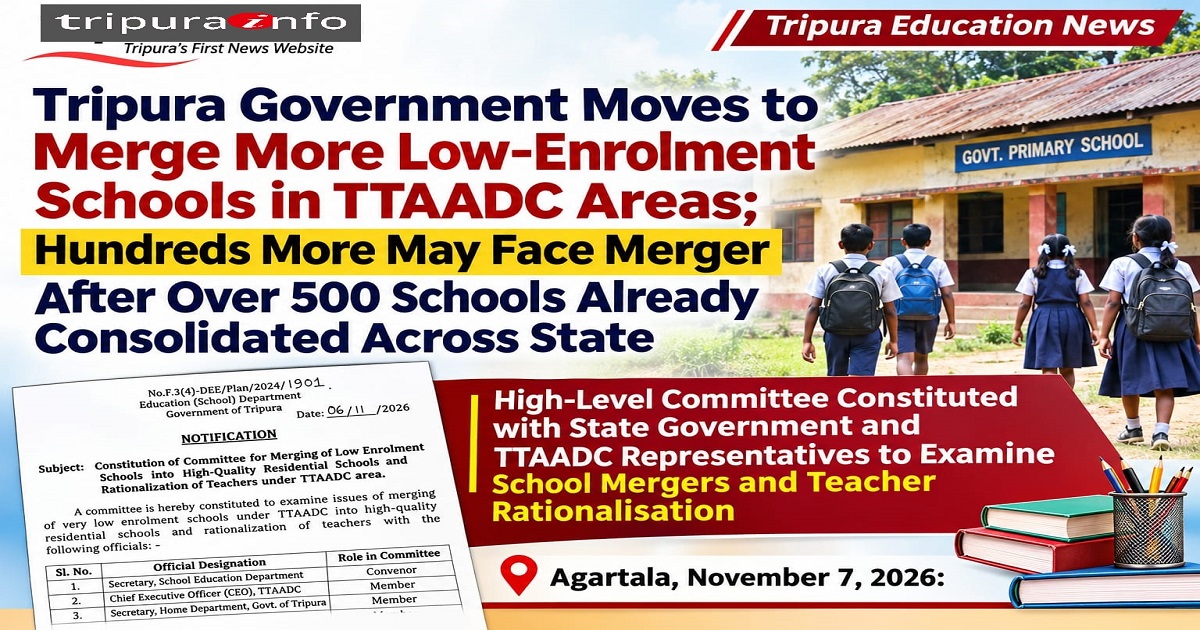 The Tripura Government has initiated another major exercise to restructure the school education system in the Tripura Tribal Areas Autonomous District Council (TTAADC) region by constituting a high-level committee to examine the merger of very low-enrolment schools into high-quality residential schools and rationalisation of teachers.
The latest notification, issued by the Education (School) Department, Government of Tripura, on November 6, 2026, signals the possibility of another round of school mergers in the state. The move has assumed significance as more than 500 schools have reportedly already been merged or consolidated across Tripura in previous exercises. Under the latest initiative, hundreds of additional schools with very low student enrolment could potentially face merger, depending on the committee's recommendations.
According to the official notification bearing No. F.3(4)-DEE/Plan/2024/1901, the committee has been constituted specifically to examine issues relating to the merger of very low-enrolment schools under TTAADC into high-quality residential schools, along with the rationalisation of teaching staff.
The Secretary of the School Education Department will serve as the Convener of the committee, while the Chief Executive Officer (CEO) of TTAADC will be a member. Other members include the Secretary of the Home Department, Director of Elementary Education, Director of SCERT, Additional CEO (Education), TTAADC, and Principal Officer (Education), TTAADC.
The composition of the committee indicates that the proposed restructuring will involve coordination between the state government's Education and Home Departments and the autonomous district council's education administration.
The government's stated objective is to consolidate schools with very low enrolment and develop high-quality residential educational institutions. However, the proposed exercise also raises important questions about the future of small schools in remote tribal and hilly areas, where geographical distance, difficult transportation and scattered settlements often make access to education particularly challenging.
The proposed merger of schools could have significant implications for students, parents, teachers and local communities. While the government may argue that consolidation will improve infrastructure, classroom facilities, teacher availability and the overall quality of education, parents and community representatives may be concerned about the distance students will have to travel to attend schools after the merger.
Another major aspect of the initiative is teacher rationalisation. The committee will examine the deployment of teachers in relation to student enrolment and institutional requirements. This could lead to the redistribution of teaching staff from schools with very low enrolment to institutions with higher student strength.
The latest notification does not specify the number of schools proposed for merger, the criteria for identifying low-enrolment institutions, the timeline for completing the exercise or the number of teachers likely to be affected. It also does not clarify whether all affected schools will be merged into residential institutions or whether alternative arrangements will be considered for students living in particularly remote locations.
The proposed exercise comes against the backdrop of the earlier consolidation of more than 500 schools across Tripura. If the latest committee recommends another large-scale merger programme, the state's school education map, particularly in the TTAADC areas, could undergo further changes.
The crucial question now is whether the proposed restructuring will genuinely improve educational standards and learning outcomes or create additional difficulties for children living in remote tribal villages.
The committee's recommendations are therefore likely to attract considerable attention from teachers' organisations, tribal representatives, parents and other stakeholders, particularly regarding accessibility, transportation, residential facilities and the protection of educational opportunities for children in remote areas.
more news...