At Last, BMS Raises the Demand for ‘Jobs for Local Residents’ in Tripura, Calls for Priority to Local Companies and Startups
By Our Correspondent
Agartala, November 7, 2026
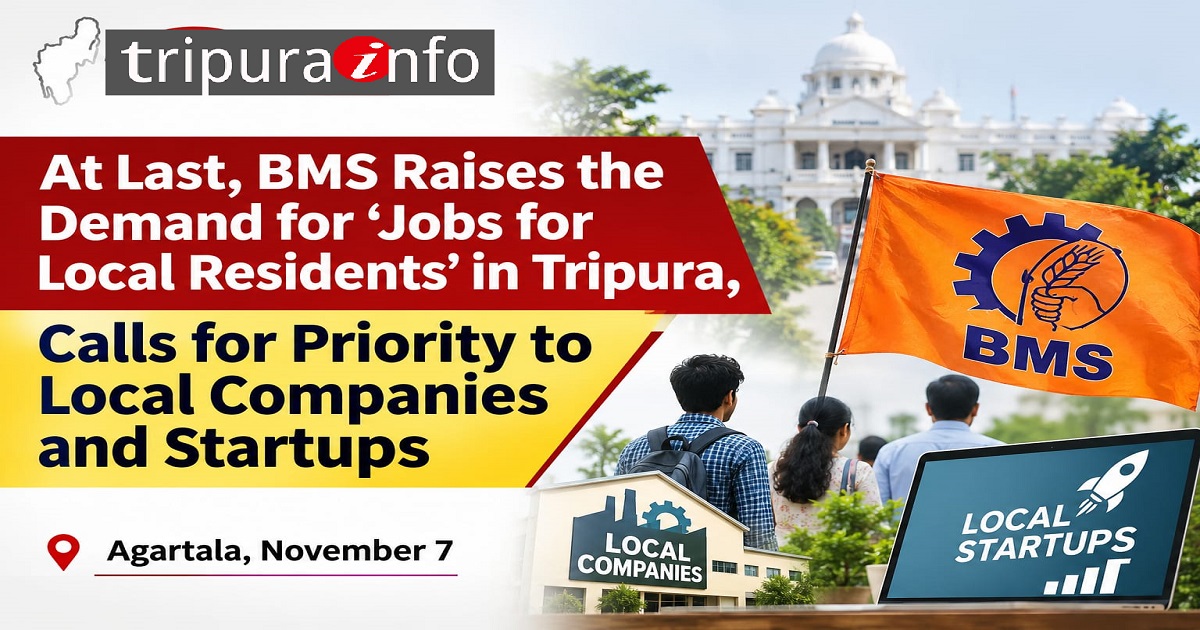 The demand for prioritising local residents in government and private-sector employment in Tripura has now found expression in a proposal from the Theka Mazdoor Sangh (BMS), Tripura Pradesh, associated with the Bharatiya Mazdoor Sangh (BMS), an RSS-affiliated trade union organisation.
The proposal for establishing the Tripura Kaushal Rozgar Nigam Limited (TKRNL) puts forward an employment framework that seeks to give preference to Tripura residents in contractual jobs, particularly experienced candidates from the district where vacancies arise.
The significance of the proposal lies in its emphasis on local employment opportunities and reducing dependence on outside manpower intermediaries. It also brings into focus the wider demand for creating a more supportive environment for Tripura-based companies, entrepreneurs and startups so that local businesses can participate more actively in employment generation and economic development.
Under the proposed framework, candidates already working or previously employed in similar positions in Tripura Government departments or organisations would receive first preference, with priority determined by their length of experience. If suitable candidates are unavailable in the concerned district, experienced candidates from other districts of Tripura would be considered. Only after these categories are exhausted would other eligible candidates be considered through a merit-based selection process.
The proposal makes Tripura citizenship a mandatory condition for the job categories listed in its three annexures, covering positions ranging from security guards, electricians, meter readers, cleaners and drivers to office assistants, data entry operators, computer instructors and other technical personnel.
The proposed Nigam would introduce a centralised online recruitment system, replacing the existing dependence on separate private manpower agencies for contractual recruitment in government departments. Job advertisements, candidate registration, merit lists and deployment would be managed through a dedicated online portal. If suitable candidates are unavailable among registered applicants, recruitment advertisements would have to be published online news portal and in at least two prominent local newspapers, one in English and another in Bengali.
Another important aspect of the proposal is its provision for private-sector participation. The proposed Nigam may also consider manpower requirements from private organisations on mutually agreed terms. This could provide an opportunity for local enterprises and businesses to access manpower services through a structured system.
The proposal submitted to state laber Minister also seeks to protect existing contractual employees by providing opportunities for their continuation or redeployment, subject to eligibility, departmental recommendations and Finance Department approval. It envisages minimum wage protection, EPF and ESI contributions wherever applicable, medical and life insurance, maternity benefits, casual and medical leave and other social security provisions.
However, appointments under the proposed framework would remain contractual, generally for an initial period of up to one year, with the possibility of extension subject to prescribed conditions. The proposal specifically states that contractual deployment would not create any automatic right to regularisation. The proposed recruitment age limit is 18 to 45 years, while deployment beyond 60 years would not be permitted.
The proposal submitted to state laber Minister, dated September 21, 2026, was prepared by Chandan Sutradhar, Deputy Office Secretary of Bharatiya Mazdoor Sangh, Tripura Pradesh, and Deputy Prabhari of Theka Mazdoor Sangh, Tripura Pradesh.
The initiative raises an important policy question for the Tripura Government: whether employment opportunities generated within the state should give greater priority to qualified local residents and whether local companies, entrepreneurs and startups can be given a stronger role in the state's economic development and job creation.
more news...