Tripura’s Gas Power Plants Face Supply Challenges, ONGC Acknowledges Gas Supply Hurdle, Solar Energy in Focus
By Our Correspondent
Agartala, November 5, 2026
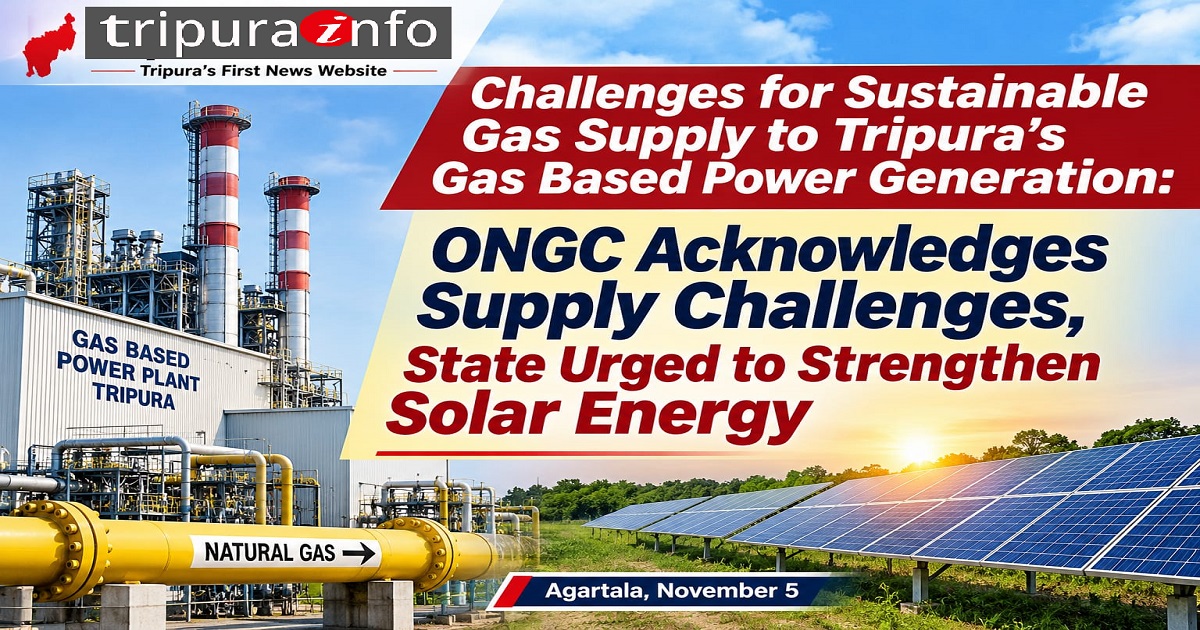 Gas based power plants have been the backbone of economic growth and development for Tripura. Since the first gas-based power plant set up by TSECL at Baramura in 1986, there was no looking back. With the commissioning of OTPC Palatana and NEEPCO, Monarchak in 2014 and 2015, Tripura became a power surplus state, exporting power to its neighbouring states and Bangladesh.
The natural gas required for generation of power is produced and supplied by ONGC from gas fields of Tripura.
Of late Tripura’s declining production from ageing gas fields are emerging as a major challenge for the state’s energy security, raising concerns about the long-term sustainability of its gas-based power generation infrastructure.
Several older gas wells across Tripura are no longer producing at their earlier levels, while declining reservoir pressure and ageing/mature fields and stringent statutory regulations have increasingly constrained gas extraction. There are indications that the availability of fuel for major gas-based power plants, including OTPC Palatana, NEEPCO Monarchak,TSECL Rokhia, Baramura and NEEPCO RC Nagar, may be heading towards major challenges.
The challenges have also been acknowledged by ONGC’s Tripura Asset Manager. While acknowledging the challenges associated with gas production, he has indicated that the situation requires sustained efforts to maintain supplies and meet the state’s growing energy demand. He expressed optimism that through continued success in exploration, the production decline from mature fields has been arrested and gas production is looking up. He emphasized that concerted efforts are being made for fast-track monetization of new discoveries in South Tulamura and North Baramura which falls in forest area, also upcoming IGGL gas trunk line will further help in monetising the Khubal field. ROU process for connecting these discoveries to the existing surface infrastructure has been initiated. Production from these new areas will further boost the gas production and aid in sustaining the production.
With active support from state authorities, ONGC continues to pursue new gas discoveries by expanding its exploration efforts into remote forest areas and challenging terrain.Support from regulatory bodies has helped expedite statutory wildlife, forest and environmental clearances, as well as land acquisition for drilling operations.
Further support would help accelerate the monetisation of the state’s untapped gas potential.
The company has been pursuing new drilling projects, deploying advanced rigs and adopting cluster drilling techniques at existing well sites. By utilising established infrastructure and previously acquired land, cluster drilling can help reduce the time and costs associated with land acquisition and obtaining fresh clearances.
The sustainability of natural gas has become a significant concern for Tripura’s power sector. The Palatana power plant,
operated by ONGC Tripura Power Company (OTPC), has a total installed capacity of 726.6 MW but has reportedly operated substantially below capacity because of inadequate gas availability.
Other gas-based power plants across the state are also dependent on reliable supplies from ONGC. Although the ONGC Asset Manager has not accepted that all plants are facing a severe shortage, he has acknowledged certain supply-related
difficulties.
The situation has raised concerns about the state's ability to meet increasing electricity demand through gas-based generation alone, particularly as older reservoirs continue to decline.
Recognising the limitations of conventional gas-based generation, the Tripura government has been urged to accelerate the development of solar energy and diversify its power generation portfolio.
Solar power could help reduce dependence on declining domestic gas reserves, improve energy security and provide an additional source of electricity during periods of gas supply constraints.
Tripura’s proposed integration with the Indradhanush Gas Grid Limited (IGGL) network could also help strengthen regional gas connectivity and provide greater flexibility in meeting future fuel requirements.
The emerging situation highlights the need for a comprehensive energy strategy combining fresh exploration, improved production efficiency, regional gas connectivity and accelerated renewable energy development to ensure a stable and sustainable power supply for Tripura.
more news...