After Class III English paper sparked controversy, Class IV half-yearly examination faces similar criticism over difficult questions
By Our Correspondent
Agartala, November 5, 2026
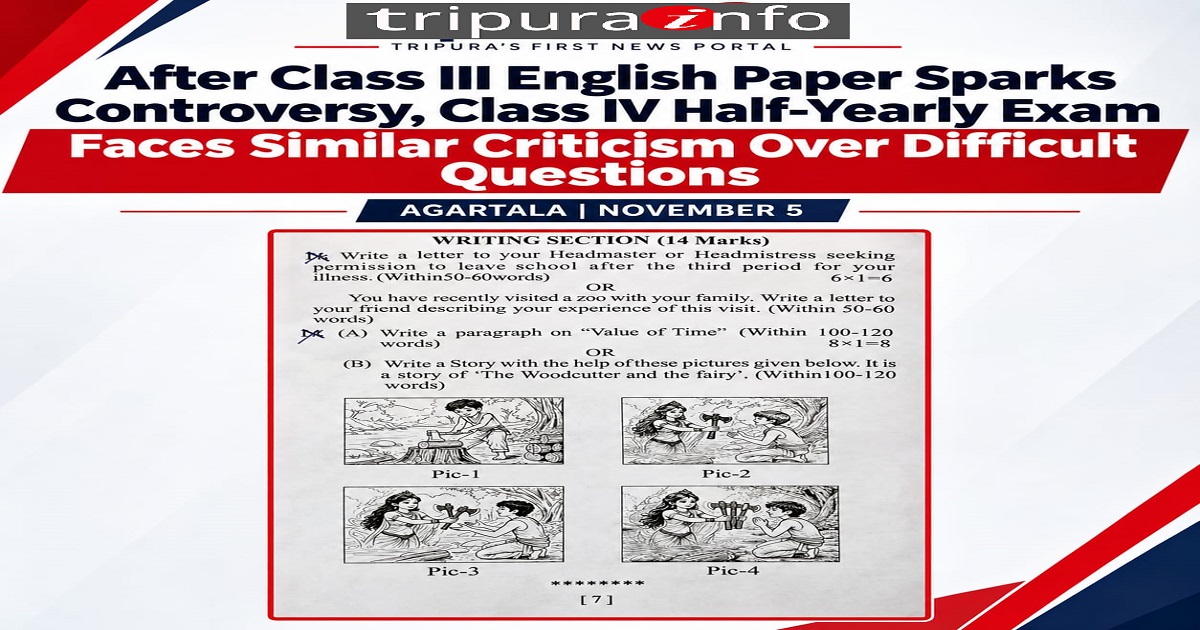 The growing controversy over the difficulty of English examination papers for primary school students in Tripura has intensified, with parents and students expressing widespread dissatisfaction over what they describe as excessively challenging questions for young learners.
Following concerns over the Class III English examination, the Class IV half-yearly English paper in Tripura has now triggered similar criticism, raising serious questions about the Education Department's approach to primary-level assessment, syllabus compliance and the actual learning conditions in Tripura’s government schools.
Parents allege that both examinations placed unreasonable demands on young students, many of whom are still developing basic English language skills. They argue that the questions failed to adequately consider the age, learning capacity and classroom preparation of children, particularly those studying in rural schools where qualified English teachers are reportedly unavailable in several institutions.
The Class III English question paper had already drawn criticism for allegedly containing questions that were too difficult for students of that age group. The Class IV examination has now added to the concerns, with parents questioning why the same problems appear to be recurring across consecutive primary classes.
The Class IV controversy centres on the inclusion of letter-writing questions and picture-based story writing in the half-yearly examination. According to the official 2026–27 term-wise examination guidelines, the prescribed half-yearly writing component included an unseen paragraph based on hints and material covered in Periodic Test-I. Informal letter writing and picture-based story writing were listed under the annual examination syllabus.
However, the half-yearly question paper reportedly required students to write letters of 50–60 words and a story of 100–120 words. Parents have questioned why these tasks were included when they were not explicitly listed in the prescribed half-yearly writing syllabus.
The picture-based story question has also attracted criticism because the illustrations were reportedly printed in black and white, making them difficult for some young students to interpret.
The critical questions are mounting: Why were primary students repeatedly confronted with difficult English questions beyond their expected learning levels? Were the Class III and Class IV question papers properly reviewed before the examinations? Were students adequately taught the writing formats required in the papers? How can rural students be expected to compete fairly when their schools reportedly lack English teachers? And who will take responsibility if children lose marks because of questions they were not adequately prepared to answer?
Parents say the issue is not opposition to academic standards or challenging students to learn. Rather, they are demanding examinations that reflect the prescribed syllabus, the children's developmental stage and the quality of instruction actually available in their schools.
The concerns come amid wider allegations of administrative shortcomings in Tripura’s government schools, including delayed textbook distribution, irregular classroom teaching, teacher absenteeism, postponed examinations and delays in evaluating answer scripts. In Khowai district, parents have reportedly complained that evaluated PT-I answer scripts were not made available for inspection.
The repeated controversies have prompted calls for the Education Department to review its question-paper preparation and examination practices, ensure that teachers are adequately deployed and provide students with timely textbooks and regular classroom instruction.
more news...