“Education Revolution” Under Question: Class III English Exam Paper Raises Concerns Over Age-Appropriate Learning
By Our Correspondent
Agartala, November 4, 2026
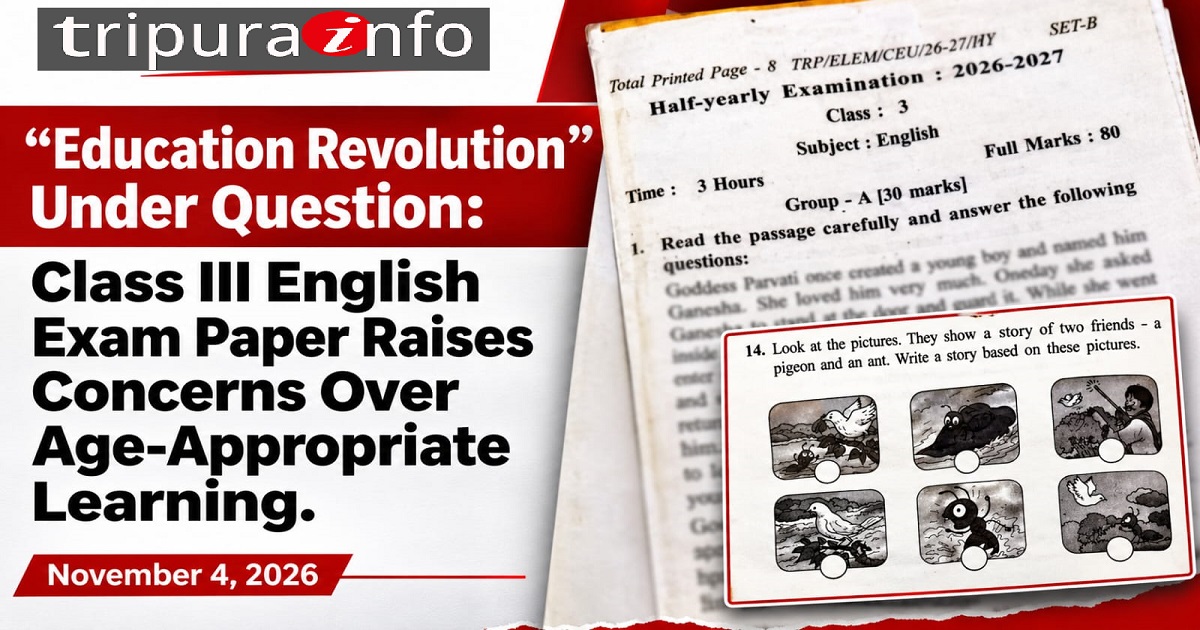 A Class III English half-yearly examination question paper for the 2026–27 Tripura’s academic session has sparked concerns over the difficulty level of questions and their suitability for young learners, particularly students studying in rural schools across Tripura.
The controversy centres on whether the examination paper adequately considers the age, reading ability, comprehension skills and developmental level of children who are encountering written examinations for the first time in their school journey.
In Tripura, students generally do not face formal written examinations in Classes I and II. Class III therefore becomes an important transition point, as children begin answering questions in writing. Against this backdrop, the English question paper has raised questions about whether the academic expectations placed on these young learners are reasonable.
The paper, carrying 80 marks and allowing three hours, includes lengthy reading passages, multiple-choice questions, comprehension exercises, grammar, creative writing and letter-writing tasks. While such exercises may be intended to strengthen language skills, critics argue that the overall complexity could overwhelm many Class III students, especially those from rural schools with limited access to additional learning support.
Lengthy Passages and Demanding Comprehension Questions
One of the most striking features of the paper is a lengthy passage narrating the story of Lord Ganesha's creation, his encounter with Lord Shiva and his revival with an elephant's head. Students are expected to read the passage carefully and answer questions based on its contents.
For a child in Class III, the passage raises a fundamental question: is the reading material appropriate for the expected reading fluency and comprehension level of an eight- or nine-year-old student?
The paper also contains extracts from poems and prose, requiring students to identify the source, interpret meanings, find opposites and answer questions involving details from the text. In one section, students must answer questions in 20–30 words, a task that can be particularly demanding for children who are still developing basic sentence-writing skills.
Letter Writing and Creative Writing Under Scrutiny
The examination asks students to write a letter to a friend inviting them to a Sunday picnic, or alternatively, a letter to an elder brother describing the school's Annual Sports event.
Other writing tasks include composing a story based on six pictures depicting a pigeon and an ant, or writing ten lines on either a favourite game or favourite food.
Although creative writing is an important part of language learning, the question is whether the combined workload and complexity are proportionate to the abilities of students at this stage.
Some Questions That Have Raised Concerns
The following examples from the question paper illustrate the level of comprehension and writing expected from Class III students:
- Reading and answering questions about a lengthy mythological passage involving Goddess Parvati, Lord Shiva and Lord Ganesha.
- Answering questions based on a poem, including identifying its title, interpreting vocabulary and recalling specific details.
- Writing answers in 20–30 words about sharing crayons, outdoor games and how children can complete a pack of crayons.
- Writing a formal-style letter to a friend inviting them to a picnic or describing an Annual Sports event.
- Composing a story from a sequence of six pictures and writing ten lines on a favourite game or food.
- Matching nouns, pronouns, verbs, adverbs, adjectives and prepositions with appropriate examples.
These questions may be manageable for some students with strong reading and writing skills, but educators and parents may reasonably question whether they are accessible to the entire Class III student population, particularly children in rural and under-resourced schools.
Questions for Those Who Prepared the Paper
The controversy has prompted a broader discussion about the purpose of primary education and the responsibilities of those who prepare examination papers.
Were the age and mental development of Class III students considered while designing the paper? Were the passages tested for readability and suitability for children who are only beginning to write answers independently? Does the examination assess foundational English skills, or does it place excessive emphasis on lengthy reading and written responses?
There is also a pointed question about the quality and appropriateness of the examination design itself: are the paper setters applying the same standards they would expect from young learners when preparing basic school-related writing tasks?
Education Should Build Confidence, Not Fear
The criticism is not directed against meaningful assessment or the need to improve English proficiency. Rather, it highlights the importance of ensuring that examinations measure what children have been taught and what they are developmentally ready to demonstrate.
For many rural students, the transition to written examinations is already challenging. An excessively difficult paper can undermine confidence, discourage learning and widen the gap between children who have access to additional educational support and those who do not.
The larger question is whether the current approach reflects the spirit of child-centred education.
Education should not mean imposing unnecessary pressure on young children. A genuine education revolution must begin with age-appropriate teaching, accessible questions and learning that builds confidence, curiosity and understanding.
more news...