Tripura Woman Farmer Represents State at Mumbai Dialogue, Showcasing Women-Led Agriculture and Rural Entrepreneurship
By Our Correspondent
Agartala, October 28, 2026
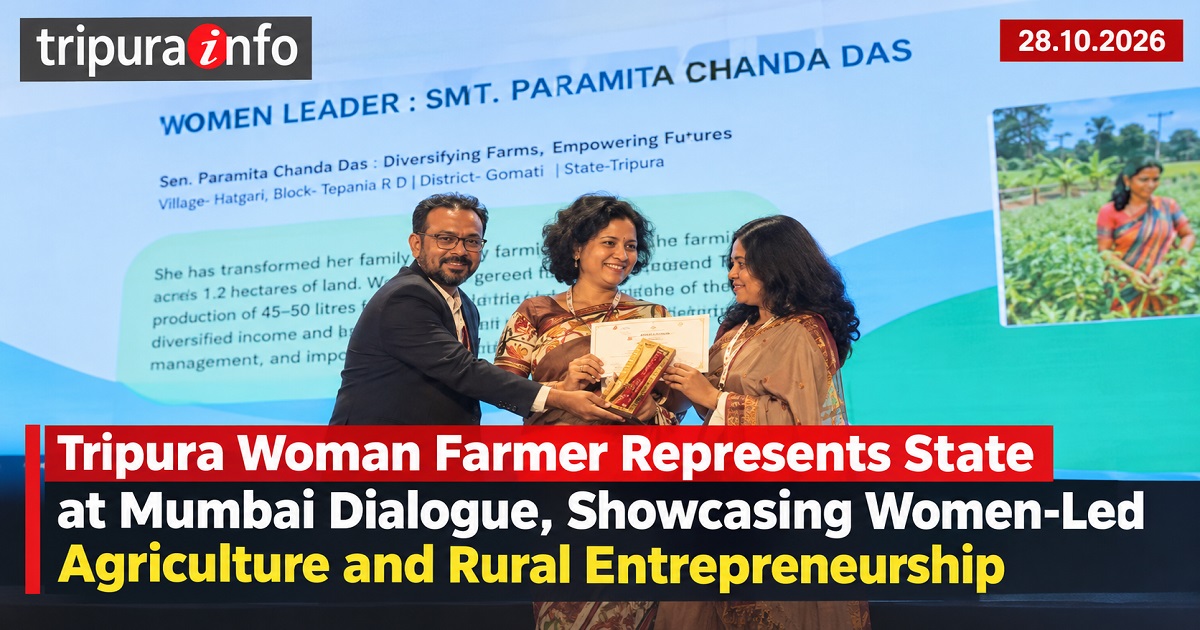 Bringing recognition to Tripura’s women farmers on a national platform, Paromita Chanda Das, a shareholder of Bagma Agri Producer Company Limited (BAPCL), represented the state at the Dialogue on Women Leaders for Sustainable Agriculture in India, held in Mumbai on October 28, on the occasion of the International Year of the Woman Farmer. Her participation highlighted the growing contribution of women to agricultural entrepreneurship, diversified farming and inclusive rural development, while underscoring the role of BAPCL and the National Bank for Agriculture and Rural Development (NABARD) in strengthening women-led agricultural initiatives.
The dialogue was organised at the Novotel Hotel near Mumbai International Airport under the Indo-German Development Cooperation Project, “Soil Matters – Innovations for Soil Health and Agroecology,” in collaboration with NABARD and Mahila Arthik Vikas Mahamandal (MAVIM), with implementation support from the Deutsche Gesellschaft für Internationale Zusammenarbeit (GIZ).
Parmita Chanda Das is actively engaged in multiple agricultural and allied activities, including crop cultivation, floriculture, fisheries, dairy farming and the operation of a milk collection centre. Her diversified involvement demonstrates how integrated farming can create additional income opportunities, strengthen household livelihoods and reduce dependence on a single agricultural activity. Her experience also reflects the potential of rural women to emerge as entrepreneurs and decision-makers within the agricultural economy.
As a shareholder of NABARD-supported BAPCL, her participation provided an opportunity to bring the experiences and aspirations of Tripura’s farming communities to a wider national audience. Farmer producer organisations such as BAPCL can help smallholders strengthen collective action, improve access to markets and institutional services, and develop commercially viable agricultural enterprises.
The inaugural session featured introductory remarks by Navin Vivek Horo of GIZ, a special address by Minhaj Ameen, Chief Executive Officer of CAT, and an inaugural address by Loken Das, Chief General Manager of NABARD’s FSDD department. Rajlakshmi Shah, Managing Director of MAVIM, delivered the keynote address. Sayantika Majumder also attended the programme.
A major highlight was the felicitation of women leaders who have made significant contributions to agriculture and rural livelihoods. During the panel discussion, “Hear the Leaders,” women farmers and agricultural leaders shared their experiences, innovations and challenges. Discussions focused on women-led enterprises, market access, agricultural knowledge, financial independence, food security and nutrition.
Another session explored innovative approaches to gender integration in agriculture, emphasising institutional support, stronger market linkages, access to productive resources and sustainable farming practices. The deliberations reinforced the importance of recognising women not merely as agricultural workers but as entrepreneurs, innovators and leaders of rural transformation.
For Tripura, the initiative carries particular significance. Women contribute substantially to crop production, floriculture, livestock rearing, fisheries and agricultural marketing across the state’s rural communities. Better access to finance, technology, training and organised markets can help them increase farm incomes and create employment opportunities.
In this context, BAPCL’s role in promoting collective farming and agricultural entrepreneurship, alongside NABARD’s institutional support, can contribute to more inclusive and resilient rural development.
Parmita Chanda Das’s participation in the Mumbai dialogue is an encouraging example of Tripura’s women farmers gaining national recognition. Her journey highlights how diversified farming, collective enterprise and institutional collaboration can empower rural women and strengthen the agricultural economy.
more news...