Former Tripura Principal Secretary of Law Datamohan Jamatia: Rape Cannot Be Settled Through Monetary Penalty, Customary Law Must Respect Fundamental Rights
By Our Correspondent
Agartala, October 27, 2026
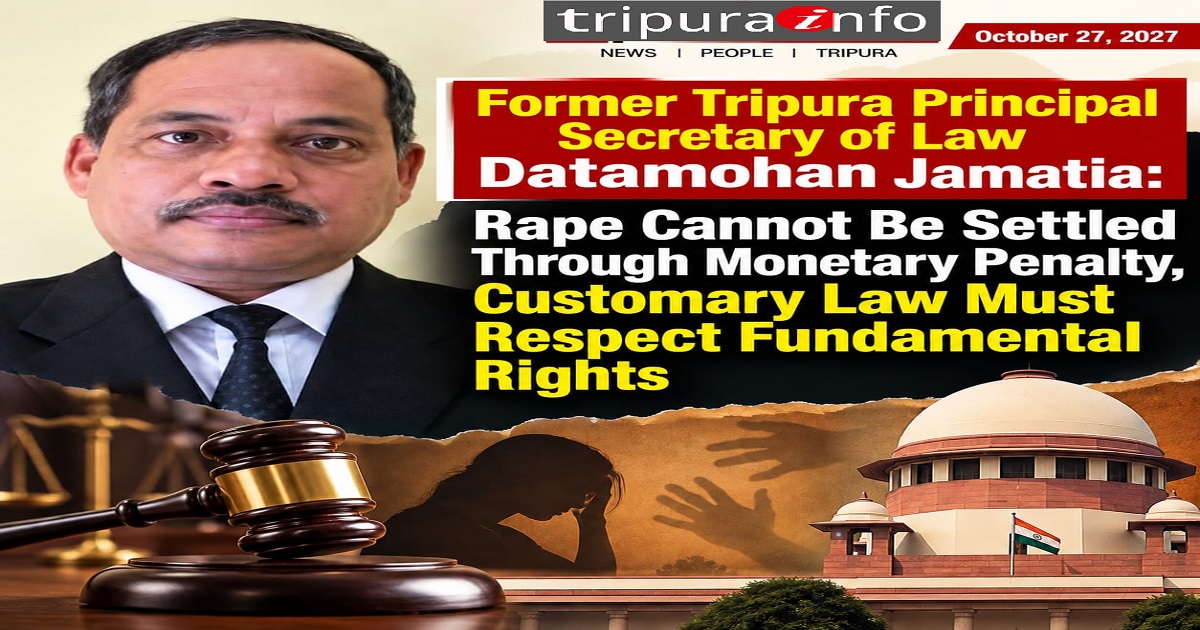 Former Tripura's Principal Secretary of Law Department Data Mohan Jamatia has clarified that rape is a heinous criminal offence that cannot be dealt with merely by imposing a monetary penalty. Reacting to the controversy surrounding Section 143 of the Jamatia Customary Laws Act, 2017, he said that any customary practice infringing upon the fundamental rights of citizens cannot survive constitutional scrutiny under Article 13 of the Constitution of India.
His clarification assumes significance as the constitutional validity of provisions of the Jamatia Customary Laws Act, 2017, has come under the scrutiny of the Supreme Court following a Public Interest Litigation (PIL) challenging the law's treatment of offences involving women. The controversy has also brought renewed attention to Tripurainfo.com’s earlier investigative reporting and published articles examining the legal and constitutional implications of the customary law.
In 2017, when the Tripura Government enacted the Jamatia Customary Laws Act with the assent of then Governor Tathagata Roy, Datamohan Jamatia was serving as the Principal Secretary of the Law Department, Government of Tripura. At present, he also serves as the Chief Legal Advisor to the Jamatia Hoda, the traditional socio-cultural body of the Jamatia community in Tripura.
According to Data Mohan Jamatia, rape is a grave offence under criminal law, punishable with severe imprisonment and, in certain cases prescribed by law, the death penalty. It cannot be treated as an offence for which justice may be delivered simply by imposing a financial penalty.
He emphasised that Article 13 of the Constitution establishes the supremacy of fundamental rights over inconsistent laws and customs. A customary rule that violates constitutionally guaranteed rights cannot claim immunity merely because it forms part of a traditional community practice.
However, he also drew attention to the specific wording and structure of the Jamatia Customary Laws Act, 2017, arguing that Section 143 must be read together with Sections 164 and 167 rather than interpreted in isolation.
Section 143 of the Act states that a person may be subjected to financial punishment for the enticement and rape of a woman, referring to Sections 164 and 167 of the legislation.
This provision has generated questions about whether its wording permits a serious offence such as rape to be resolved through a financial penalty under the customary justice system.
Data Mohan Jamatia maintained that the provision must be interpreted in the context of the Act's other sections. According to his explanation, the references to Sections 164 and 167 make it clear that rape cases are not triable by the traditional Okras or Panchais.
The distinction is important: the appearance of the word “rape” in Section 143 does not, by itself, establish that traditional customary authorities have jurisdiction to conduct a rape trial or replace the criminal justice process with a monetary settlement.
The former Law Secretary further referred to Section 154 of the Act, which, according to his interpretation, limits the criminal cases that may be tried by the Jamatia Hoda to those that are compoundable—that is, offences legally capable of being settled between the parties under the applicable law.
Rape is a serious criminal offence that is not compoundable merely through an agreement or compromise between the accused and the victim. Therefore, he argued, the question of imposing a fine as a substitute for criminal prosecution and punishment does not arise.
His explanation highlights the need to distinguish between a customary institution's authority to resolve certain disputes and the jurisdiction of the regular criminal justice system over serious offences.
The precise scope and constitutional validity of the relevant provisions, however, remain matters for judicial consideration.
The issue has assumed national legal significance following the reported issuance of notice by the Supreme Court to the Tripura Government and the Tripura Tribal Areas Autonomous District Council (TTAADC) in connection with the challenge by Advocate Madhumita Bhattacharjee to the Jamatia Customary Laws Act, 2017.
With the matter now before the country's highest court, Data Mohan Jamatia said that the State Government and the TTAADC would have to submit their responses and clarify the legal position before the Court.
He expressed the view that, once the provisions are properly explained and their relationship with the relevant sections of the Act is clarified, the Supreme Court would be able to appreciate the precise legal issue involved.
The proceedings will provide an opportunity for the constitutional questions surrounding the Act to be examined in light of the submissions of the parties and the applicable law.
Tripurainfo.com’s earlier reporting and published articles on the Jamatia Customary Laws Act, 2017, are an important part of the public discussion surrounding the issue. The portal had examined the implications of the customary law, particularly the questions arising from provisions relating to women, sexual offences, financial penalties and access to justice.
The issue was also addressed in an article written by the petitioner, Advocate Madhumita Bhattacharjee, before the matter reached the present stage of Supreme Court scrutiny. Subsequent investigative reporting by a Tripurainfo.com correspondent further examined the law and raised questions about its compatibility with constitutional protections and the criminal justice system.
The present judicial proceedings have brought these questions into sharper focus. The constitutional validity of the relevant provisions will ultimately be determined by the Supreme Court on the basis of the pleadings, the statutory text and the arguments advanced before it.
The controversy raises a broader question about the relationship between customary law and constitutional guarantees. Respect for community traditions and customary institutions must operate within the framework of the Constitution and applicable criminal law.
No customary mechanism can lawfully replace the prescribed criminal justice process for a non-compoundable offence such as rape. Nor can a financial settlement, by itself, substitute for investigation, prosecution and punishment under the applicable law.
As the Supreme Court examines the challenge, the responses of the Tripura Government and the TTAADC will be significant in clarifying the intended scope of the disputed provisions.
The central issue is not merely the wording of Section 143, but whether the Act, properly interpreted and applied, remains consistent with the fundamental rights of women and the constitutional framework governing criminal justice in India.
more news...