SC Seeks Responses from Tripura Govt. and TTAADC on PIL Challenging Jamatia Customary Law, Tripurainfos Reporting Brings Constitutional Questions into Focus
By Our Correspondent
Agartala, October 26, 2026
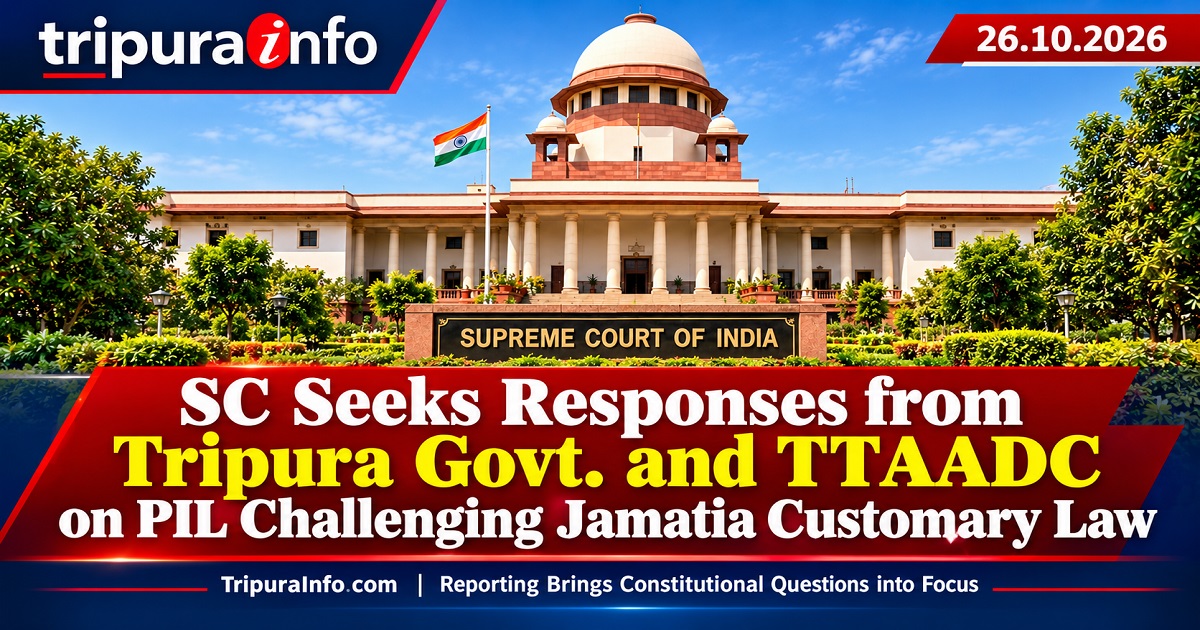 The Supreme Court of India has sought responses from the Tripura Government and the Tripura Tribal Areas Autonomous District Council (TTAADC) on a Public Interest Litigation (PIL) challenging the constitutional validity of Section 143 of the Jamatia Customary Laws Act, 2017, which deals with financial punishment for the enticement and rape of a woman.
The development has brought renewed attention to an issue that had earlier been raised through legal analysis and news reporting published by Tripurainfo.com, Tripura’s first and most reputed news portal. The controversy concerns whether a provision in a codified customary law can permit financial punishment in cases involving serious sexual offences and, if so, whether such a provision is consistent with constitutional safeguards and the national criminal justice framework.
According to the sequence of events described in the petition papers and related Tripurainfos reporting, the issue was first highlighted in an article written by the petitioner of this case, Advocate Madhumita Bhattacharjee, which subsequently raised legal and constitutional questions concerning the disputed provision. However, no response was forthcoming from either the State Government or TTAADC following the publication of that article. Tripurainfo.com also published a reports examining the controversial provision, the legal implications of financial penalties in rape-related cases and the potential conflict between customary law and constitutional protections. Despite the continuing public discussion and the questions raised through these publications, no response from the State Government or TTAADC was reported in connection with the concerns highlighted.
With the issue remaining unresolved, Advocate Ms Madhumita Bhattacharjee approached the Supreme Court of India through a PIL, seeking to challenge the constitutional validity of Section 143 of the Act. The petition has now brought the matter before the country’s highest court, which has sought responses from the State Government and the autonomous district council.
According to a report published by Verdictum on October 26, a Bench comprising Chief Justice of India Surya Kant and Justices Joymalya Bagchi and V. Mohana sought responses from the two respondents. The Court also tagged the petition with a pending matter.
The Supreme Court’s move represents an important stage in the legal proceedings. However, the Court has not yet ruled on the constitutional validity of the disputed provision, and the arguments advanced in the petition remain to be examined through the judicial process.
Notably, the controversy surrounding Section 143 of the Jamatia Customary Laws Act, 2017, developed through a series of legal and journalistic interventions that questioned the implications of allowing financial punishment in cases involving the enticement and rape of a woman.
The petition papers specifically refer to article published on Tripurainfo.com on May 17, 2026. The titled of the article was “Provision of fine in rape cases, new legal and constitutional questions regarding ‘Jamatia Customary Law’ in Tripura”, is attributed in the petition documents to Madhumita Bhattacharya, Lawyer. The second news article, titled “Controversy over Jamatia Customary Law in Tripura after provision allowing fine in rapes!”, was also published in Tripurainfo.com under the byline “Our Correspondent”.
Both articles were included in the Supreme Court petition as Annexures P-2 and P-3, respectively. Their inclusion establishes a documentary link between the issues raised in Tripurainfo.com’s coverage and the subsequent constitutional litigation.
The articles examined questions about whether customary adjudication could address allegations involving rape through financial penalties or social settlements, and whether such an approach could be reconciled with the legal framework governing serious criminal offences.
The first article, written by Advocate Madhumita Bhattacharjee, brought the legal and constitutional concerns into public discussion. In the absence of a reported response from the State Government or TTAADC, further coverage by Tripurainfo.com continued to examine the implications of the provision.
The matter subsequently moved beyond public debate when Advocate Madhumita Bhattacharjee filed the PIL before the Supreme Court, seeking judicial scrutiny of Section 143.
This sequence highlights the role of journalism in bringing questions of public importance to wider attention and documenting issues that may eventually become the subject of legal proceedings.
Reportedly, the Jamatia Customary Laws Act, 2017, was enacted by TTAADC to codify the traditional customs, social institutions and customary practices of the Jamatia community.
Section 143 is titled “Punishment for enticement and rape of woman”. The provision deals with financial punishment for enticement and rape of a woman, as mentioned in Sections 164 and 167 of the Act. It also provides for an aggrieved party to approach the appropriate forum against a judgment pronounced by the Okras.
The PIL contends that, when Section 143 is read alongside the Act’s provisions concerning penalties and fines, it permits a financial penalty of up to Rs 1 lakh in a rape-related case.
The petitioner argues that this raises a serious legal question because rape is treated as a grave criminal offence under the national criminal justice system and is not an ordinary private dispute that can simply be resolved through a monetary settlement between the parties.
The PIL does not simply challenge the existence of Jamatia customary institutions or the general objective of codifying tribal traditions. Its central question is whether the specific provision dealing with enticement and rape falls within the legislative authority granted to TTAADC.
The petitioner argues that customary autonomy cannot be interpreted as authorising an autonomous body to displace the national criminal law framework governing heinous offences.
At the same time, the constitutional question requires examination of the actual wording of the Act, the scope of the Sixth Schedule and the legal effect of the disputed provisions. Those questions must be resolved judicially rather than presumed in advance.
The case could have implications beyond the Jamatia community if the Supreme Court examines the limits of customary legislation and its relationship with fundamental rights and the national criminal justice system.
The petition seeks a declaration that Section 143 of the Jamatia Customary Laws Act, 2017, is unconstitutional and should be quashed, rescinded, cancelled or withdrawn.
It also seeks directions requiring the respondents to produce and transmit relevant records concerning the enactment of the 2017 law to the Supreme Court, along with any other orders the Court considers appropriate. The petition was filed through Advocate Shoumendu Mukherji.
more news...