Dismissed Teacher Dies by Suicide in Dharmanagar Amid Years of Financial Distress, Raises Questions About the Human Cost of Job Loss
By Our Correspondent
Agartala, October 25, 2026
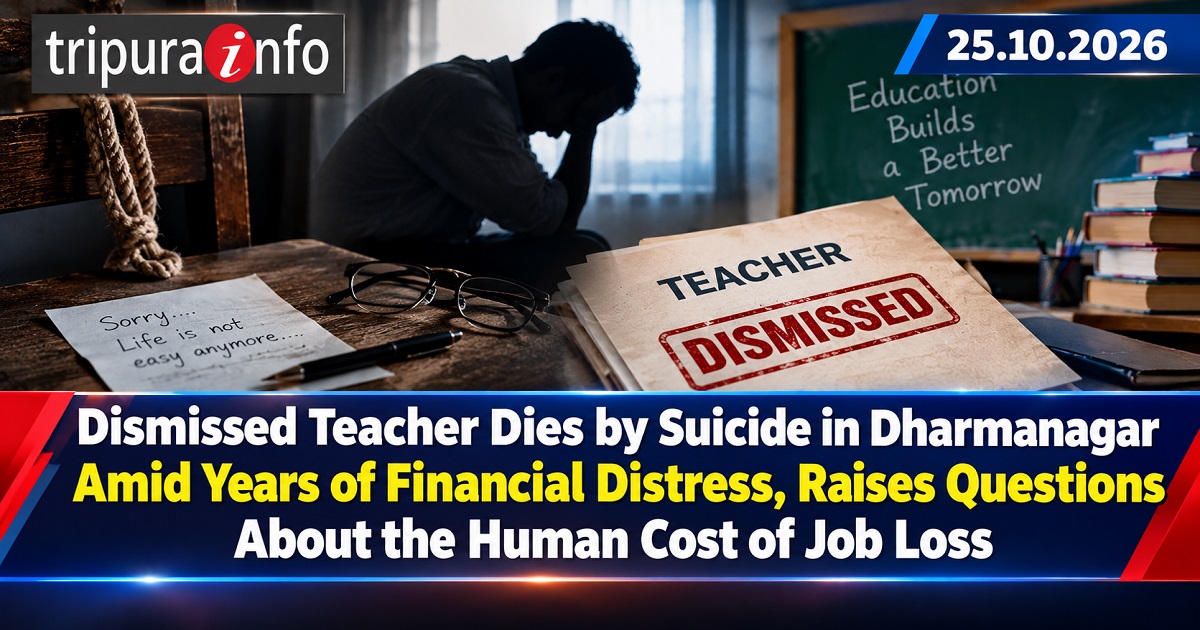 The alleged suicide of Uttam Das, a 52-year-old resident of Ward No. 5 of Sripur Gram Panchayat under Dharmanagar subdivision, has brought renewed attention to the devastating financial and psychological consequences of prolonged unemployment, particularly among teachers affected by the cancellation of the recruitment process involving 10,323 teachers in Tripura.
According to the news report, Das, who had been associated with the movement of the dismissed teachers, allegedly died by suicide at his residence late on Wednesday night. He was reportedly found hanging. Police recovered the body and sent it to Dharmanagar District Hospital for a post-mortem examination. The body was handed over to his family on Thursday after the examination.
The news report states that Das had been struggling with severe financial hardship and uncertainty for several years after losing his teaching job. He had reportedly worked as a teacher-in-charge at a primary school in Betachhara before his employment ended. Subsequently, he tried to support his family through various small occupations, including working in a shop and selling household goods by bicycle in nearby villages. The report further states that he eventually resorted to collecting firewood from the forest and selling it to sustain his family.
His reported death has cast a shadow of grief over the locality and once again highlighted the precarious circumstances in which some families affected by the mass cancellation of teaching appointments have been living.
The incident comes against the backdrop of the long-running legal controversy surrounding the recruitment of 10,323 teachers in Tripura. The cancellation of the recruitment process and the subsequent loss of employment by the affected teachers have had far-reaching consequences for many individuals and their families.
For people who had built their lives around a regular government salary, losing employment meant more than the loss of monthly income. It also meant uncertainty over children's education, household expenses, medical treatment, repayment of loans and the ability to maintain a basic standard of living.
The news report about Das describes a prolonged struggle to earn a livelihood after his teaching career ended. His reported attempts to find alternative employment and undertake small businesses appear to have failed to provide adequate financial security.
The tragedy also invites renewed discussion in the context of a recent Supreme Court observation concerning the serious consequences of dismissal from service. The key point is that the Supreme Court’s observation that dismissal from service is “no less than a death penalty”.
In its judgment dated October 16, 2026, in the case of R Saravanan vs. Periyar University, the Supreme Court of India observed that “the award of punishment of dismissal or removal from service is the harshest measure of punishment and no less than a death penalty for the government servant,” emphasising that such action can have far-reaching financial and social consequences for the employee and their family. A Bench of Justices Prashant Kumar Mishra and Shree Chandrashekhar set aside the Madras High Court Division Bench’s decision and restored the relief granted by a Single Bench to R Saravanan, a Periyar University Deputy Registrar, after finding that the disciplinary findings against him lacked essential supporting evidence and were based on conjectures and surmises. The Court also stressed that High Courts should not remain passive when serious injustice is alleged and may exercise their constitutional powers of judicial review under Article 226 in appropriate cases, even where an alternative statutory remedy is available.
more news...