UP CM Highlights Recovery of Illegally Occupied Land and Housing for the Poor, Tripura Faces Allegations of Khas Land Grabbing, Waterbody Filling
By Our Correspondent
Agartala, October 23, 2026
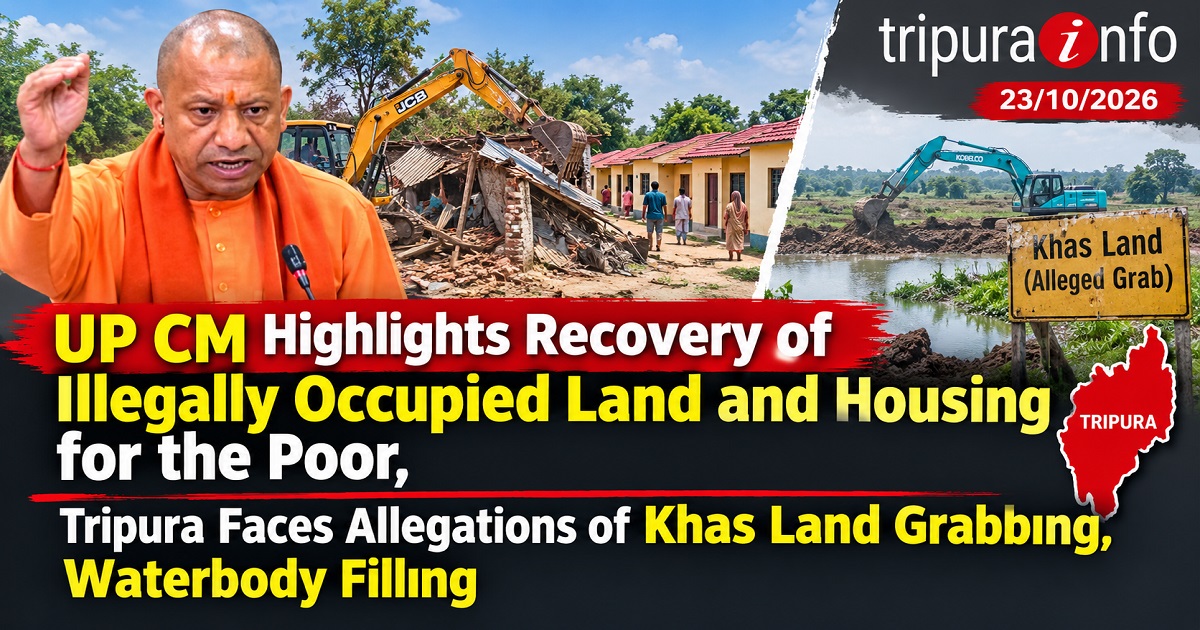 A growing debate over the protection of government land, recovery of illegally occupied property and housing for landless and homeless families has brought contrasting approaches to the forefront in Uttar Pradesh and Tripura. While the Uttar Pradesh government, led by Chief Minister Yogi Adityanath, has repeatedly highlighted action against alleged gangsters, land mafias and illegal encroachments, serious allegations continue to emerge in Tripura over the grabbing of government khas land, illegal filling of waterbodies and the construction of buildings on allegedly encroached land.
The central question being raised is whether government land and public resources are being protected effectively in Tripura, or whether politically influential individuals are able to exploit administrative loopholes and alleged political patronage to conduct illegal land transactions.
Reportedly, the Uttar Pradesh government has projected its efforts to reclaim illegally occupied land and utilise recovered land for public welfare as an important part of its campaign against organised land grabbing. The administration has also highlighted housing initiatives intended to provide homes to economically disadvantaged and homeless families.
The broader policy message is that land recovered from illegal occupation can be put to productive use, including the construction of housing for people who lack secure shelter.
Meanwhile, in Tripura, allegations of illegal occupation and transfer of government khas land have raised concerns about the protection of public property. According to allegations and claims requiring official verification, government land in different parts of the state has been illegally occupied, transferred to private parties and subsequently sold to unsuspecting buyers.
There are also allegations that influential individuals have taken control of government land, divided it into plots and sold the plots for substantial profits, despite questions over the legality of the original occupation or transfer.
The situation has prompted questions about the role of revenue officials, land-record authorities and district administrations responsible for protecting government land.
Particularly serious are allegations that certain illegal transactions have continued despite administrative action in several cases. Critics contend that the existence of enforcement proceedings has not been sufficient to eliminate the wider problem.
One of the most pressing concerns is the alleged destruction of waterbodies across Tripura through unauthorised filling and subsequent real-estate or other construction activities.
It is alleged that huge number of waterbodies across the state have been illegally filled over the past eight years, with residential buildings, commercial establishments and other structures subsequently developed on some of the affected sites.
If substantiated, such activities would raise serious concerns not only about land ownership and planning regulations but also about environmental protection, natural drainage, flood management and the preservation of traditional community water resources.
Waterbodies perform essential ecological and public functions, particularly in urban and semi-urban areas. Their destruction can reduce rainwater storage capacity, obstruct natural drainage and increase the vulnerability of nearby settlements to waterlogging.
Residents and environmental observers have reason to demand that the authorities establish how many waterbodies have been affected, whether the relevant permissions were granted, and what action has been taken against those responsible.
The allegation that filled waterbodies are subsequently sold or developed at substantially higher prices also requires a comprehensive investigation of land records, ownership transfers, building permissions and the financial transactions involved.
Alongside the alleged filling of waterbodies, concerns have been raised over the purported illegal transfer of thousands of government khas land parcels across Tripura.
Khas land is government-owned land, and its occupation, allotment or transfer must comply with the applicable laws, rules and administrative procedures. Any unauthorised transfer to private parties can undermine public ownership and deprive eligible beneficiaries of land intended for legitimate public purposes.
It is alleged that land-grabbing networks have operated in different areas, with government land being occupied or transferred and subsequently marketed as private property.
The scale of the alleged problem warrants a district-wise review of khas land records, mutation orders, allotment documents and registration records. Authorities must also determine whether any transfers were facilitated by forged documents, irregular administrative orders or the misuse of official positions.
Where illegal transfers are established, the government should initiate appropriate legal proceedings, recover land wherever legally permissible and take action against all responsible individuals, regardless of their political connections or official status.
The issue has acquired an additional dimension following reports of disciplinary action against government officials and employees over alleged irregularities involving khas land transfers in West Tripura district.
It is claimed that more than a dozen officials and employees have been suspended in connection with alleged illegal transfers of government land to private parties.
The reported suspensions raise important questions about how the alleged irregularities occurred, who authorised the transactions, whether the beneficiaries have been identified and whether the disputed land has been recovered.
Suspending officials may be an important administrative step, but disciplinary action alone cannot resolve the problem if the land remains under illegal occupation or has already changed hands through subsequent transactions.
The government must establish whether departmental inquiries have been completed, whether criminal cases have been registered wherever warranted, and whether action has been taken against private beneficiaries and other persons allegedly involved.
more news...