Centre Issues Advisory to Private TV Channels on Programme Code Complianc, Tripura Cable Operators May Face Scrutiny
By Our Correspondent
Agartala, October 22, 2026
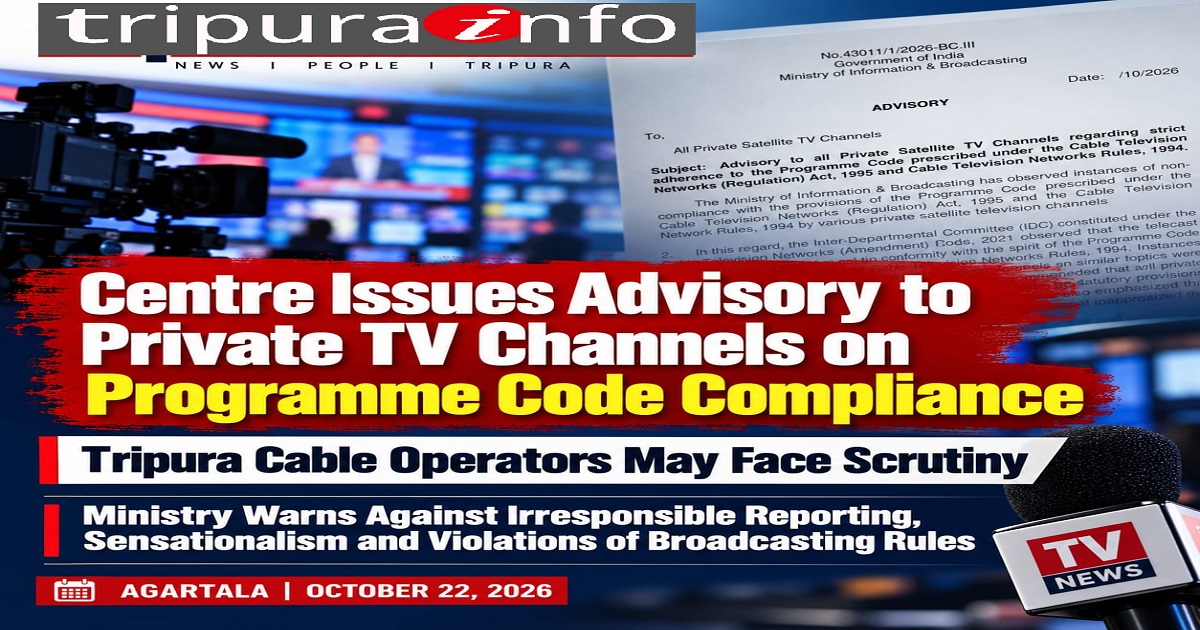 The Ministry of Information and Broadcasting, Government of India, has issued an advisory directing all private satellite television channels to strictly comply with the Programme Code prescribed under the Cable Television Networks (Regulation) Act, 1995, and the Cable Television Networks Rules, 1994. The advisory highlights concerns over instances of non-compliance and cautions broadcasters against content that violates the established standards of responsible television journalism.
The advisory, bearing reference number No. 43011/1/2026-BC.III, notes that the Ministry has observed instances of television broadcasts that do not conform to the spirit and provisions of the Programme Code. The Inter-Departmental Committee, constituted under the Cable Television Networks (Amendment) Rules, 2021, also reportedly observed similar news reports and visuals being broadcast across multiple channels on comparable subjects.
The Ministry has therefore called upon all private cable and satellite TV channels to adhere to the statutory provisions governing television content in both letter and spirit. It has particularly emphasised that inappropriate behaviour and language must not be normalised through television broadcasts.
The advisory outlines several areas requiring special editorial attention. Channels have been instructed to exercise due caution while broadcasting violent, graphic or disturbing visuals, ensuring that such content does not offend good taste and decency or cause unnecessary distress to viewers.
Coverage of crime and violence must be based on verified facts and presented in a balanced and responsible manner. Broadcasters have been cautioned against deliberate, false or suggestive innuendos and half-truths. Sensational reporting that could glorify unlawful or socially undesirable behaviour has also been discouraged.
The Ministry has further advised channels to avoid repeatedly broadcasting disturbing visuals and to use appropriate blurring or masking techniques wherever necessary, particularly when reporting incidents involving death, violence and other sensitive circumstances.
In cases involving crimes against women and children, broadcasters have been reminded to exercise due diligence and comply with the relevant provisions of the Programme Code.
The advisory reiterates that live coverage of anti-terrorist operations by security forces is prohibited under the relevant Programme Code provisions. Media coverage during such operations must be restricted to periodic briefings by an authorised officer until the operation concludes.
Channels have also been advised to ensure that visuals are appropriately time-stamped wherever necessary, preventing viewers from receiving a misleading impression that recorded footage represents a live event.
The Ministry has placed particular emphasis on maintaining communal harmony and preventing the promotion of anti-national attitudes through television programming.
News debates and panel discussions must be conducted with adequate editorial oversight, including careful selection and preparation of panellists and participants. Channels have been advised to take immediate corrective measures, such as muting, disclaimers, interruptions or discontinuation of a feed, wherever necessary to prevent derogatory, abusive or inflammatory content from being broadcast.
The advisory also reiterates the need to protect the identity of victims of sexual offences. Channels must strictly follow the directions of the Supreme Court and applicable legal provisions prohibiting the disclosure of victims' identities, including through photographs, family details, locality information or other identifying particulars.
The Ministry has also advised private satellite channels to use only authentic maps of India as published by the Survey of India in television broadcasts, graphics and digital presentations.
Coverage of natural calamities, disasters and major accidents must be appropriately time-stamped wherever necessary to avoid unnecessary panic among viewers. Reporting must be based on verified facts and comply with the Programme Code.
Another significant aspect of the advisory concerns the use of Artificial Intelligence (AI), including Generative AI, in television news production.
The Ministry has advised broadcasters to exercise due caution when using AI tools to create graphics, virtual news presentations and other programme elements. AI may be used in an assistive capacity, provided it does not compromise the accuracy, authenticity or sensitivity of news content and the broadcast remains compliant with the Programme Code.
The advisory has implications for cable television operators and news broadcasters in Tripura as well. Local cable TV channels that carry news, conduct debates or produce their own programmes may need to review their editorial practices to ensure compliance with the applicable statutory requirements.
In Tripura, in absence of satellite TV, where local cable channels play an important role in disseminating regional news and information, broadcasters are expected to exercise particular care while covering crime, political controversies, communal issues, accidents and other sensitive developments.
more news...