Maha Ashtami at Sonamura : When Joy Had No Religion!!!!
Biswanath Bhattacharya
Agartala, October 19, 2026
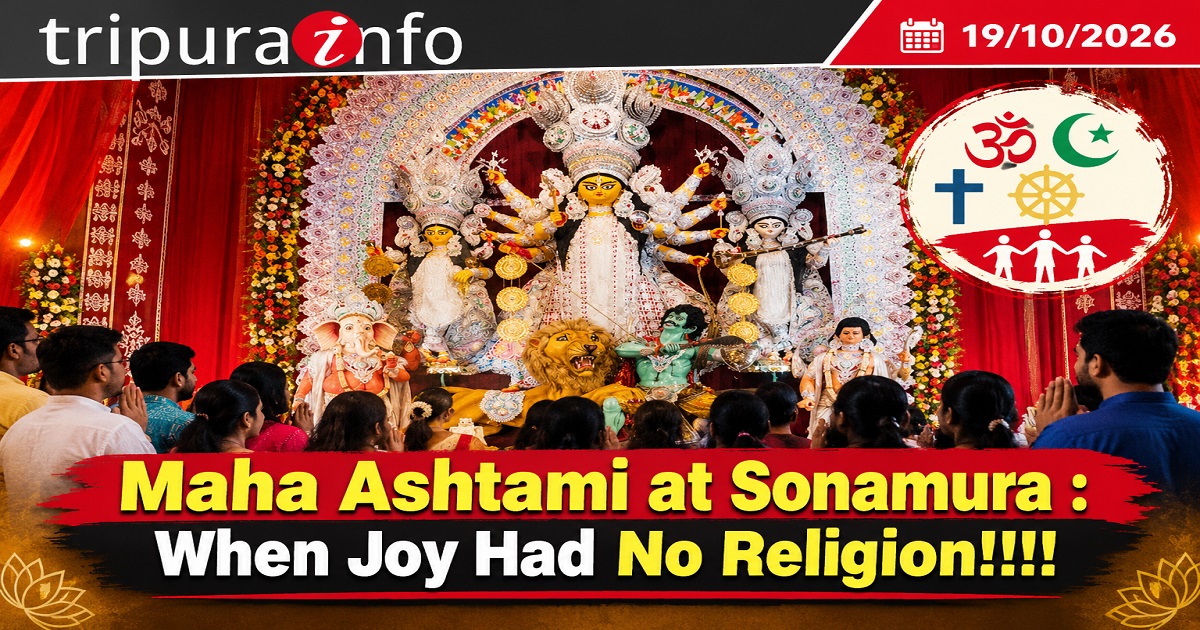 Where the gentle arms of the Gomati curved past the drowsing banks of Sonamura, autumn once arrived like a benediction breathed upon the earth. Kaash flowers shivered beside the river like pale flames; shiuli blossoms fell before dawn like stars that had died fragrantly in the night; and the first sombre roll of the dhak crossed the lanes with the summons of an ancestral heartbeat. Doors opened. Children burst into the light. Age loosened its grip upon the old. Durga Puja did not come to us as the guarded estate of a single faith. It descended like moonlight—entering Hindu courtyards and Muslim hearts with the same silver tenderness, asking no child the name by which his family called God.
“Once, Mahastami entered Sonamura like a river of fire and flowers: it asked no boy his religion, only whether his heart was young enough to burn with joy. Today the drums are louder, the lights more dazzling—and yet somewhere beneath that splendour, the old shared heartbeat is dying.”
Those days return through a mist of unbearable brightness. Barefoot boys flew from pandal to pandal, wild as sparrows startled from a banyan tree. We jostled, quarrelled, forgave, shouted and ran again beneath bamboo arches trembling with coloured cloth, paper flowers and strings of uncertain bulbs. Sandalwood, ghee and dhuno mingled with rain-dark earth and the sugary breath of cheap sweets. Conch shells climbed above the drums; laughter broke upon the lanes; the whole town seemed to breathe through one immense chest. No one stood beyond that breath. No one waited at the margin to be admitted. We belonged to one another before we had learned the terrible grammar of separation; memory returns to that innocence precisely because the present has forgotten how to speak it.
Yet the deepest truth is this: Mahastami belonged most rapturously to our Muslim friends. Shah Alam, Alfu, Jagit, Saju, Zulfi and so many others claimed the day with an abandon that we Hindu boys could never quite equal. We celebrated it; they surrendered to it. They drank Mahastami to the last incandescent drop, as though the goddess had come especially to fling open the locked gates of childhood. From morning until the lamps paled before dawn, they were everywhere—before the idol, beside the dhakis, at the sweet stalls, beneath the festoons, at the molten centre of every uproar. Their joy was neither borrowed nor apologetic. It required no invitation, carried no consciousness of trespass, asked for no certificate of belonging. It rose from them like a flock of birds suddenly released into the autumn sky.
The girls of Sonamura moved through that clamorous world like a quieter form of music. In white sarees edged with red, they seemed clothed in river mist and vermilion flame. Their anklets whispered along the narrow lanes; their laughter flashed and vanished between courtyards; their hands gathered shiuli and bakul with the tenderness of prayer. Against the thunder of the dhak, their presence was a luminous pause, and for a brief hour the ordinary streets became a celestial procession.
Even the Imam of the Sonamura Bazar Masjid stood naturally within that landscape of welcome. His greeting near the great pandal was not an arranged gesture for public admiration; it flowed from the old, unadvertised decency of neighbours who had shared floods and harvests, hunger and weddings, market quarrels and monsoon evenings long before identity was sharpened into a weapon. Faiths stood beside one another then, not because difference had vanished, but because affection had disarmed it. A Hindu story could enter a Muslim ear without trespass; a Muslim blessing could cross a Puja threshold without losing its sanctity. We did not call it harmony. We simply called it Sonamura.
Among all those memories, none returns with more piercing sweetness than Shah Alam and the shoes. I had received a new pair—the kind of festival gift a boy repeatedly takes from its box, touches, admires and imagines wearing beneath the lights. Shah Alam, too, had waited for that small miracle by which Mahastami could turn an ordinary child into someone newly splendid. But his father brought him canvas shoes: sensible, serviceable, doubtless purchased with care. Shah Alam stared at them in stunned silence. His eyes moved from the pale canvas to my shoes and back again, and in that wounded glance the whole injustice of childhood seemed suddenly to gather. He did not see a father’s sacrifice or a household’s limits; a child cannot always read the hidden arithmetic of love. He saw only that I had crossed into splendour and he had been left behind. He wanted shoes like mine—not a practical substitute, not an adult explanation, but the shining equality which, in a child’s heart, can become the entire measure of affection. His face crumpled. He flung the canvas pair away in despair, as though rejecting the humiliation rather than the gift, and then the tears came—hot, helpless and bitter enough to darken the brightness of Mahastami.
Who can forget that crying? Perhaps the shoes landed in dust; perhaps the drums went on thundering while his small grief stood unheard beneath them. For a fleeting instant it may have seemed comic, as the catastrophes of childhood often appear to those who have survived childhood. But there was nothing trivial in the way his shoulders shook, nothing foolish in the tears he could not command. Beneath them lay an innocence so fierce that memory still trembles before it. Shah Alam was not weeping merely for leather instead of canvas. He was weeping for equality, for festival splendour, for his unquestioned place beside me on the brightest day of the year. He wanted to belong to Mahastami without footnote or permission, to walk through its lights neither behind me nor apart from me, but beside me. Those tears still outshine the vanished bulbs of the pandal, because they came from a world in which a Muslim boy could love a Hindu festival so completely that an unsuitable pair of shoes felt like a sentence of exile.
At night, oil lamps trembled along the Gomati, scattering broken necklaces of gold upon the black water. We wandered until hunger, exhaustion or a parent’s distant call finally drew us home. No one spoke the cold, possessive language of cultural ownership. The worship was Hindu, but the wonder belonged to Sonamura. Ritual had its custodians; joy had no border guards. Mahastami crossed courtyards, kitchens and consciences with the freedom of the river, carrying every child upon the same shining current. That river still flows past Sonamura; it is we who have built embankments within the heart.
And now the remembered radiance throws a harsher, longer shadow. Durga Puja is increasingly displayed and defended as though it were the fenced inheritance of Hindus alone. Muslim neighbours still come. They watch the illuminations, exchange greetings, taste the sweets and remain for a while at the edge of the crowd. Yet arrival is no longer the same as belonging. The old abandon has ebbed from the shore. Where Shah Alam, Alfu, Jagit, Saju and Zulfi once rushed in as sons of the festival, many now approach with the measured courtesy of visitors. Between the road and the pandal stands an invisible checkpoint: a pause in the step, a softening of the voice, the private wound of wondering whether one is welcomed or merely permitted. Once, the festival erased the threshold; now the threshold survives even beneath the brightest archway.
The tragedy is not that devotion has deepened; devotion deserves its sacred fire. The tragedy is that the circle of celebration has contracted. The pandals may be grander, the lights more lavish, the music more deafening, yet the human space beneath them has grown smaller. Loudspeakers can shake the night and still fail to awaken a neighbour’s trust. Ten thousand lights can turn darkness into noon and still not restore the glow on the face of a Muslim boy who once knew, without asking anyone, that Mahastami was his own. Then, poverty could not keep Shah Alam from claiming the festival; now, prosperity cannot guarantee that his belonging would feel as effortless. What we have gained in display can be counted. What we have lost in intimacy has no arithmetic, no ledger, no language adequate to its absence.
Now, from the far bank of age, I close my eyes and the lost Sonamura rises petal by petal from the dark. The Gomati glimmers beneath an autumn moon. Dhak beats trouble the peepal leaves. Girls in white and red pass like remembered flame. The Imam lifts his hand in quiet greeting. Alfu, Jagit, Saju and Zulfi dissolve into a laughing crowd. And there is Shah Alam—small, wounded, inconsolable—his discarded canvas shoes lying between us while tears run down a face that had wanted nothing more than to shine beside mine. For one suspended instant the town lives again: no guarded entrances, no careful identities, no child stranded outside the circle of joy. I almost hear our bare feet returning through the dust. I almost believe that if I turn quickly enough, we shall all still be there, young and unseparated beneath the same autumn sky. But memory is merciless even when it is beautiful. The drums recede beyond recall. The river darkens. One by one, the lamps upon the water are extinguished; one by one, the beloved faces disappear. I open my eyes, and the present stands before me—brighter with electricity, louder with assertion, and filled with the terrible silence of those who no longer enter as though the festival were also theirs.
Perhaps that Sonamura cannot be summoned back by nostalgia alone. Memory cannot rebuild a vanished world; it can only sit beside its ruins and call each lost name into the wind. Yet it must do more than console us. It must hold a lamp before the present and reveal what the glare conceals. The goddess who came to destroy darkness cannot be honoured by leaving a neighbour in shadow. Mahastami is diminished whenever possession becomes more important than participation, whenever identity closes the door that affection once kept open. Its truest splendour will return only when every child can run towards the drums without first wondering whether the music is meant for him. Until then, Shah Alam will remain forever where memory last found him: a little boy in his festival clothes, his canvas shoes cast into the dust, waiting to walk beside me into the lights. But the boy beside him has grown old, the old Sonamura has withdrawn beyond reach, and no one can now bend down, lift those shoes, and give that wounded child back the world in which he once belonged without question.
“If Shah Alam’s tears no longer belong to Durga Puja, the goddess may still stand beneath a kingdom of lights, the drums may still shake the night, and the crowds may still call it celebration. But in the dust beside one discarded pair of canvas shoes lies the truth of what Sonamura has lost: not a ritual, not a festival, but the old human faith by which one neighbour kept a lamp burning for another—and every child came running because he knew the light was also his. When that faith dies, the lamps do not go out; they simply cease to lead us home.”
more news...