Ration Card Portability Suspended for a Year in Tripura, Jolaibari Beneficiaries Denied Ration at Agartala
By Our Correspondent
Agartala, October 19, 2026
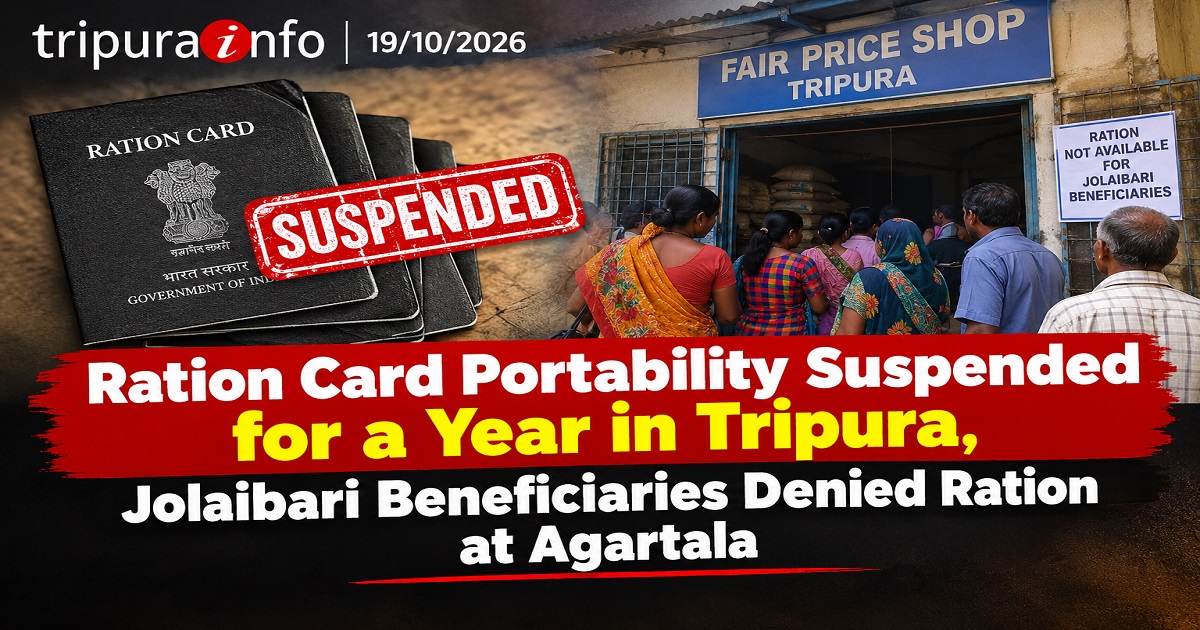 Questions over the functioning of Tripura’s Public Distribution System (PDS) have intensified after ration cardholders reported difficulties in obtaining essential commodities under the festive relief scheme and alleged that beneficiaries from other parts of the state were being denied ration at shops in Agartala.
Consumers have alleged that the earlier facility under the One Nation One Ration Card (ONORC) scheme, which enabled eligible beneficiaries to collect their entitled foodgrains from ration shops outside their registered locations, has remained suspended or non-functional in Tripura for nearly a year. As a result, ration cardholders from Jolaibari in South Tripura are reportedly being denied ration commodities when they approach ration shops in Agartala.
The situation has raised concerns about the availability of ration portability for migrant workers, people staying away from their home constituencies and families temporarily residing in other parts of the state. Beneficiaries want the government to clarify why the facility is reportedly unavailable and when it will be restored.
According to complaints received from consumers, ration shop dealers in Agartala are refusing to distribute ration commodities to some cardholders registered in outside Agartala like Jolaibari, citing the apparent non-availability of the portability facility.
The One Nation One Ration Card system was introduced to allow eligible beneficiaries to access their entitled foodgrains from participating fair-price shops beyond their home locations, subject to the applicable rules and operational arrangements.
If the portability facility is not functioning, beneficiaries who are temporarily living or working away from their registered locations may have to return to their home areas to collect their ration. Such difficulties can create additional travel expenses and inconvenience, particularly for economically disadvantaged families.
Consumers have urged the Tripura Food Department to explain whether the portability facility has been formally suspended, whether the problem is technical or administrative, and what arrangements have been made to ensure that eligible beneficiaries are not deprived of their entitlements.
The department's official position on the reported suspension and the specific complaints concerning Jolaibari cardholders is awaited.
Free Durga Puja Ration Items Become Another Point of Controversy
The dispute over ration portability comes amid growing questions about the distribution of free food items announced for Sharad Utsav.
Food Minister Sushanta Chowdhury had reportedly announced at a press conference in Bargarh that every family in Tripura would receive one kilogram of sugar, two kilograms of maida (refined flour) and 500 grams of suji (semolina) free of cost during the festive season.
However, several consumers have alleged that ration shop dealers are providing conflicting explanations about the availability and eligibility criteria for these commodities.
According to the complaints, some dealers have said that sugar is unavailable, while others have reportedly claimed that suji will be distributed only to Below Poverty Line (BPL) families.
These explanations have left consumers uncertain about whether the announced benefits are being implemented uniformly across the state or whether specific conditions apply to particular commodities.
Beneficiaries are demanding a clear notification specifying the quantities to be distributed, the categories of eligible ration cardholders, the availability of stocks and the deadline for completing the distribution.
The Food Department needs to clarify whether the announcement covers every ration cardholding family or whether any item is subject to separate eligibility conditions.
Atta Supply Disrupted in September, Price Reportedly Increased in October
Another concern raised by ration consumers relates to the supply and price of atta through the public distribution network.
According to consumer complaints, atta was not supplied through ration shops in September. In October, its reported price increased from Rs 13 to Rs 15 per kilogram, marking a rise of Rs 2 per kilogram.
The reported increase has prompted questions about why the supply was disrupted in the previous month and what prompted the subsequent price revision.
Consumers want to know whether the revised price was formally notified by the competent authority and whether ration dealers have received official instructions regarding the new rate.
For households that depend on subsidised food commodities, even a modest price increase can add to their monthly expenditure, especially when it follows a disruption in supply.
The reported atta price revision and the reasons for the September supply disruption could not be independently confirmed from an official order at the time of writing.
Consumers Compare This Year's Arrangements With Previous Festive Distribution
Some ration cardholders have also compared the present situation with the previous year's festive distribution, when several food items were reportedly supplied free of cost through ration shops.
They allege that this year, beneficiaries are facing difficulties in obtaining all the expected commodities, even when they are willing to pay for items available at the prescribed rates.
The complaints have raised broader questions about supply management, communication between the Food Department and ration dealers, and the effective implementation of welfare measures announced by the government.
For families dependent on the public distribution system, uncertainty over the availability, price and collection of essential commodities can cause considerable hardship.
The reported increase in the price of atta has also drawn attention in the wake of the state government's recent announcement of a 3 per cent increase in Dearness Allowance for government employees.
Some consumers have questioned whether rising household expenses are reducing the practical benefits of financial relief. However, the DA revision and the reported atta price increase are separate matters, and their actual impact differs according to household income, ration entitlements and consumption.
The immediate demand from consumers is for transparent information about the price revision and uninterrupted access to essential ration commodities.
more news...