Maha Saptami: When the Mother Walks Through the Gathering Dark!!!
Biswanath Bhattacharya
Agartala, October 17, 2026
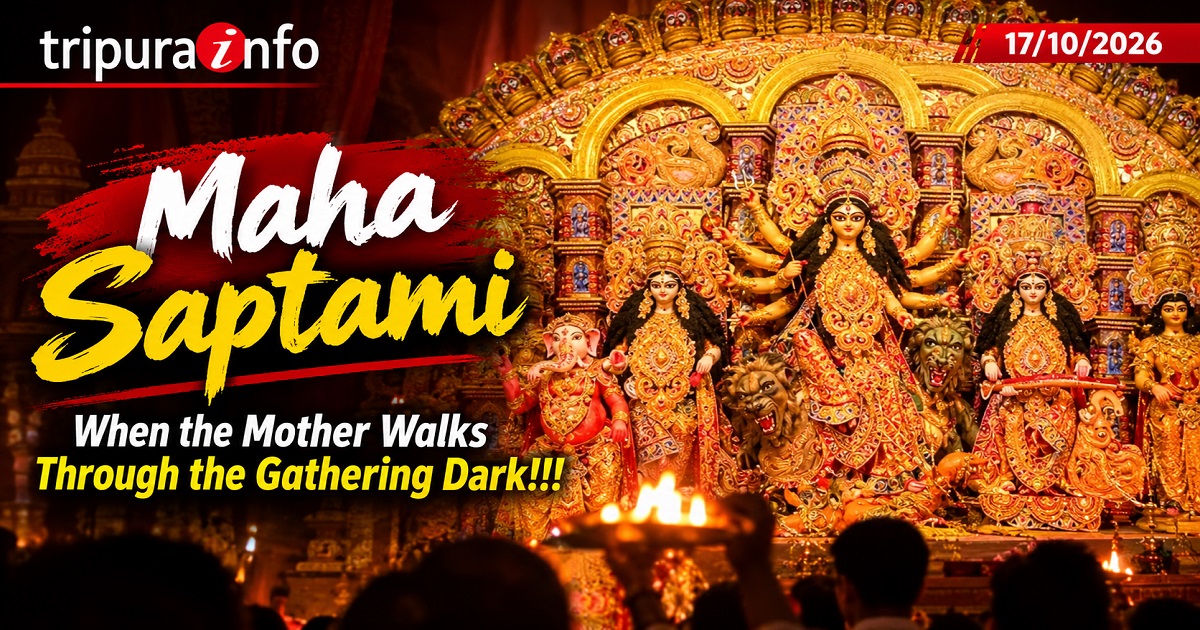 “There comes an hour when darkness grows so complete that it begins to believe it has outlived the dawn. The roads fall silent, the lamps tremble, and even memory seems afraid to speak. It is then that the Mother walks through the gathering dark—not merely to destroy the night, but to awaken in the human soul the last forbidden flame the night could neither find nor devour.”
This article was written long ago, in another season of unease. I have returned to it now—not to dust it, soften it, or merely polish its fading surface, but to reshape and overhaul it, to enter again the chamber of its silences and listen for the buried drumbeat beneath its words. For Maha Saptami does not grow old. The darkness to which it answers is never finally defeated; it only changes its garments, its slogans, its flags, and its excuses. It slips across borders, sits behind official doors, learns the language of respectability, and waits inside the secret chambers of the heart. Yet every autumn, when the light begins to thin and the world appears to lean towards night, the Mother returns.
Today is Maha Saptami, the sacred seventh day of the autumnal worship of Goddess Durga. Across Bengal, Tripura, Bangladesh, and the far-flung Bengali world, dawn does not simply arrive; it seems to rise from some ancient wound in time. Before the sky has fully opened its eyes, the dhak begins to speak—not as music alone, but as ancestral thunder climbing through the ribs of the earth. Conch shells tear open the half-dark. Incense ascends like the breath of forgotten generations returning for one night. Within the sanctum, the clay face appears to listen. The painted eyes cease to be paint. A presence gathers—immeasurable, tender, and terrible—and crosses the invisible threshold between image and incarnation. For one suspended instant, the crowd forgets to breathe. The Mother has arrived.
To an international reader encountering Durga Puja for the first time, Maha Saptami may appear to be one luminous movement within a magnificent public festival. It is that—but beneath the radiance lies an alarm. The day asks whether courage will awaken before cruelty becomes custom; whether conscience will speak before silence hardens into complicity; whether we can still recognise the Divine Feminine as the fierce, sustaining power by which life refuses to kneel before annihilation.
या देवी सर्वभूतेषु शक्तिरूपेण संस्थिता।
नमस्तस्यै नमस्तस्यै नमस्तस्यै नमो नमः॥
Yā devī sarvabhūteṣu śaktirūpeṇa saṃsthitā;
namastasyai namastasyai namastasyai namo namaḥ.
“To the Goddess who abides in all beings as power: salutations to Her, salutations to Her, salutations to Her again and again.”
The verse comes from the Devi Mahatmya, known across eastern India as the Chandi or Chandi Path, a cycle of seven hundred verses embedded in the Markandeya Purana. Its spiritual vision remains startlingly radical: the Goddess is not confined to heaven, temple, or icon. She inhabits every being—as consciousness, hunger, sleep, compassion, memory, courage, and power. The repeated salutation is not flattery offered to a distant divinity; it is an act of recognition. The sacred breathes in the trembling animal, the exhausted mother, the stranger halted at a border, the frightened child, and the human heart still struggling, against the advancing night, to remain human.
Maha Saptami begins before daylight has fully opened its eyes. In the traditional Nabapatrika rite, nine plants are gathered, bathed, draped, and ceremonially installed beside Ganesha. Popularly called the Kola Bou, the sari-clad banana plant is often imagined as Ganesha’s bride. Yet within the rite’s deeper symbolism, it anchors a gathering of nine plants associated with distinct divine forms and proclaims the holiness of the vegetal world. Leaf, stem, water, grain, and soil cross the threshold of the sanctum. Nature does not remain outside as scenery. She enters, veiled and breathing, and is worshipped.
The rite bears an ecological wisdom modern civilisation has learned almost too late. A culture that bows before a plant cannot honestly pretend that a forest is mute property. A people who invoke the river as purifier must also confront the sacrilege of poisoning it. Maha Saptami binds theology to responsibility with an uncompromising thread: the Mother adored in vermilion and flame is the same Mother whose wounded body is river, rain, harvest, animal, forest, and earth. To praise one while ravaging the other is not devotion. It is amnesia wearing the mask of prayer.
सर्वमङ्गलमाङ्गल्ये शिवे सर्वार्थसाधिके।
शरण्ये त्र्यम्बके गौरि नारायणि नमोऽस्तु ते॥
Sarvamaṅgalamāṅgalye śive sarvārthasādhike;
śaraṇye tryambake gauri nārāyaṇi namo’stu te.
“O auspiciousness of all that is auspicious, O fulfiller of every aim, refuge of all, three-eyed Gauri, Narayani: salutations to You.”
The battles of the Chandi are often read as mythic warfare: the Goddess slays Mahishasura, Chanda and Munda, Raktabija, Shumbha and Nishumbha. Yet the scripture endures because its demons never truly die. They retreat, rename themselves, acquire respectable voices, and return wearing the manners of a new age. Mahishasura is brute power, forever changing shape to escape recognition. Raktabija is violence that breeds from every drop it spills. Shumbha and Nishumbha are possession and vanity—the fevered delusion that beauty, strength, land, faith, and even another human being may be owned. Chandi’s terrible radiance is not a licence for hatred. It is the fierce intelligence required to recognise hatred beneath its disguises and stop it before it learns to multiply.
Across Tripura and West Bengal, the season seems gloriously ungovernable. Streets become rivers of light; neighbourhoods rise as temporary republics of art; humanity moves through the night beneath arches, domes, forests, palaces, and impossible dreams fashioned from bamboo, cloth, colour, and devotion. Yet beneath the splendour runs a cold undertow. Something almost Stefan Zweig-like trembles there. In The World of Yesterday, Zweig remembered a civilisation that trusted music, refinement, and beauty even as history darkened beyond its windows. Durga Puja can evoke a similarly poignant tension: a people surrendering to art and fellowship while the age outside is bruised by suspicion, displacement, war, and fear. But here the resemblance must end. Illumination must not become escape. The lamp before the Mother must teach us to see, with greater clarity, every darkness it cannot by itself dispel.
Across the border in Bangladesh, Durga Puja continues to carry the warmth of community, memory, artistry, and belonging. The same conch sounds beneath another flag; the same dhak answers the autumn sky; the same prayer rises from hearts divided by history yet joined by language and culture. This continuity is precious precisely because it is fragile. A festival becomes truly sacred when one neighbour stands between another and fear; when the majority refuses the narcotic comfort of indifference; when faith ceases to be a wall behind which we hide and becomes a shelter beneath which others may safely stand.
देवि प्रपन्नार्तिहरे प्रसीद
प्रसीद मातर्जगतोऽखिलस्य।
प्रसीद विश्वेश्वरि पाहि विश्वं
त्वमीश्वरी देवि चराचरस्य॥
Devi prapannārtihare prasīda; prasīda mātar jagato’khilasya.
Prasīda viśveśvari pāhi viśvaṃ; tvam īśvarī devi carācarasya.
“O Goddess, remover of the distress of those who seek refuge, be gracious. Be gracious, O Mother of the whole world. O Sovereign of the universe, protect the world. O Goddess, You are the ruler of all that moves and all that does not.”
On Maha Saptami, may we dare to ask for more than private success, guarded homes, and happiness purchased by looking away. May we seek the defeat of the Mahishasura within us—the arrogance that charges blindly, tramples the vulnerable, and baptises violence as strength. May every Raktabija of hatred be starved of the blood in which it multiplies. May we remember those who worship beneath threat; those who wake to the terrible silence where a home once stood; those whose festivals carry the taste of ash; and those who keep vigil through dangerous hours so that even a stranger’s lamp may survive the night. For somewhere, while the drums are sounding, a child will be staring at a darkened doorway, waiting for the world to prove that goodness has not abandoned it.
Let peace prevail—but never the peace of mouths sealed by terror, never the peace of shuttered doors, never the graveyard stillness of a street emptied by fear while hatred sharpens its knives behind drawn curtains. Let there be the sterner peace born of truth, justice, compassion, and the recognition of the Divine Mother in every human face. Let the drums of Maha Saptami break beyond pandals and borders. Let them enter the rooms where cruelty is drafted into policy, the alleys where rumours are taught to burn, and the hearts that have forgotten the sound of their own tenderness. Let them thunder through every fortress of indifference until the demons within us are hauled into the merciless light, stripped of their masks, called by their true names, and left without a throne, an altar, or an obedient silence in which to hide.
“May the Mother’s lion keep watch tonight at the threshold of every frightened home. May Her light cross every border fear has drawn, enter every room hatred has darkened, and find every human being whom the world has abandoned to the night. And when the final drumbeat sinks into the autumn silence, may peace remain—not the pale hush that follows surrender, not the cold stillness left by ruin, but the fierce, undefeated heartbeat of a humanity that has stood at the lip of the abyss, heard the darkness whisper its ancient invitation, and answered—not with another darkness, but with fire.”
more news...