Durga Puja Traffic Chaos Paralyzes Agartala on Shashthi, Raises Questions Over Traffic Management and Emergency Access
By Our Correspondent
Agartala, October 16, 2026
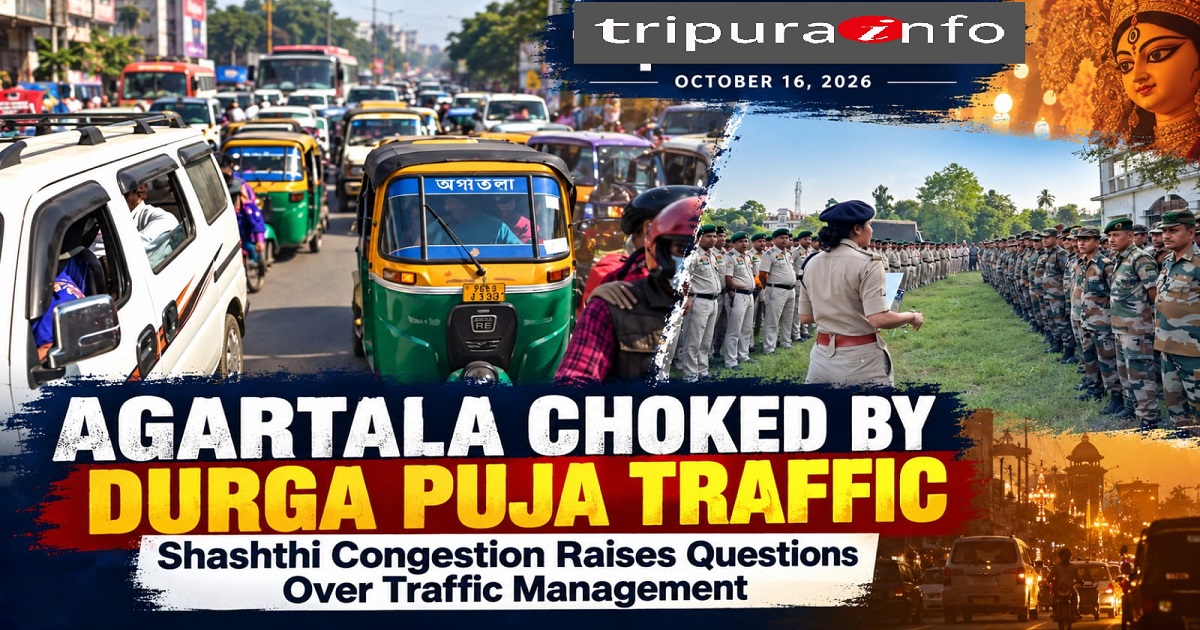 Agartala witnessed severe traffic congestion on Shashthi, the first major day of Durga Puja celebrations, with vehicles reportedly stranded for hours in several important parts of the capital. The situation caused considerable hardship for commuters, office-goers, students, elderly people and ordinary Puja visitors. Concerns were also raised over the movement of ambulances and other emergency vehicles, bringing the city's traffic management arrangements under public scrutiny.
The traffic congestion during the afternoon and evening raised questions about the preparedness of the Traffic Police and the effectiveness of the arrangements made for the festival. With thousands of people expected to visit Puja pandals across the city, the inability to maintain smooth traffic movement at several busy junctions triggered criticism from commuters and sections of the public. Allegations of serious lapses in traffic management were directed at the office of the Superintendent of Police (Traffic), Kanta Jangir. However, the reasons behind the congestion and the responsibility for the disruption require a detailed assessment of traffic deployment, road restrictions, crowd movement and the implementation of the notified arrangements.
The situation was particularly concerning because the administration had already announced extensive traffic restrictions, alternative routes, designated parking areas and special arrangements for emergency medical travel during the five-day festival. Despite these preparations, reports of prolonged congestion on Shashthi raised questions about whether the measures were implemented effectively on the ground.
The West Tripura district administration has announced that no-entry restrictions will remain in force in Agartala from October 17 to October 21, between 5 pm and 1 am, while several additional restrictions on vehicular movement will apply from 5 pm to 5 am the following morning. The arrangements are intended to manage the heavy flow of vehicles and pedestrians expected during the busiest hours of Durga Puja.
The restrictions cover numerous important roads, junctions and neighbourhoods across the capital. These include stretches connecting North Gate, Radhanagar, Circuit House, Nehru Park, Bhagwan Thakur Chowmuhuni, Bodhjang Chowmuhuni, Indranagar Bridge, Dhaleswar, the Old Central Jail area, Ashram Chowmuhuni, Kalyani Crossing, Old Motor Stand, Golbazar, Kaman Chowmuhuni, Shivbari, Battala, Dashmighat, Paradise Chowmuhuni and Melarmath. Several other roads, including approaches to the flyover, will also come under traffic regulation.
General vehicular movement will be restricted on designated stretches, while vehicles holding valid passes will be permitted to use certain routes in accordance with the notified conditions. Emergency vehicles are supposed to be allowed access through designated corridors, with traffic personnel responsible for ensuring that the routes remain clear. The effectiveness of these arrangements will be crucial, particularly during peak evening hours when thousands of visitors are expected to travel between Puja pandals.
The administration has also announced that buses, minibuses, jeeps and light motor vehicles will have to follow designated terminal arrangements between 5 pm and 5 am during the notified period. Rickshaws and auto-rickshaws are expected to operate from selected locations to facilitate passenger movement. The restrictions are intended to reduce the number of vehicles entering congested areas, although their success will depend on proper coordination, timely public announcements and adequate alternative transport facilities.
To prevent roadside parking from obstructing traffic, the authorities have directed that illegally parked vehicles be removed from 4:15 pm onwards. Crane services will be deployed to clear vehicles found blocking roads or violating parking rules. Motorists have been advised to use authorised parking spaces and move their vehicles before the restrictions take effect.
Special routes have also been prescribed for patients and other people travelling between TMC in Hapania, IGM Hospital, GBP Hospital and ILS Hospital. Vehicles travelling from TMC towards the major hospitals have been directed to follow the route through Badharghat, A.D. Nagar, the flyover, IGM Chowmuhuni, TRTC Crossing, B.K. Chowmuhuni, Colonel Chowmuhuni, Hardhan Sangha, North Gate and Radhanagar before reaching the hospital area.
For return journeys from GBP or ILS Hospital towards TMC in Hapania, the prescribed route passes through Murti Prangan, Radhanagar, North Gate, Hardhan Sangha, Colonel Chowmuhuni, B.K. Chowmuhuni, RMS Chowmuhuni, IGM Chowmuhuni, the flyover, A.D. Nagar and Badharghat. An alternative route through Abhaynagar, Bhagwan Thakur Chowmuhuni, Bodhjang Chowmuhuni, Women's College, Lions Gate, Orient Chowmuhuni and RMS Chowmuhuni has also been notified for vehicles travelling towards Hapania.
The congestion reported on Shashthi has nevertheless highlighted a fundamental concern: issuing a detailed traffic notification is not enough unless the arrangements work effectively during actual peak-hour conditions. The authorities will need to ensure that traffic personnel are deployed at vulnerable junctions, barriers are operated according to clear instructions, alternative routes remain accessible and emergency corridors are not blocked by vehicles or crowds.
Another controversy has emerged over the conditions printed on passes issued to journalists covering Durga Puja. Journalists have objected to a reported restriction stating that entry into Puja pandals would not be permitted with the pass. The restriction has prompted questions about how journalists are expected to cover the celebrations if they cannot enter the very locations where events, crowd movements and public activities are taking place.
Journalists have a professional responsibility to report on the celebrations, document public concerns and inform citizens about developments at major pandals. Any restrictions on their movement therefore require clear justification and practical arrangements that allow legitimate news gathering without compromising public safety. Critics have questioned whether the pass conditions were framed after adequate consultation with media representatives. Reports that some journalists are considering returning or withdrawing their passes have added to the controversy.
At the same time, questions have been raised on social media over the alleged distribution of VIP vehicle passes during Durga Puja and Diwali. A social media user from Udaipur claimed that vehicle passes were reportedly being associated with payments of Rs 5,000 for cars and Rs 1,500 to Rs 2,000 for motorcycles. The allegations have not been independently verified, and no conclusion can be drawn about the existence of any such payment arrangement without documentary evidence or an official investigation.
Nevertheless, the allegations have prompted demands for transparency in the distribution of VIP passes. The police and administration may need to clarify the eligibility criteria, the number of passes issued, the purpose of different categories of passes and whether any authorised fee applies.
more news...