Durga Puja Traffic Pass Controversy Erupts in Agartala: Journalists Allege Selective Denial, Harassment Over Pending Fines
By Our Correspondent
Agartala, October 15, 2026
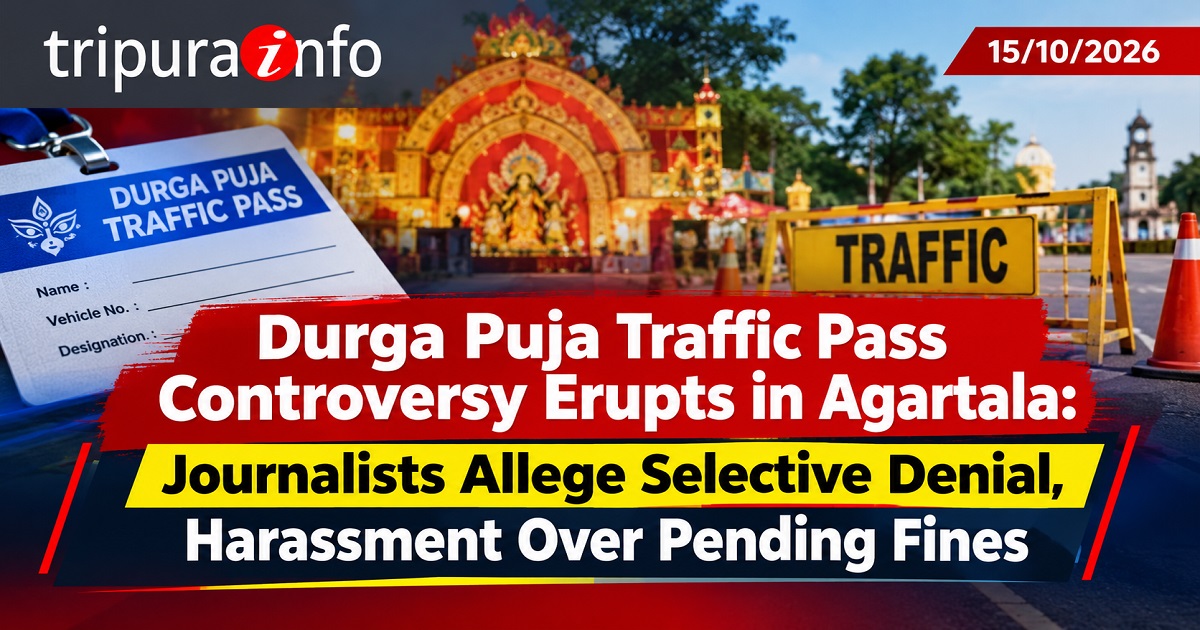 A controversy has erupted in Tripura over the distribution of special vehicle passes for Durga Puja 2026, with several journalists and vehicle owners alleging that the Traffic Department is using the pass-issuing process to demand payment of old traffic fines. The allegations have triggered resentment among sections of the media fraternity, with questions being raised over transparency, accountability and whether traffic rules are being applied equally to journalists, ordinary citizens, political leaders and government officials.
The controversy comes as the West Tripura district administration has announced special traffic regulations for Durga Puja from October 17 to 21, 2026, to manage vehicular movement, pedestrian safety and congestion around major puja pandals in Agartala. Under the notification issued by District Magistrate and Collector Dr Vishal Kumar, IAS, designated no-entry zones will remain operational from 5 PM to 1 AM, with the possibility of extending restrictions depending on crowd conditions.
Several applicants seeking special vehicle passes, including media representatives and other private establishments, have reportedly alleged that they were asked to clear substantial amounts of pending traffic fines before their applications could be approved. According to the allegations, the applicants had not previously been informed about the purported violations or outstanding dues, and the demand for payment arose only after they applied for Durga Puja passes.
Some applicants have further alleged that those unwilling to pay the demanded amounts were denied passes. They questioned why the department had allegedly remained silent about the outstanding fines for months before raising the issue during the Puja pass application process.
The allegations have raised concerns over whether the pass-distribution system is being used as a mechanism for collecting pending penalties.
An official response from the Traffic Department would be necessary to clarify the allegations.
Some reports and claims circulating among sections of the media fraternity have also referred to approximately Rs 150 crore in traffic fines allegedly collected from vehicle owners during the previous year, with a further Rs 150 crore said to remain outstanding.
Journalists have questioned whether applicants were provided with vehicle-specific violation records, the dates and locations of the alleged offences, photographic or electronic evidence where applicable, and a clear calculation of the outstanding amounts. They have also sought clarification on the legal basis, if any, for making the settlement of earlier traffic penalties a condition for receiving a temporary festival pass.
The reported denial of passes to a substantial section of media representatives has intensified the controversy. Some journalists have claimed that a large proportion of applicants from the media fraternity were unable to obtain the passes required for movement during the festival.
The issue has also raised practical concerns about the ability of journalists to cover Durga Puja celebrations, particularly at major pandals where traffic restrictions and crowd-control arrangements may limit access.
A specific objection concerns the reported condition printed on the passes stating that entry into puja pandals is not permitted. Journalists have questioned how they are expected to discharge their professional responsibilities if they are barred from entering the very venues where newsworthy events, public gatherings and festival activities take place.
Media representatives have argued that traffic management arrangements should distinguish between unrestricted personal movement and authorised professional duties. They have called for clear, practical guidelines allowing accredited journalists to reach designated reporting locations while complying with security and crowd-control requirements.
At the same time, journalists' access to restricted areas cannot be assumed to be automatic; the administration needs to specify appropriate accreditation, entry permissions and safety procedures.
The controversy has also prompted strong reactions from many senior journalists, who have questioned whether the restrictions and enforcement measures are being applied uniformly.
One senior journalist reportedly said that if the Traffic Department intends to prevent journalists from using special passes for personal movement with their families during Puja, the same standard must apply to political leaders, their associates, police personnel and other government officials.
He warned that if individuals from these categories were seen using passes for personal or family outings in violation of the prescribed conditions, he would question them publicly and highlight any apparent double standards.
The central demand emerging from the criticism is that traffic rules and pass conditions must apply equally to everyone, irrespective of political influence, official position or professional identity.
Another senior journalist launched a sharp attack on the functioning of the Traffic Department, alleging that the authorities were displaying excessive strictness towards ordinary citizens and journalists while failing to demonstrate the same resolve in dealing with influential political individuals.
He questioned whether the administration's priorities were focused on improving traffic management and reducing congestion or on enforcing pass-related restrictions selectively. He also criticised what he described as a disparity between the treatment of ordinary people and that of politically influential persons like MLAs and Minister’s.
more news...