From Road Blockades to Locking Government Offices : A New Form of Protest for Justice Gains Ground in Tripura
By Our Correspondent
Agartala, October 15, 2026
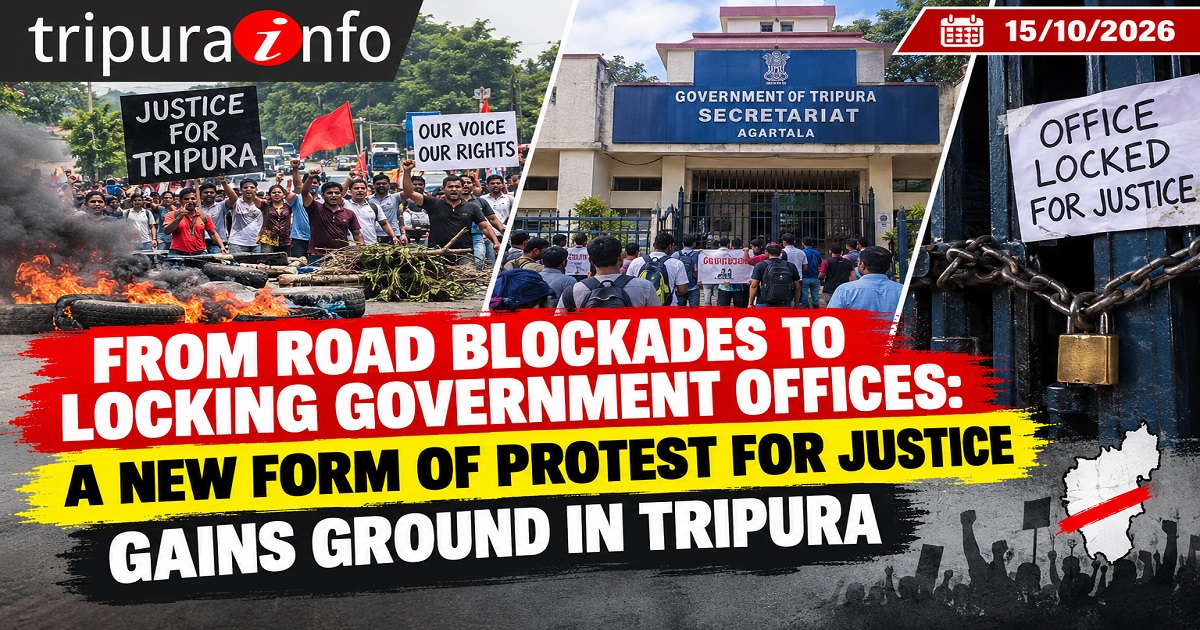 A new form of agitation appears to be gaining ground in Tripura, where people and organisations seeking justice are increasingly resorting to locking government offices after road blockades and demonstrations fail to produce the desired results. The latest incident in Bishalgarh, where aggrieved contractors locked the main gate of the Drinking Water and Sanitation (DWS) Division office over alleged unpaid bills, has once again brought this emerging pattern of protest into focus.
Road blockades have long been used in Tripura as a means of drawing the government's attention to public grievances, ranging from demands for recruitment and infrastructure development to financial disputes and administrative decisions. However, the growing use of office-locking protests suggests that some aggrieved groups are now adopting a different approach by directly disrupting the functioning of government establishments to press for action.
The latest incident occurred on Wednesday when contractors engaged in drinking water and sanitation projects locked the main gate of the DWS Divisional office in Bishalgarh. The contractors alleged that more than Rs 300 crore in bills remained unpaid to over 100 contractors despite the completion of various works. With Durga Puja approaching, they claimed that the prolonged delay in payments had pushed many of them into serious financial difficulties.
The transfer of Executive Engineer Subir Das reportedly added to their uncertainty over the clearance of pending bills. The protesting contractors demanded immediate intervention and sought assurances that their outstanding dues would be settled. The office remained locked during the agitation until local administrative intervention led to the reopening of the gate.
A delegation of contractors subsequently met Sepahijala District Magistrate Dr Siddhartha Shiv Jaiswal, who reportedly assured them that necessary steps would be considered to address their grievances. Although the office reopened, the contractors maintained that their principal demand for payment remained unresolved and warned of further agitation if effective action was not taken.
The Bishalgarh incident reflects a broader question about the changing nature of public protests in the state. When repeated representations, demonstrations and road blockades fail to secure a satisfactory response, some groups appear increasingly willing to target the offices where administrative decisions are made or their grievances are expected to be addressed.
Locking government offices can attract immediate attention and temporarily halt routine administrative activities. At the same time, such protests can disrupt public services and affect employees and citizens who have no direct involvement in the dispute. The growing use of this method therefore raises questions about the effectiveness of existing grievance-redressal mechanisms and the ability of departments to respond promptly to legitimate complaints.
more news...