Police Harassment Triggers Suicide Attempt Inside Bishalgarh PS, Incident Raises Serious Questions Over Tripura Police’s Investigation Methods and Intelligence Network
By Our Correspondent
Agartala, October 15, 2026
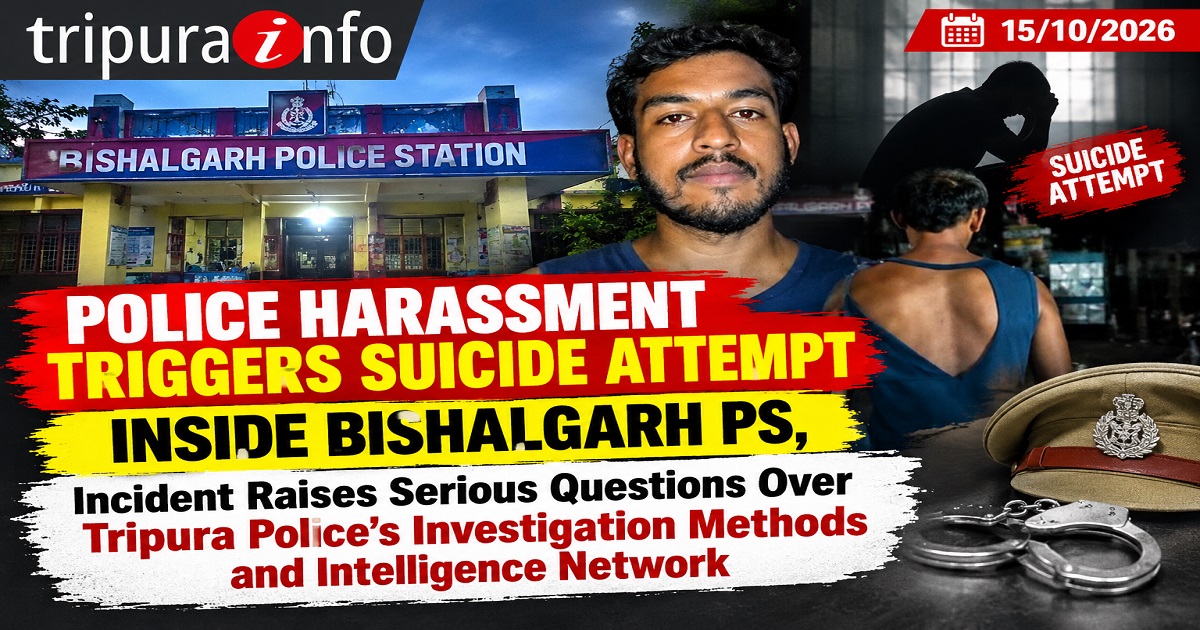 Serious questions have emerged over the investigation methods, intelligence-gathering capabilities and custodial practices of Tripura Police following an alleged suicide attempt by a young man inside Bishalgarh Police Station. The incident has triggered concerns over the use of coercive interrogation, the treatment of suspects and the need for urgent reforms to improve professional policing in the state.
According to reports, the youth, identified as Manir Hossain of Prabhurampur, was brought to Bishalgarh Police Station on suspicion of involvement in a theft case. He allegedly remained at the police station for several hours, from around 2 pm until 7 pm, during which he claimed that pressure was being exerted on him to confess to the alleged theft. Subsequently, he reportedly poured petrol on his body and set himself on fire inside the police station premises.
The incident has raised serious concerns about the circumstances in which a person brought to a police station for questioning could allegedly obtain petrol and attempt to take his own life while under police supervision. One police personnel and a Special Police Officer (SPO) reportedly sustained injuries while trying to intervene and rescue him.
The youth was initially taken to Bishalgarh Hospital for emergency treatment and was subsequently referred to Hapania Hospital in Agartala for further medical care, according to the available account.
The incident has placed the role of the police personnel responsible for supervising the youth under scrutiny. Questions have also arisen over the procedures followed during questioning, the safeguards in place to prevent coercion and the adequacy of monitoring arrangements inside the police station.
The incident has reignited a broader debate over the effectiveness of Tripura Police’s intelligence network and its ability to conduct evidence-based investigations. Critics argue that relying excessively on suspicion and pressure to obtain confessions, rather than establishing a case through scientific investigation and independently verifiable evidence, can undermine both public confidence and the quality of criminal investigations.
A suspicion of theft, by itself, does not establish guilt. Investigators are expected to establish the facts through lawful methods, including the examination of available evidence, witness statements, forensic analysis where appropriate and other legally permissible investigative procedures.
If a person is subjected to coercive questioning without sufficient evidence, the consequences can extend beyond the immediate case. Such practices risk undermining the credibility of an investigation, exposing innocent individuals to unnecessary suffering and allowing the actual circumstances of an offence to remain unestablished.
The Bishalgarh incident therefore raises an important question: whether the police had specific, verifiable evidence linking the youth to the alleged theft or whether suspicion played a disproportionate role in bringing him to the police station and questioning him.
The answer must emerge from an impartial inquiry rather than assumptions about either the youth's alleged involvement or the conduct of the police personnel concerned.
How Did Petrol Reach a Person Under Police Supervision?
One of the most serious questions concerns the reported availability of petrol to the youth while he was inside the police station.
more news...