Author Panna Lal Roy’s ‘Padmavatir Kabi’ (poet of Padmavati) , a treasure trove of Tripura’s history
By Our Correspondent
Agartala, October 14, 2026
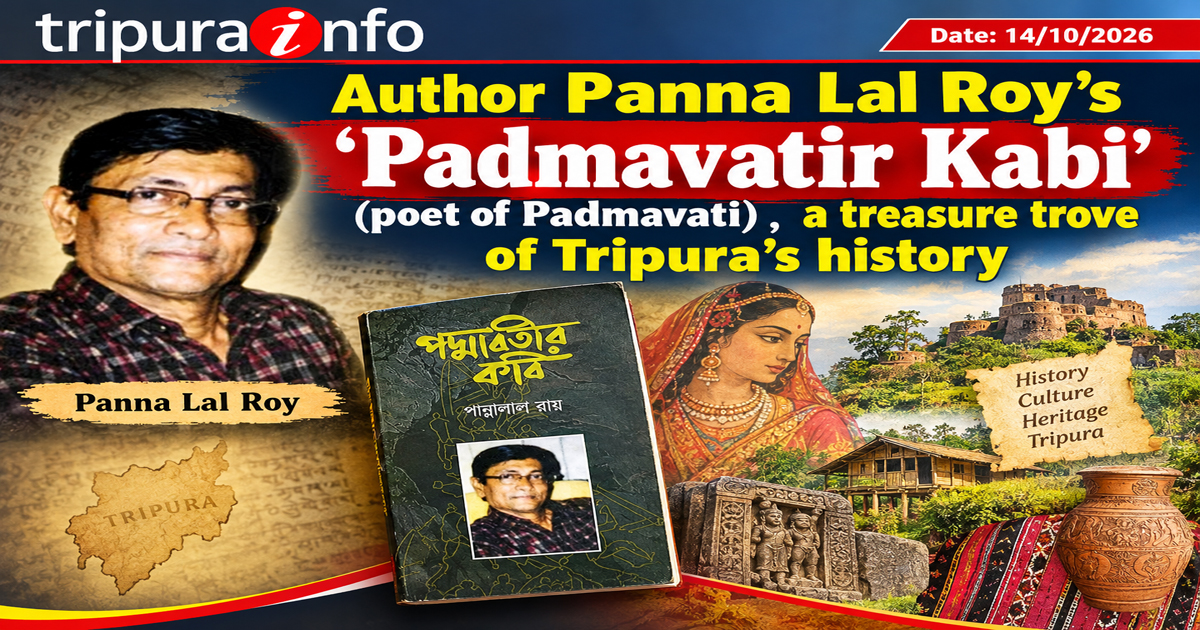 At a time when AI agents threaten to turn back on and neutralize their creators in the age of super science and technology, the study of history is dismissed or frowned upon by sections of the elite intelligentsia. But is it really that simple ? The utility of studying history lies in an incontrovertible fact : we comprehend and analyze our present in the light of our study and experience of the past to build a secure future. The study of history, perennially an embattled arena because of the ideological predilections that drive its composition and analysis of the past , therefore retains and shall continue to retain its salience as a knowledge branch.
The 103-page book entitled ‘Padmavatir Kabi’ (poet of Padmavati) penned by renowned author of Tripura’s history , Panna lal Roy, is an eloquent testimony to the importance of studying history in its multi-dimensional facets. From recent study of print media and coverage in the electronics media, readers and viewers are well aware of the recent bloody history of the Arakan province in western Myanmar , renamed as Rakhine as recently as in 1989. This unfortunate province has emerged as a major cauldron of religious and ethnic conflicts following the Myanmarese government crackdown on the rebellious Muslim Bengali population that had settled there from southern Bangladesh over the past many centuries. But leaving aside the ethnic and religious conflict, Arakan or Rakhine province is also endowed with a rich culture and literary compositions.
In his latest work author Panna Lal Roy has shed light on a little known and obscure chapter of history : the composition of an epic titled ‘Padmavatir Kabi’ by celebrated poet Syed Alaol in 1648 on the life and self-immolation of the famous queen of Chittorgarh in Rajasthan ‘Maharani’ Padmini or Padmavati. Maharani Padmavati or Padmini , chief consort of Rana Ratan Singh of Chittorgarh, had played a crucial historical role in the fight against the Muslim Sultan of Delhi Alauddin Khilji (1296-1316) and had self-immolated herself along with other women of Rajput royalty before the Chittorgah fort was overwhelmed by invader and sex-maniac Alauddin . Syed Alaol had composed the epic at the instance of Magan Thakur , minister in the court of Arakan king on the popular theme of sacrifice of a great queen to protect her dignity and honour. Apart from Syed Alaol the other leading poets and ballad writers among Bengalis in Arakan were Mollah Dawood, Kutubuddin, Malik Mohammed Jaisi and Mon Jhan Ahmed. At that point of time in history the enchanting land of Arakan formed part of the Gour (Bengal) kingdom under the suzerainty of the Mughal rulers of Delhi. Alaol’s epic is also famous for giving in graphic details a pen picture of contemporary Arakan, its land and water scape.
Apart from the chapter on the composer of Arakanese epic , author Panna Lal Roy has also dwelt on the ‘Durga Puja’ festival during princely rule in Tripura, pointing out that at least till the late 16th century human sacrifice was a feature of religiosity by the Hindu kings of Tripura. A significant historical episode has also been enacted in the book on how the towering ten-handed images of ‘Mata Durga’ and her retinue underwent a diminution at the advice of Hindu pundits after Maharani Sulakhshana Debi, queen of Maharaja Krishna Kishore Manikya, had fainted at the sight of the towering ten-handed image of the mother Goddess in the royal palace. The origin of the ‘Hasom Bhojan’ in which the kings used to invite the ‘Sardars’ , specially belonging to the unruly Kuki and Halam communities to prevent them from carrying out depredations on other sections of the people has also been discussed by author Panna Lal Roy. Besides , reference to the brigand Shamsher Gazi who had ruled Tripura from 1748 to 1760 after overthrowing king Krishna Manikya till he was sentenced to death by the Nawab of Bengal Meer Kashim in 1760 also stirs the memory of the students of history.
What however is sure to stimulate the curiosity of readers of history is the indirect political role played by nobel-laureate poet Rabindra Nath Tagore in Tripura’s court, specially during the rule of king Radha Kishore Manikya and controversy triggered by this. The way successive kings of Tripura extended liberal assistance to the intellectual stalwarts of Bengal , specially to Rabindra Nath Tagore and his dream institution ‘Santi Niketan’ makes for enriching reading . But the most enlightening part is the essay on the history of launching present Agartala as the capital of the state in 1838 by the king Krishna Kishore Manikya (1830-1849) who also stunned most of his courtiers and royal family members by marrying a Manipuri lady cook in the royal kitchen, named Purna Kala Debi. Krisnna Kishore was known for his sensual exuberance and he proved this by marrying the Manipuri Brahmin lady cook Purna Kala Debi when he was already sixty one but in the wake of the marriage the king converted the present Dhaleshwar area of Agartala as an area of Manipuri habitation. Tragically , the present Agartala town or Tripura hardly retains any memory of the succession of magnanimous kings of Tripura.
By composing the book ‘Padmavatir Kabi’ Panna Lal Roy has made a signal contribution to the cause of preservation of Tripura’s history and culture. The posterity will pass the final judgment on the quality of his work but the present generation of readers fed on the rich diet of mobile, social media and cable TV would benefit from a study of his work , published sleekly by ‘Tulsi Publishing House’.
more news...