NLU Tripura Hosts Workshop on Legal Innovation, Artificial Intelligence and Entrepreneurship, Around 130 Participants Attend
By Our Correspondent
Agartala, October 14, 2026
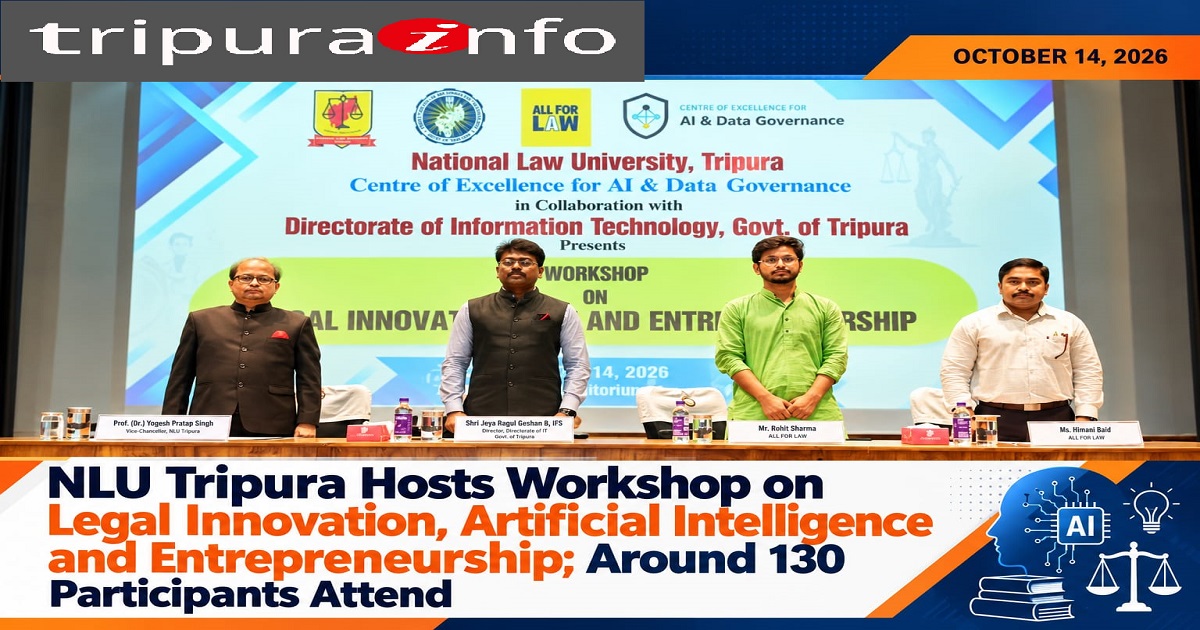 The National Law University, Tripura (NLU Tripura), in collaboration with the Directorate of Information Technology, Government of Tripura, organised a workshop on “Legal Innovation, AI and Entrepreneurship” at the TJA Auditorium, Narsingarh, on Wednesday, bringing together students and participants from leading educational institutions to explore the growing role of artificial intelligence in the legal profession and technology-driven entrepreneurship.
The workshop was organised through the university’s Centre of Excellence for AI & Data Governance (AIDG Centre), with the objective of encouraging innovative approaches to contemporary legal challenges, promoting interdisciplinary research and exploring the potential of artificial intelligence in developing practical, technology-based solutions.
Prof. (Dr.) Yogesh Pratap Singh, Vice-Chancellor of NLU Tripura, delivered the welcome address at the inaugural session. Highlighting the growing significance of artificial intelligence in the legal domain, he observed that AI has become an increasingly important component of legal education and that its integration into law schools is inevitable in the present technological era. His remarks underscored the need for future legal professionals to understand emerging technologies and prepare themselves for the changing demands of legal practice.
Shri Jeya Ragul Geshan B, IFS, Director of the Directorate of Information Technology, Government of Tripura, attended the programme as the chief guest. In his address, he emphasised the importance of collaboration between legal institutions and the technology sector to identify emerging opportunities at the intersection of law, artificial intelligence and entrepreneurship.
He also highlighted the Government of Tripura’s T-RISE and NGIN initiatives, encouraging aspiring entrepreneurs to make effective use of these government-supported opportunities to develop innovative ideas and explore entrepreneurial ventures. His address highlighted the potential of institutional cooperation and government initiatives in encouraging innovation and supporting emerging entrepreneurs.
The inaugural session concluded with a vote of thanks delivered by Er. Aparajita Banerjee, Programme Lead and Co-Director of the AIDG Centre at NLU Tripura.
The workshop featured three interactive sessions conducted by Mr. Rohit Sharma and Ms. Himani Baid from the organisation ALL FOR LAW. The sessions focused on identifying practical problems, undertaking context-specific research, developing prototypes and exploring potential solutions to challenges that could be addressed through innovative and technology-driven approaches.
The sessions encouraged participants to look beyond theoretical discussions and consider how research, technological tools and entrepreneurial thinking could be combined to address real-world problems. The emphasis on prototype development and practical problem-solving provided participants with an opportunity to explore how emerging technologies could be applied to legal and related professional challenges.
Approximately 130 participants from National Law University, Tripura; MBB University; Government Law College; and the University of Nagaland attended the workshop. The participation of students and members of different academic institutions added an interdisciplinary dimension to the programme, facilitating the exchange of ideas on the future of legal education, technological innovation and entrepreneurship.
The programme also included a feedback session, allowing participants to share their responses and observations, followed by the distribution of certificates to the participants.
The initiative reaffirmed the commitment of NLU Tripura and the Directorate of Information Technology, Government of Tripura, to promoting interdisciplinary engagement and exploring the evolving relationship between legal practice, artificial intelligence and entrepreneurship.
As AI continues to influence legal research, documentation, professional services and institutional processes, such initiatives are expected to contribute to greater awareness of emerging technological opportunities and encourage students to develop practical, research-oriented and innovation-driven approaches to future challenges.
more news...