Tripura Cabinet honours Modi’s 25 years in public service; Rs.1.32 lakh crore in investment proposals
By Our Correspondent
Agartala, October 13, 2026
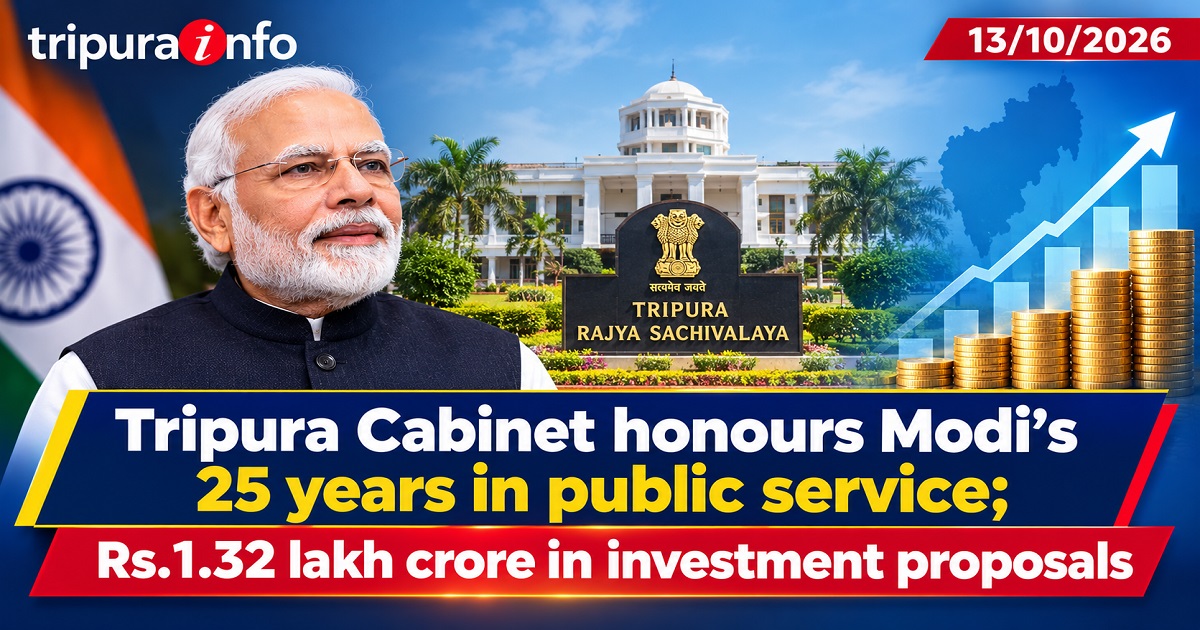 The Tripura Cabinet has unanimously adopted a resolution acknowledging Prime Minister Narendra Modi’s 25 years in public service, as Chief Minister Manik Saha outlined the State’s development priorities, investment prospects and commitment to building a “Developed Tripura” by 2047. The announcement comes amid continuing concerns over employment, with thousands of job aspirants awaiting recruitment and two teacher appointment processes held up by pending court cases.
Addressing a press conference at the State Secretariat in Agartala on Tuesday, Mr. Saha said appointment letters would be issued to 1,452 teachers on Wednesday. The appointments comprise 766 candidates who qualified in the Teachers’ Eligibility Test-II (TET-II) and 686 candidates recommended for newly created secondary teacher posts.
However, the government’s announcement leaves unresolved the immediate concerns of candidates awaiting appointments through TET-I and 230 Secondary Teacher Graduate Teacher (STGT) posts. The Chief Minister said these recruitment processes could not proceed because cases were pending in court. He did not specify a timeline for resolving the legal hurdles, leaving candidates uncertain about when the remaining appointments would be completed.
The Cabinet’s resolution places Mr. Modi’s political journey and the Centre’s development agenda at the centre of the State government’s stated vision. Mr. Saha referred to the Prime Minister’s assumption of office as Gujarat Chief Minister on October 7, 2001, and his subsequent appointment as Prime Minister on May 26, 2014.
The resolution highlighted the principles of “Nation First” and “Citizen First”, alongside the slogan “Sabka Saath, Sabka Vikas, Sabka Vishwas, Sabka Prayas”, as defining features of Mr. Modi’s approach to governance. It also cited major national decisions, including the abrogation of Article 370, the implementation of One Rank One Pension, the creation of the Chief of Defence Staff post and the introduction of new criminal laws replacing colonial-era legislation.
Referring to the 2016 surgical strikes, the 2019 Balakot airstrikes and Operation Sindoor in 2025, Mr. Saha said India’s security preparedness and international standing had strengthened under the Prime Minister’s leadership. The Cabinet also pointed to international honours conferred on Mr. Modi and his addresses to foreign legislatures as indicators of India’s growing global profile.
Turning to Tripura’s development, the Chief Minister emphasised the HIRA model, covering highways, internet connectivity, railways and air links. Of the 923 km of national highways approved for the State, 514 km have been upgraded to two-lane roads with paved shoulders, according to figures presented by him.
Work on the Agartala City West Bypass has begun, while efforts to upgrade the Agartala–Churaibari and Agartala–Udaipur corridors to four lanes are progressing. Railway electrification, the development of four stations under the Amrit Bharat Station Scheme and the modernisation of Agartala airport were also cited as key infrastructure initiatives.
Investment proposals formed a major part of the government’s development narrative. Mr. Saha said the 2025 Rising North East Business Summit had attracted investment proposals worth Rs.15,300 crore. At the Destination Tripura Business Conclave held in July 2026, the State received 468 memorandums of understanding involving proposed investments of ₹1.32 lakh crore.
The government has prepared a 100-day action plan to facilitate large investments, he said. However, the scale of the proposals raises questions about how much capital will translate into actual projects, how many industries will become operational and how many jobs will be created. The figures announced represent investment proposals rather than completed investments.
The Chief Minister also highlighted developments in healthcare, education, drinking water and housing. According to him, the number of MBBS seats in Tripura increased from 200 in 2022 to 550 in 2026. He said the Ayushman Bharat scheme and the Mukhyamantri Jan Arogya Yojana had expanded access to cashless healthcare.
Under the Jal Jeevan Mission, tap-water connections had reached 86.59% of rural households, he said. More than 3.5 lakh pucca houses had been constructed in rural areas and over 80,000 in urban areas under the Pradhan Mantri Awas Yojana, according to the figures presented by the government.
Women’s empowerment, tribal welfare and agricultural support were also highlighted. Mr. Saha said nearly 1.40 lakh women in the State had become ‘Lakhpati Didis’, while more than 2.85 lakh farmers had received direct financial assistance under the PM-KISAN scheme.
Tourism, another priority sector, has reportedly registered substantial growth. The number of tourists visiting Tripura increased from 2.84 lakh in 2022-23 to 7.29 lakh in 2025-26, Mr. Saha said, attributing the growth partly to the development of destinations such as Matabari, Dumboor Lake and Unakoti.
The Cabinet resolution reaffirmed the State’s commitment to working with the Centre towards the national goal of an Aatmanirbhar Bharat and a developed India by 2047, with Tripura pursuing its own development targets.
Yet, alongside infrastructure expansion and investment ambitions, employment remains a pressing concern. The appointment of 1,452 teachers is a significant step for the candidates concerned, but the unresolved recruitment cases underline the gap between new appointments and the expectations of those still waiting for jobs. The government’s broader development agenda will ultimately be judged not only by investment commitments and infrastructure projects, but also by their implementation and their ability to generate employment.
more news...