Tripura High Court Refuses to Quash FIR Against Former CM Manik Sarkar Over ‘Militant Movement’ Remark, Directs Him to Avoid Provocative Speeches
By Our Correspondent
Agartala, October 13, 2026
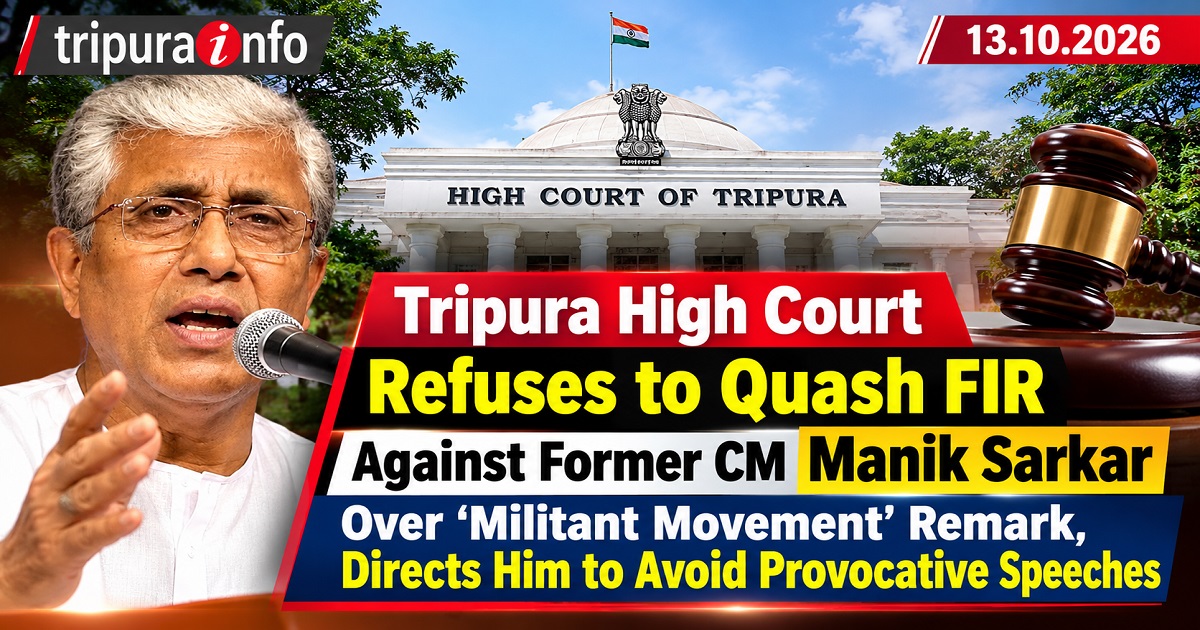 In a significant judgment addressing the relationship between political dissent, freedom of speech and public order, the High Court of Tripura has dismissed a petition filed by former Chief Minister and senior CPI(M) leader Manik Sarkar seeking the quashing of a criminal case registered against him over an alleged controversial political speech delivered in Agartala on August 10, 2026. The court directed Sarkar to refrain from making provocative or hate speeches in the future and instead motivate people towards progress, peace, harmony and brotherhood.
The judgment was delivered on October 13 by a Division Bench comprising Justice Dr. T Amarnath Goud and Justice Biswajit Palit in WP(Crl.) No. 16 of 2026. The ruling is significant because it examines the responsibility of influential political leaders when addressing large gatherings, the limits of constitutional protection for political expression and the circumstances in which a High Court should allow a criminal investigation to proceed rather than terminate it at the initial stage.
The court did not find it appropriate to quash the FIR before the investigation was completed. Instead, it held that the allegations required further examination of the words used, their context, the atmosphere surrounding the gathering and their potential impact on public order. The judgment does not establish Sarkar’s criminal guilt, and the allegations remain subject to investigation and the applicable legal process.
Manik Sarkar was the petitioner in the case, represented by senior advocate BR Bhattacharjee, assisted by advocates D Singha and S Ganguly. The respondents were the State of Tripura, the Officer-in-Charge of West Agartala Police Station and Prabir Roy, the de-facto complainant. The State was represented by Public Prosecutor R Datta, assisted by Additional Public Prosecutor S Saha. The matter was heard on October 7, 2026, and the final judgment was delivered on October 13. The order bears the reference number 2026:THC:1414-DB and is marked fit for reporting.
The case originated from a political demonstration held in Agartala on August 10, 2026, as part of a wider protest movement organised by central trade unions, farmers’ organisations and other civil organisations. Left parties and their affiliated mass organisations participated in a statewide “Jail Bharo” civil-disobedience programme opposing policies of the BJP-led governments at the Centre and in Tripura.
According to the submissions made on behalf of Sarkar, the demonstration advanced an 11-point charter of demands concerning workers, farmers, poorer sections, the middle class, Scheduled Castes, Scheduled Tribes, OBCs, women, students and youth. Sarkar’s lawyers argued that his approximately eight-minute speech criticised government policies and warned that failure to address public grievances could lead to a broader and more vigorous democratic movement. The defence maintained that he had also appealed to the demonstrators to cooperate peacefully with the police during arrest and detention.
The State presented a different account of the circumstances surrounding the speech. According to the prosecution, thousands of demonstrators marched towards the office of the Sub-Divisional Magistrate in Sadar, Agartala. Security barricades had been erected to protect administrative infrastructure and maintain public order. The State told the court that the gathering breached and dismantled the first two barricades before police stopped the march at a third barrier, where an Executive Magistrate declared the assembly under arrest.
The prosecution maintained that Sarkar delivered the disputed address in this tense atmosphere. Significantly, the judgment records the State’s position that the earlier breach of the barricades took place before the speech and was not attributed to the speech itself. However, the prosecution argued that these preceding events formed part of the circumstances relevant to assessing the meaning and likely effect of the words used.
The controversy centres on the Bengali expression quoted in the complaint as “Jongi Andoloner Pothe Jabe Desh-Rajya”. The complainant alleged that the statement meant that the country and the state would have to take the path of a militant or aggressive movement. He argued that such words, spoken by a prominent former Chief Minister, could encourage violence, disturb public peace and tranquillity, obstruct public servants and promote unlawful activities.
Prabir Roy, a resident of Abhoynagar in Agartala, lodged the complaint with the Officer-in-Charge of West Agartala Police Station on August 16, 2026. The complaint stated that Sarkar’s remarks had been broadcast by electronic media and reported in the local daily on August 11. Roy requested the registration of an FIR and sought the collection of CCTV footage, newspaper reports and electronic media recordings to establish the circumstances of the speech.
Acting on the complaint, West Agartala Police Station registered Case No. 2026 WAG 109 on August 16, 2026, under Sections 192, 353(1)(b) and 61(1) of the Bharatiya Nyaya Sanhita, 2023. Sarkar subsequently approached the High Court under Article 226 of the Constitution, seeking to quash the FIR and all consequential proceedings. He also sought interim protection against arrest and coercive action.
Senior advocate BR Bhattacharjee argued that the FIR was politically motivated, malicious and intended to harass an opposition leader. The defence contended that the disputed expression had been taken out of context and that the translation relied upon by the complainant was inaccurate. According to the petitioner, the words could refer to a vigorous or intensified political agitation rather than a violent or militant movement. The defence described the expression as incomplete and ambiguous and maintained that the entire speech did not contain any call for violence or an attack on the State.
The petitioner further argued that the FIR did not identify any actual riot, act of violence, property damage or specific individual who had been induced to commit an offence. He maintained that the essential ingredients of the offences invoked by the police were absent and that the criminal process was being used to penalise legitimate political criticism protected under Article 19(1)(a) of the Constitution. The defence also questioned the six-day interval between the speech and the complaint and relied on Supreme Court decisions, including State of Haryana v. Bhajan Lal and Asoke Kumar Chaudhury v. Kunal Saha, in support of its challenge.
Opposing the petition, Public Prosecutor R Datta, assisted by Additional Public Prosecutor S Saha, argued that the FIR should not be quashed before the police completed their investigation. The State maintained that the disputed phrase could not be assessed in isolation from the size and mood of the gathering, the march towards the SDM office, the breach of two barricades and the subsequent intervention of law enforcement.
The prosecution argued that the translation and contextual meaning of the words were disputed questions of fact requiring examination of independent evidence. It also questioned the sufficiency of the private electronic recordings and transcripts submitted by the petitioner, maintaining that investigators should obtain authentic recordings from media organisations and surveillance systems, along with witness statements and contemporaneous field reports. The State relied on Supreme Court precedents, including Neeharika Infrastructure Pvt. Ltd. v. State of Maharashtra, Pradip N. Sharma v. State of Gujarat and State of Chhattisgarh v. Aman Kumar Singh, to argue that courts should exercise restraint when asked to terminate an investigation at its inception.
After examining the competing submissions, the Division Bench concluded that the petition did not satisfy the threshold for quashing the FIR. The court observed that the extraordinary jurisdiction of a High Court must be exercised sparingly, particularly when the facts are disputed and relevant evidence has yet to be collected. It held that the meaning and impact of the disputed expression could not be determined solely on the basis of the competing interpretations advanced by the complainant and the petitioner.
The court emphasised that investigators must examine the entire speech, the circumstances in which it was delivered, its dissemination through the media and its potential effect on public tranquillity. It also rejected the argument that the absence of a completed riot automatically prevented the invocation of Section 192 of the BNS. The Bench noted that the provision also addresses certain forms of wanton provocation intended or known to be likely to cause rioting even when a riot does not ultimately occur.
With regard to Section 353(1)(b), the court considered the prosecution’s contention that the words might have caused public alarm or encouraged offences affecting public tranquillity. Whether the statutory requirements were actually satisfied would have to be examined through investigation. Regarding Section 61(1), which concerns criminal conspiracy, the Bench recognised that the provision requires evidence of an agreement between two or more persons to commit an illegal act or to accomplish a legal act by illegal means. The investigation would have to determine whether the evidence supported that allegation. The State had indicated that the conspiracy provision could be dropped in its final report if the necessary ingredients were not established.
The Bench also held that allegations of political vendetta, by themselves, were insufficient to justify quashing an FIR when the complaint contained specific allegations requiring verification. The six-day interval between the speech and the complaint did not, in the court’s view, warrant termination of the proceedings at this preliminary stage.
An important feature of the judgment is its reliance on Supreme Court decisions emphasising judicial restraint during the early stages of criminal investigation. In Neeharika Infrastructure Pvt. Ltd. v. State of Maharashtra, reported in (2021) 19 SCC 401, the Supreme Court laid down principles governing the quashing of FIRs and interim orders restraining investigations. The Tripura High Court relied on these principles to underline that investigations ordinarily should be allowed to proceed when the allegations disclose a cognizable offence, unless exceptional circumstances justify intervention.
The Bench also referred to Pradip N. Sharma v. State of Gujarat and Another, reported in 2025 SCC OnLine SC 457, and discussed the principles in State of Chhattisgarh v. Aman Kumar Singh, reported in (2023) 6 SCC 559, as well as State of Haryana v. Bhajan Lal and Asoke Kumar Chaudhury v. Kunal Saha. These authorities informed the court’s consideration of whether the disputed allegations should be investigated before their legal sufficiency was finally determined.
Beyond the procedural question of quashing the FIR, the judgment contains strong observations about the responsibility attached to political leadership. The Bench noted that Sarkar had served as Chief Minister of Tripura for nearly 20 years, from March 1998 to March 2018, and observed that statements made by a leader of his stature could carry considerable influence among followers and the public.
The court considered the use of the word “militant” in the context of the disputed expression and observed that language capable of encouraging confrontation could have implications for law and order. It stated that a senior political leader should motivate people towards progress rather than use language that could aggravate tensions. In paragraph 41, the judgment emphasised that freedom of speech is not an absolute right and must be exercised with responsibility, referring to the constitutional balance between Article 19(1)(a), which protects freedom of speech and expression, and Article 19(2), which permits reasonable restrictions, including those relating to public order and incitement to an offence.
The significance of the judgment lies in its examination of political rhetoric in its immediate circumstances rather than treating the disputed phrase solely as a question of translation. The Bench considered the prosecution’s account of the demonstration, the movement towards an administrative office, the barricades and the law-and-order situation. It also made clear that the absence of a completed riot does not necessarily prevent an investigation under Section 192 of the BNS, provided the statutory requirements for the alleged offence are properly examined.
In its final order, the Division Bench dismissed Sarkar’s petition seeking to quash West Agartala Police Station Case No. 2026 WAG 109, dated August 16, 2026. The FIR and the investigation arising from it therefore remain in place. The court held that further investigation was required and declined to terminate the police inquiry merely because the petitioner disputed the complainant’s interpretation of the speech or alleged political motivation.
Considering Sarkar’s age and his position as a former Chief Minister, the Bench observed that he could approach the competent lower court by filing an appropriate bail application. It directed the court below to consider such an application, with conditions, in accordance with law. The High Court did not itself grant anticipatory bail or provide unconditional protection from arrest in its final order.
The Bench expressly directed Sarkar to refrain from making provocative or hate speeches in the future. Instead, it urged him to motivate the people of Tripura towards prosperity, peace, harmony and brotherhood. The court also ordered that any pending miscellaneous application would stand closed as a consequence of the dismissal of the main petition. The final order was signed by Justice Biswajit Palit and Justice Dr. T. Amarnath Goud.
more news...