Tripartite Accord: Tipra Motha Seeks Time-Bound Implementation as Centre Yet to Deliver Beyond Commitments, new Resolution Raises Questions
By Our Correspondent
Agartala, October 9, 2026
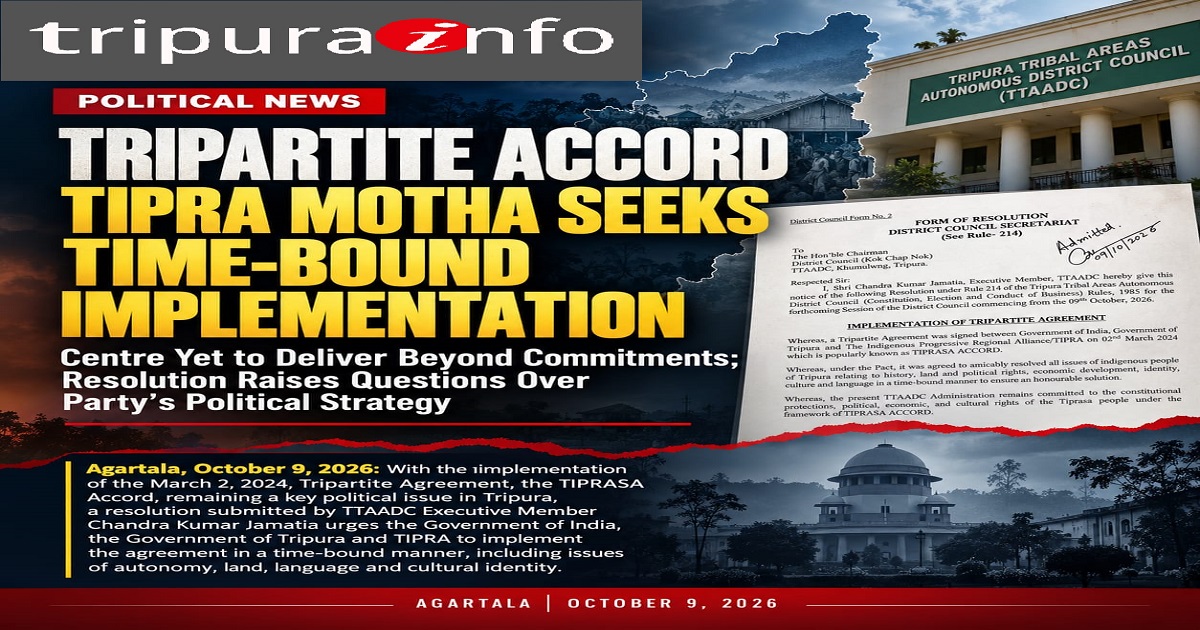 With the implementation of the March 2, 2024, Tripartite Agreement, popularly known as the TIPRASA Accord, remaining a major political issue in Tripura, the Tipra Motha leadership appears to be facing growing pressure to demonstrate tangible progress on the commitments made to the indigenous people of the state. As the Government of India and the Tripura Government have yet to translate the agreement’s commitments into a comprehensive, publicly evident resolution of the major demands, questions are being raised over whether successive assurances are gradually turning into a political challenge for the ruling Tipra Motha leadership.
Against this backdrop, a resolution submitted by Chandra Kumar Jamatia, Executive Member of the Tripura Tribal Areas Autonomous District Council (TTAADC), for the District Council session commencing on October 9, 2026, has once again brought the implementation of the TIPRASA Accord to the centre of political discourse in Tripura.
The resolution urges the Government of India, the Government of Tripura and the Indigenous Progressive Regional Alliance (TIPRA) to implement the Tripartite Agreement in a time-bound manner. It emphasises greater autonomy for the indigenous areas, protection of land, language and cultural identity, and the constitutional and democratic aspirations of the Tiprasa people.
The political significance of the resolution, however, extends beyond its stated demands. Critics may interpret the renewed call for implementation as an indication that the Tipra Motha leadership continues to face the difficult task of explaining to its tribal support base why the major commitments associated with the accord have not yet produced the outcomes many people expected.
The agreement, signed on March 2, 2024, between the Government of India, the Government of Tripura and TIPRA, generated considerable expectations among indigenous communities regarding the resolution of longstanding concerns relating to history, land rights, political rights, economic development, identity, culture and language. The accord envisaged an amicable and time-bound process for addressing these issues.
However, the gap between political commitments and their visible implementation has become an important subject of debate. While the Tipra Motha leadership continues to press for the fulfilment of the agreement, the absence of a publicly demonstrated, comprehensive settlement of the major demands has fuelled questions about the pace and effectiveness of the process.
In this political context, the repeated assurances and renewed demands for implementation could also be viewed as a means of sustaining the confidence of the party’s core tribal electorate. As long as the major commitments remain unfulfilled or their implementation is not clearly demonstrated, the leadership faces the challenge of keeping public expectations alive while maintaining its political credibility.
The resolution also expresses gratitude to the people of the TTAADC areas for their peaceful cooperation and continued support for Tipra Motha in pursuing the TIPRASA Accord.
more news...