Legal questions raised over the ADC Council’s efforts to secure salary payments despite the High Court’s interim restraint
By Our Correspondent
Agartala, October 9, 2026
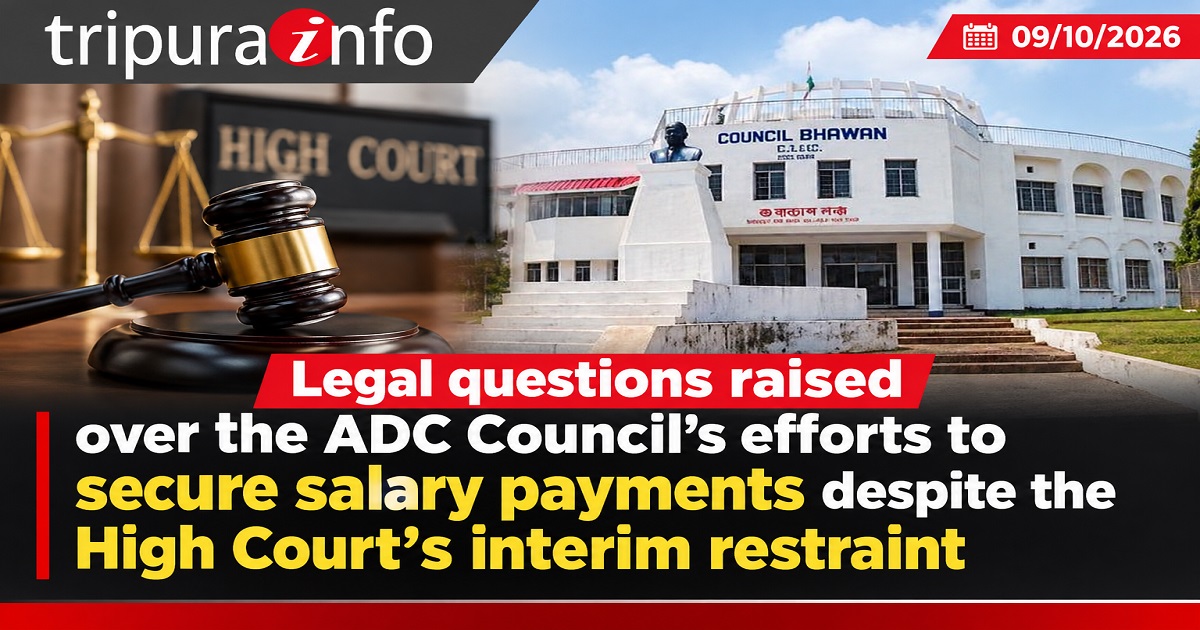 The Tripura Tribal Areas Autonomous District Council (TTAADC) administration is seeking legal relief concerning salary payments to more than 120 employees whose appointments have been challenged over allegations of recruitment without advertisement and a transparent selection process. This has raised questions about the Council’s approach to the disputed appointments, as the Tripura High Court had earlier restrained salary payments to the concerned employees.
The Supreme Court, on October 5, 2026, disposed of Special Leave Petition (Civil) Nos. 30956–30957 of 2026, filed by TTAADC and another petitioner against the High Court’s interim order dated August 13, 2026. The Bench comprising Justice Manoj Misra and Justice Vijay Bishnoi did not direct the Council to resume salary payments or overturn the High Court’s restraint.
Instead, the Supreme Court granted the petitioners liberty to approach the Tripura High Court for modification of its earlier order. The Court also observed that the High Court could consider allowing ad-hoc engagements to ensure the Council’s functioning until regular selections are made.
The crucial point is that permission to approach the High Court is not permission to pay the disputed employees. The Supreme Court left the question of modifying the salary restriction to the High Court, which must consider any application in accordance with law.
Council’s Position and the Unresolved Recruitment Dispute
During the Supreme Court proceedings, the Council’s counsel submitted that recruitment rules were awaiting the Governor’s assent and that ad-hoc arrangements had been made to meet administrative requirements. The Council also argued that stopping salary payments could disrupt its functioning.
The High Court, however, had expressed a prima facie view that the appointments had been made without a transparent recruitment procedure and had consequently restrained the Council from paying salaries to the private respondents in the pending writ proceedings.
The dispute raises questions about whether the absence of Council-specific recruitment rules can justify appointments without open advertisement and a fair selection process. It also raises concerns about eligible unemployed candidates who may have been denied the opportunity to apply for these posts.
Legal Experts’ View: Administrative Necessity Does Not Automatically Override Recruitment Rules
From a legal perspective, the Council’s administrative requirements and the legality of the disputed appointments are separate questions. Even if the Council needs personnel to maintain essential services, that necessity does not automatically establish that the original recruitment process complied with the applicable rules.
The relevant legal framework includes the Sixth Schedule to the Constitution, the TTAADC (Constitution, Election and Conduct of Business) Rules, 1985, and the constitutional guarantees of equality and equal opportunity in public employment under Articles 14 and 16.
The Supreme Court’s Constitution Bench judgment in Secretary, State of Karnataka v. Umadevi (3), reported in (2006) 4 SCC 1, is also relevant to questions concerning irregular public appointments and regularisation.
The Supreme Court’s October 5 order did not finally determine whether the disputed appointments were illegal. That issue remains subject to judicial examination.
The Question Now Before the High Court
If TTAADC authorities are seeking to pay the disputed employees, the legal basis for doing so must be considered in light of the High Court’s existing order. The Council cannot treat the Supreme Court’s permission to seek modification as an automatic lifting of the salary restriction.
The High Court will have to consider the Council’s submissions, the administrative consequences of withholding payments, the circumstances of the appointments and the applicable constitutional and service rules before deciding whether any modification is justified.
The larger issue is whether public employment opportunities in Tripura are being administered in a manner that protects equal opportunity for all eligible candidates while ensuring the lawful functioning of the autonomous district administration.
Until the Tripura High Court passes a further order, the Supreme Court’s decision cannot be interpreted as authorising the resumption of salary payments to the disputed employees. The next step rests with the High Court, and the legality of the appointments remains a matter for judicial determination.
Notably, TTAADC wanted to say that since the TTAADC does not have recruitment Rules approved by the Governor, they have recruited employees on ad hoc basis without advertisement and interview. This is false statement of TTAADC. In fact, under para 2(6) (h) of the Sixth schedule, the Governor for first constitution of District council, has framed the TTAADC ( constitution, Election and conduct of Business) Rules, 1985. In rule162 of the said Rules, it has been provided that until rules are framed newly by the TTAADC for conditions of service/ recruitment Rules for district council, the rules of the state Govt shall apply to them. So all state rules shall have to be complied with.
TTAADC can not say that they are out of any law and so they have done as per their whims. Also it can not go beyond supreme court’s order in umadebi case.
However,v rule162 of the TTAADC (constitution, Election and conduct of Business) Rules, 1985 is reproduced as under, “TTAADCs Power to make rules regarding service conditions of officers & staff:
162. Subject to the approval of the Governor, the District Council may make rules regulating the conditions of service of officers and staff appointed to the services and posts in connection with the affairs of the District Council;
Provided that until rules are made by the District Council the conditions of service of such officers and staff of the Council shall be regulated by the relevant rules applicable to like officers and staff of the State Government, subject to such modifications as the Governor may direct in the case of a particular appointment or class or classes of appointments.
more news...