School Computer Teachers Receive August Salary After Threat of Agitation, Questions Raised Over Tender Process and Salary Deductions
By Our Correspondent
Agartala, October 8, 2026
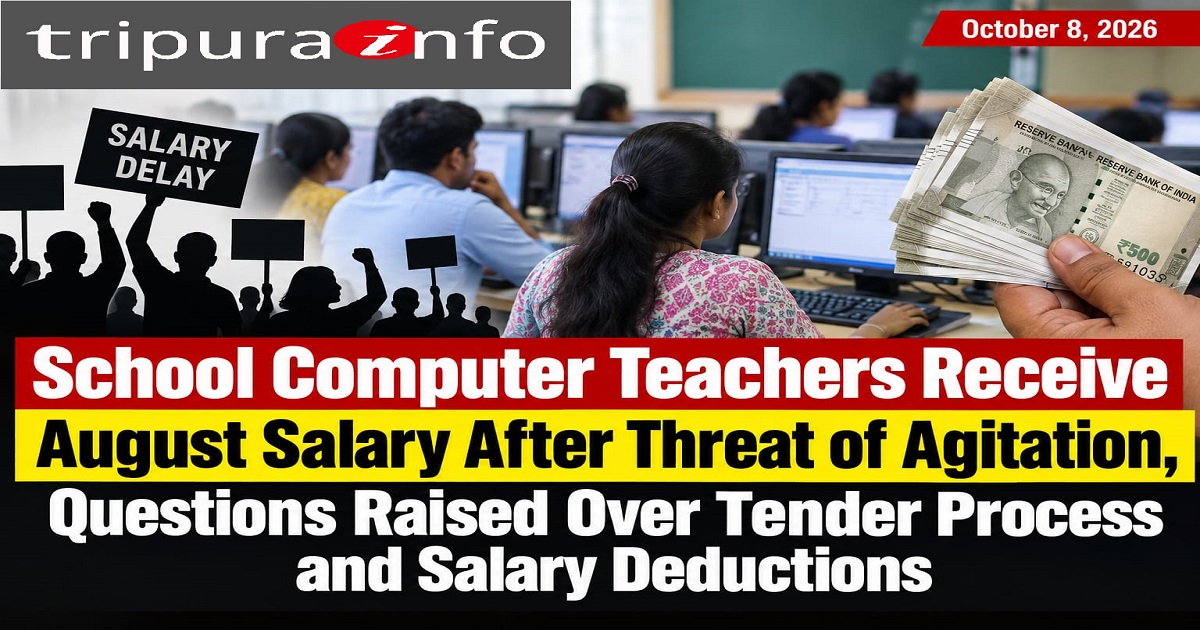 The issue of delayed salary payments to computer teachers engaged as ICT Instructors in government schools has intensified in Tripura, with affected teachers raising questions about the functioning of private agencies selected by the School Education Department and the department’s monitoring of these companies.
According to the teachers, SIBIN Learning Cart Pvt. Ltd., Akhaura Road, had not paid their salaries for August and September. However, following threats by the affected teachers to launch a strike or agitation over the delay, the company released the salary for August on Thursday, October 8.
The teachers are now awaiting payment for September.
The teachers allege that salary payments by the company have repeatedly been delayed. They said that even the salary for July was released only on September 1, creating considerable financial difficulties for employees who depend entirely on their monthly remuneration.
Salary promised at Rs.10,000, teachers allegedly receive Rs.8,200
Another major issue raised by the computer teachers concerns the salary structure.
According to allegations made by the teachers, at the time of recruitment, the company had committed to paying Rs.10,000 per month to each computer teacher. However, they are presently receiving only Rs.8,200, with approximately Rs.1,800 being deducted in the name of EPF and ESIC .
The teachers are seeking clarification regarding the salary structure, the statutory EPF and ESIC contribution and whether the full amount promised at the time of recruitment is reflected in their employment documents and the contract between the company and the government.
The salary dispute has also brought renewed attention to the larger issue of the selection of private agencies for providing computer education services in government schools.
There are allegations that tender conditions have been framed in a manner that makes it difficult for local vendors to participate, resulting in companies from outside Tripura securing contracts.
The complainants allege that, after obtaining the contracts, these outside agencies recruit local computer-trained youths and teachers to perform the actual work in government schools, while the employees receive comparatively low fixed remuneration.
They are questioning why qualified local unemployed youths and local service providers cannot be given greater opportunities in such government programmes.
There are also allegations that certain senior officials who were involved in finalising earlier tenders had close or undisclosed links with outside agencies.
It has further been alleged that an officer associated with the earlier tender process was subsequently transferred, while the newly posted officer has reportedly stated that he was not involved in the earlier decisions and therefore has limited knowledge of the matter.
This has created uncertainty over who is responsible for monitoring the contractual obligations of the agencies and ensuring timely payment to teachers.
The problem is reportedly not limited to SIBIN Learning Cart.
According to information provided by the affected teachers, Extramarks and Keltron, both outside-Tripura companies engaged in school computer education-related activities, have also allegedly failed to ensure timely payment of salaries to their computer teachers.
The teachers are therefore questioning why the School Education Department has not taken visible action against agencies that allegedly fail to make timely salary payments.
They have demanded that the department establish a clear mechanism under which private agencies must pay teachers within a fixed period every month and face appropriate action if they repeatedly violate contractual conditions.
The computer teachers have also stated that they are not being provided any Puja bonus, adding to their financial difficulties during the festive season.
The teachers say that while they are performing duties in government schools under programmes administered through the School Education Department, their employment conditions and salary payments depend heavily on private agencies.
They therefore want the department to directly monitor salary disbursement rather than leaving the matter entirely to the companies.
.
more news...