Tripura Government Announces 3% DA Hike, HRA Raised from 8% to 10% and Ceiling Increased to Rs.10,000
By Our Correspondent
Agartala, October 6, 2026
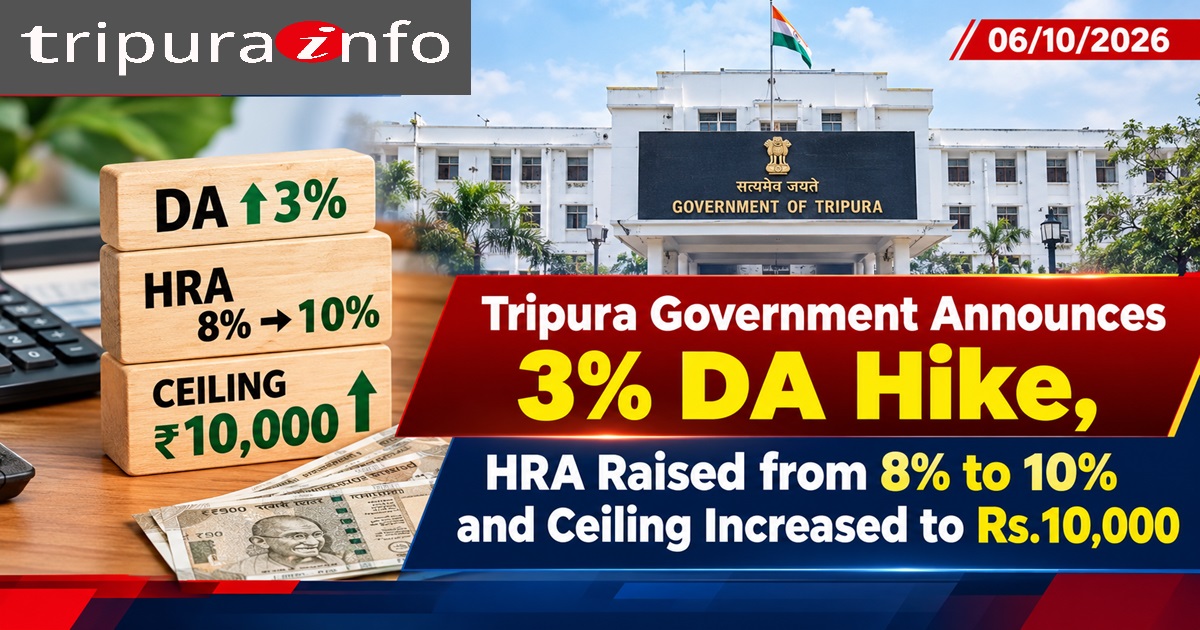 The Tripura Government has decided to increase the Dearness Allowance (DA) for state government employees by another 3%, providing additional financial relief to employees across the state.
The announcement was made at a press conference held at the State Secretariat in Agartala on Tuesday evening, following the meeting of the State Cabinet. Chief Minister Prof. Dr. Manik Saha and Finance Minister Pranajit Singha Roy were present at the press conference while announcing the Cabinet decisions.
Along with the DA hike, the State Government has also announced a significant revision of the House Rent Allowance (HRA) for government employees.
Under the revised arrangement, HRA will be increased from the existing 8% of Basic Pay to 10% of Basic Pay. At the same time, the maximum ceiling for HRA has been substantially enhanced from Rs.3,000 to Rs.10,000 per month.
The revision is expected to provide additional monthly financial benefits to employees, particularly those whose HRA was previously restricted by the existing maximum ceiling.
The 3% DA increase will further enhance the monthly salary of serving government employees. The corresponding increase in Dearness Relief (DR) for eligible pensioners is also expected to provide additional financial support to retired government employees.
The decisions were announced after the State Cabinet meeting as part of the government's latest measures concerning the financial benefits and allowances of state government employees.
Speaking at the press conference, the Chief Minister and Finance Minister outlined the decisions taken by the Cabinet, including the revision of DA and HRA.
With the latest changes, government employees will benefit from both an increase in the DA component of their salary and a higher HRA rate, while the substantial enhancement of the HRA ceiling is expected to particularly benefit employees drawing HRA close to or above the previous Rs.3,000 limit.
more news...